How to Ace the Oral Picture Description in the DTZ B1 German Exam
Standing outside the exam room, heart thumping, waiting for the oral portion of the Deutsch-Test für Zuwanderer (DTZ) is an experience thousands of...
Read more
This article was drafted by AI and edited by a person before it was published.
AI can get things wrong. For anything official, check the source it points to.
AI-generated image
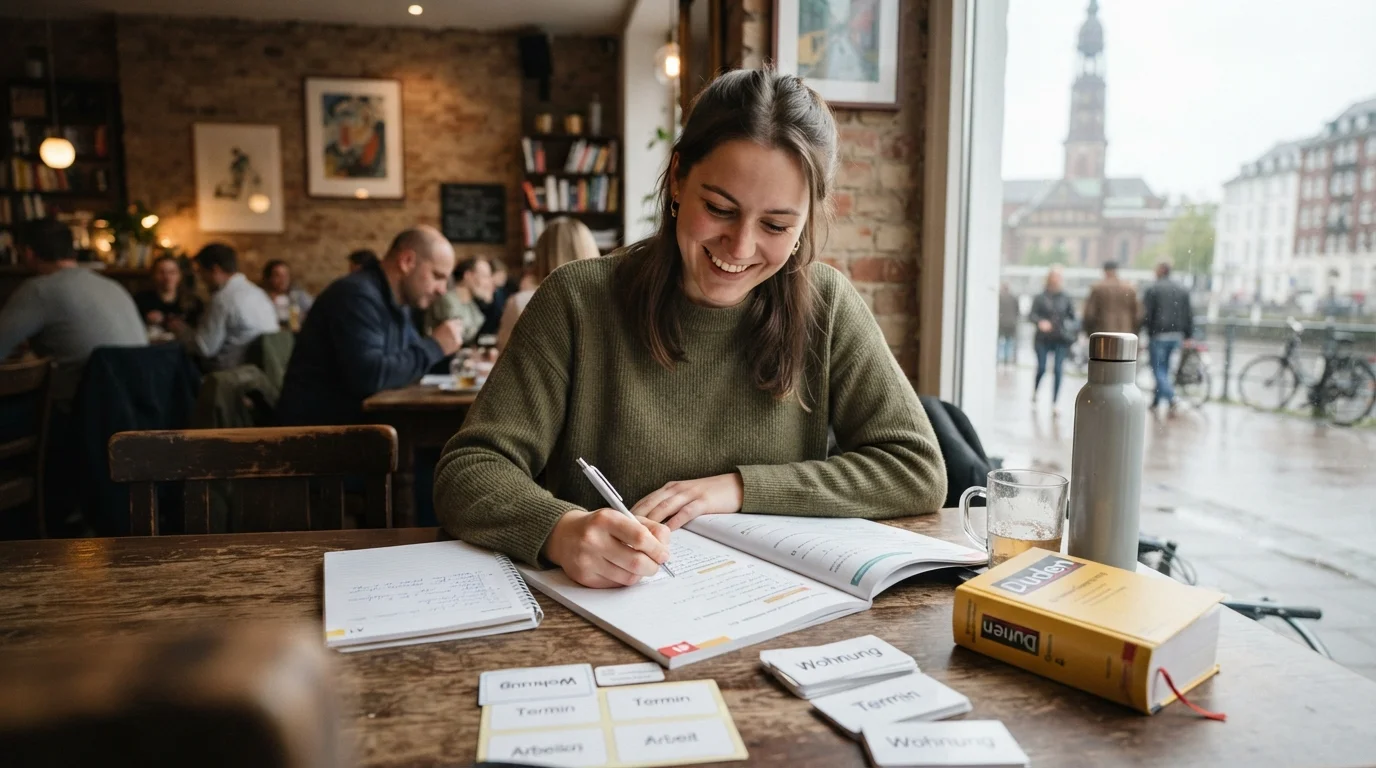
Relocating to Germany brings excitement, culture, and opportunity—along with bureaucratic appointments, official letters (Briefe), and the unavoidable challenge of learning the German language. For most newcomers, reaching the B1 level is the ultimate milestone. It is the legal prerequisite for permanent residency (Niederlassungserlaubnis), standard citizenship (Einbürgerung), and full participation in German social and working life.
However, if you are starting from zero (A0 or A1), one pressing question always comes up: How long does it actually take to go from A1 to B1 German for integration?
The short answer is anywhere between 6 months to 2 years, depending on your study intensity, native language background, and daily practice habits. In this comprehensive guide, we break down the total hours required, examine official guidelines from the Federal Office for Migration and Refugees (BAMF), explore each phase of the journey, and share actionable strategies to help you reach B1 proficiency as efficiently as possible.
The Common European Framework of Reference for Languages (CEFR) standardizes language competence across Europe. Understanding what happens at each stage helps you set realistic expectations for your integration journey:
For integration purposes, B1 represents the transition from merely surviving in Germany to genuinely thriving independently.
Language acquisition is measured in guided learning hours (classroom or focused instructional time) plus autonomous study hours (homework, immersion, review). According to the Goethe-Institut and BAMF standards, here is the approximate time required for each stage:
How do these hours translate into real calendar months? Here are three common learning scenarios:
If you are studying full-time (20–25 hours per week in class plus 10–15 hours of self-study), you can progress from complete beginner to exam-ready B1 in roughly 4 to 6 months. This model is common for individuals attending full-time immersion bootcamps or those who have paused employment to focus entirely on integration.
A standard BAMF Integration Course (Integrationskurs) consists of 600 hours of language instruction spread over 6 modules. Classes typically run for 4 to 5 hours per day, 4 to 5 days a week. If you are enrolling in a BAMF-approved integration course, this pathway takes approximately 6 to 8 months to reach the Deutsch-Test für Zuwanderer (DTZ) examination.
If you work full-time or have family commitments, you might attend evening classes 2 to 3 times a week (4–6 hours weekly) and supplement with self-study. At this steady, sustainable pace, progressing from A1 to B1 generally takes between 12 and 18 months.
Your main priority at A1 is getting comfortable with German phonetic pronunciation, grammatical gender (der, die, das), present tense conjugation of regular and common irregular verbs (sein, haben, möchten), and basic sentence structures (Subject-Verb-Object). Focus heavily on building a foundation of 500–800 essential words.
The jump from A1 to A2 introduces past tense constructions (Perfekt and basic Präteritum with modal verbs), modal verbs (können, müssen, dürfen, wollen, sollen), accusative and dative cases, and simple two-way prepositions (Wechselpräpositionen). You will shift from one-word answers to connected sentences using connectors like weil (because), dass (that), and obwohl (although).
At B1, German starts to click. You learn relative clauses, passive voice, the subjunctive II (Konjunktiv II for polite requests and hypotheticals), and professional correspondence skills. A crucial requirement of the DTZ exam is mastering German B1 letter writing, where you draft formal complaints, landlord inquiries, and job applications under timed conditions.
Reaching B1 is far more than a personal linguistic victory; it is a major legal stepping stone. German immigration legislation heavily rewards language competence:
Why do some learners finish the A1–B1 journey in 6 months while others struggle for several years? Several distinct variables influence your speed:
To pass B1 comfortably, you need an active vocabulary of approximately 2,400 to 3,000 words. Instead of cramming word lists once a week, review vocabulary daily using spaced repetition systems (SRS). Spending just 15 minutes every morning reviewing noun genders and plural forms embeds vocabulary permanently into your long-term memory.
German syntax is notoriously rigid. In main clauses, the conjugated verb must always take the second position (V2 rule). In subordinate clauses introduced by conjunctions like weil, wenn, or obwohl, the verb is pushed all the way to the end. Master this rule early at A2 so it feels instinctive by the time you start your B1 preparations.
Do not wait until B1 to practice spoken dialogues. Use AI language tools like Bretzi to practice natural conversations in safe, low-pressure environments where you receive real-time corrections on your grammar and pronunciation. When you are ready for the official exam, you can focus on specific test strategies like preparing for the DTZ B1 exam without feeling crippled by test anxiety.
Language does not exist in a vacuum. Understanding German social norms, waste separation rules (Mülltrennung), labor office procedures, and local traditions provides context to your vocabulary. Familiarity with everyday civic concepts also lays the groundwork for passing the integration course's 100-hour orientation segment (Orientierungskurs).
Going from zero to B1 German is an achievable, life-changing journey that typically takes between 6 to 12 months of consistent, structured study. While German grammar has a reputation for being challenging, a systematic approach—combining structured grammar lessons, active vocabulary retention, and consistent daily speaking practice—makes fluency fully within your reach.
Ready to jumpstart your A1 to B1 journey? Start building your streak today with Bretzi, and transform everyday German from an intimidating barrier into your greatest asset for life in Germany.
Share this article:
Standing outside the exam room, heart thumping, waiting for the oral portion of the Deutsch-Test für Zuwanderer (DTZ) is an experience thousands of...
Read moreGermany's modernized citizenship law has transformed how long-term foreign residents build their futures in the country. Following landmark updates...
Read moreSecuring a German B1 language certificate is one of the most critical milestones for anyone building a life in Germany. Whether you are aiming for a...
Read more