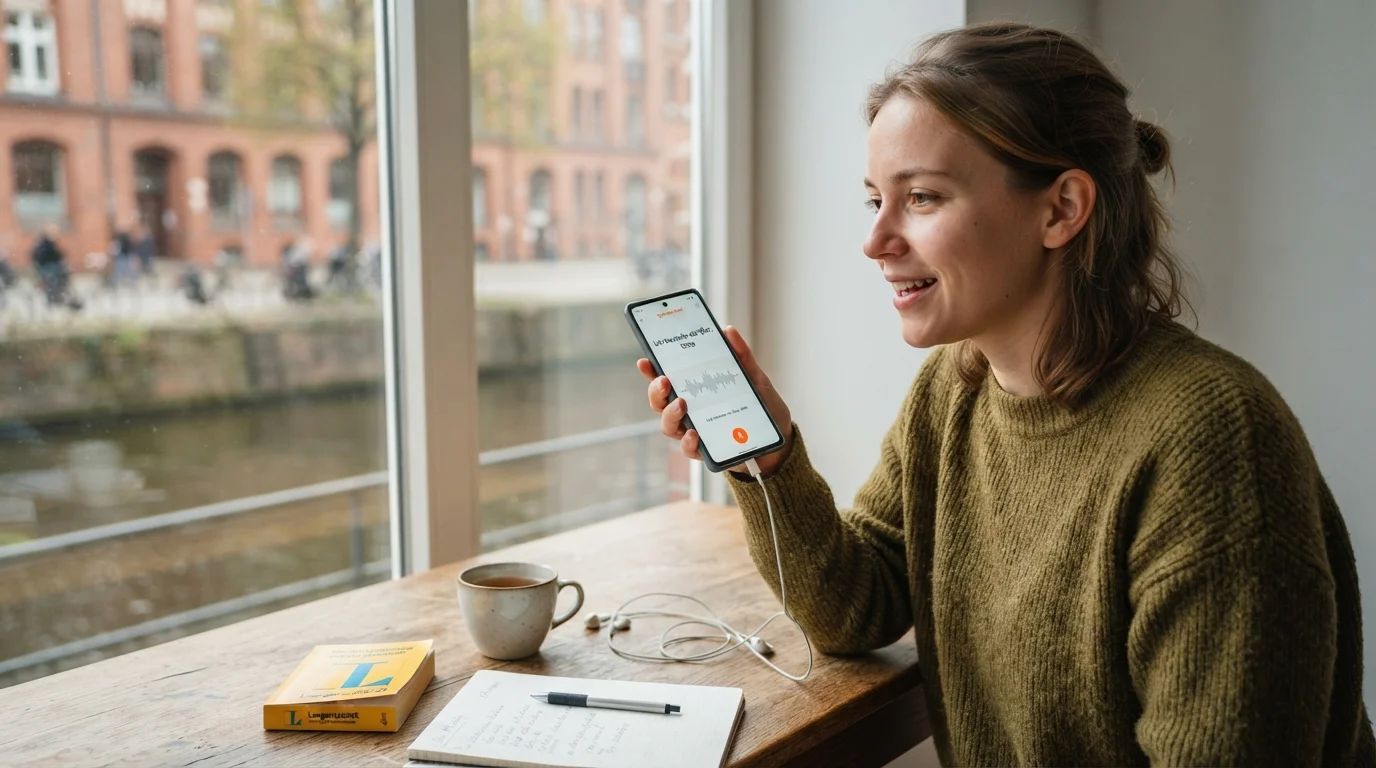
How to Practice German Pronunciation: Best App Features and Voice Recognition Tools
When you start learning German, the grammar often gets the lion's share of the attention. You wrestle with cases, memorize noun genders, and...
Read more
Learning German vocabulary is notoriously challenging. Between mastering the three genders (der, die, and das), memorizing complex plural forms, and wrapping your head around compound words like Geschwindigkeitsbegrenzung (speed limit), traditional rote memorization often falls short. To conquer this mountain, most modern learners turn to language learning apps.
For years, Memrise has been a household name in the language learning community, celebrated for its gamified flashcards and Spaced Repetition System (SRS). But a new contender has emerged: Bretzi, an AI-powered German learning platform designed specifically to bridge the gap between memorizing words and actually using them in real-world conversations. If you are an expat living in Germany, a student preparing for integration exams, or a language enthusiast, you might be wondering: Which app is truly better for mastering German vocabulary?
In this comprehensive comparison, we will dissect the methodologies, features, pros, and cons of both Bretzi and Memrise to help you choose the ultimate tool for your German language journey.
To understand which app is better, we first need to look at how they approach vocabulary acquisition. Memorizing a word is one thing; knowing how to deploy it naturally in a sentence during a high-pressure conversation at the Bürgeramt (citizens' registration office) is another.
Memrise built its reputation on the concept of sensory association and spaced repetition. The core philosophy is to help you commit words to your long-term memory as quickly as possible. It achieves this through user-generated decks, official courses, and short video clips of native speakers (called "Learn with Locals").
Memrise treats vocabulary as individual building blocks. You see a word, hear it, match it to its meaning, and repeat the process at scientifically optimized intervals. While this is highly effective for rapid memorization, it often lacks deeper grammatical context. You might learn the word for "appointment" (der Termin), but you won't necessarily practice booking one in a simulated conversation.
Bretzi takes a radically different, holistic approach. Instead of treating vocabulary as isolated units, Bretzi embeds vocabulary acquisition into active communication. The app recognizes that vocabulary, grammar, and speaking skills are deeply interconnected.
While Bretzi utilizes a robust vocabulary building system with spaced repetition, it immediately pushes you to apply those words. Through German vocabulary contextualization, learners do not just swipe through cards; they use their newly acquired words in interactive dialogue games and real-life scenarios. Bretzi’s core philosophy is that you haven't truly learned a word until you have spoken it, spelled it, and used it to solve a practical problem.
Let’s compare how these two platforms perform across the critical dimensions of German vocabulary learning.
One of the biggest hurdles in German is learning the grammatical gender of nouns. If you get the gender wrong, your cases (nominative, accusative, dative, genitive) will also be incorrect.
Learning vocabulary is useless if native speakers cannot understand your pronunciation.
No two language learners have the same goals. An expat trying to find a job in Berlin needs different vocabulary than a tourist visiting Munich for Oktoberfest.
Memrise remains a highly capable tool, especially for certain types of learners. Let’s look at its specific strengths and weaknesses for German learners.
Bretzi is built from the ground up to address the limitations of traditional flashcard apps, making it a powerful tool for serious learners and expats.
To help you visualize the differences, here is a direct comparison of how Bretzi and Memrise stack up against each other:
| Feature | Memrise | Bretzi |
|---|---|---|
| Primary Method | Spaced Repetition (SRS) Flashcards | AI-Contextualized Speaking & SRS |
| Speaking Practice | Basic repetition exercises | Interactive AI conversations & instant feedback |
| Gender Training | Static text memorization | Dedicated Article Mastery games |
| Grammar Integration | Minimal / Separated | Fully integrated (A0 to C1 levels) |
| Exam Prep Support | Community-made vocabulary lists | Targeted exam preparation structures |
No matter which app you choose, vocabulary acquisition requires strategy. Here are some proven, actionable tips to help you learn German words faster and retain them permanently:
The choice between Memrise and Bretzi ultimately depends on your learning style, current language level, and long-term goals.
Choose Memrise if: You are an absolute beginner looking for a casual, highly visual introduction to basic German vocabulary, or if you specifically want to browse thousands of niche, community-generated flashcard decks.
Choose Bretzi if: You want to transition from passively recognizing words to actively speaking them. If you are an expat living in Germany, preparing for the Einbürgerungstest, or looking to master German grammar alongside vocabulary, Bretzi’s AI-powered personalized learning plans, article mastery games, and real-life AI conversation simulations make it the more comprehensive choice.
Ready to stop memorizing and start speaking? Take your German to the next level with Bretzi. Download the app today and experience the future of AI-powered language learning!
Share this article:
When you start learning German, the grammar often gets the lion's share of the attention. You wrestle with cases, memorize noun genders, and...
Read moreAnyone who has attempted to learn German knows the infamous 'motivation cliff.' You start with immense enthusiasm, eager to master words like...
Read moreMoving to Germany, Austria, or Switzerland is an exciting milestone, but for many expats, the initial excitement quickly collides with linguistic...
Read more