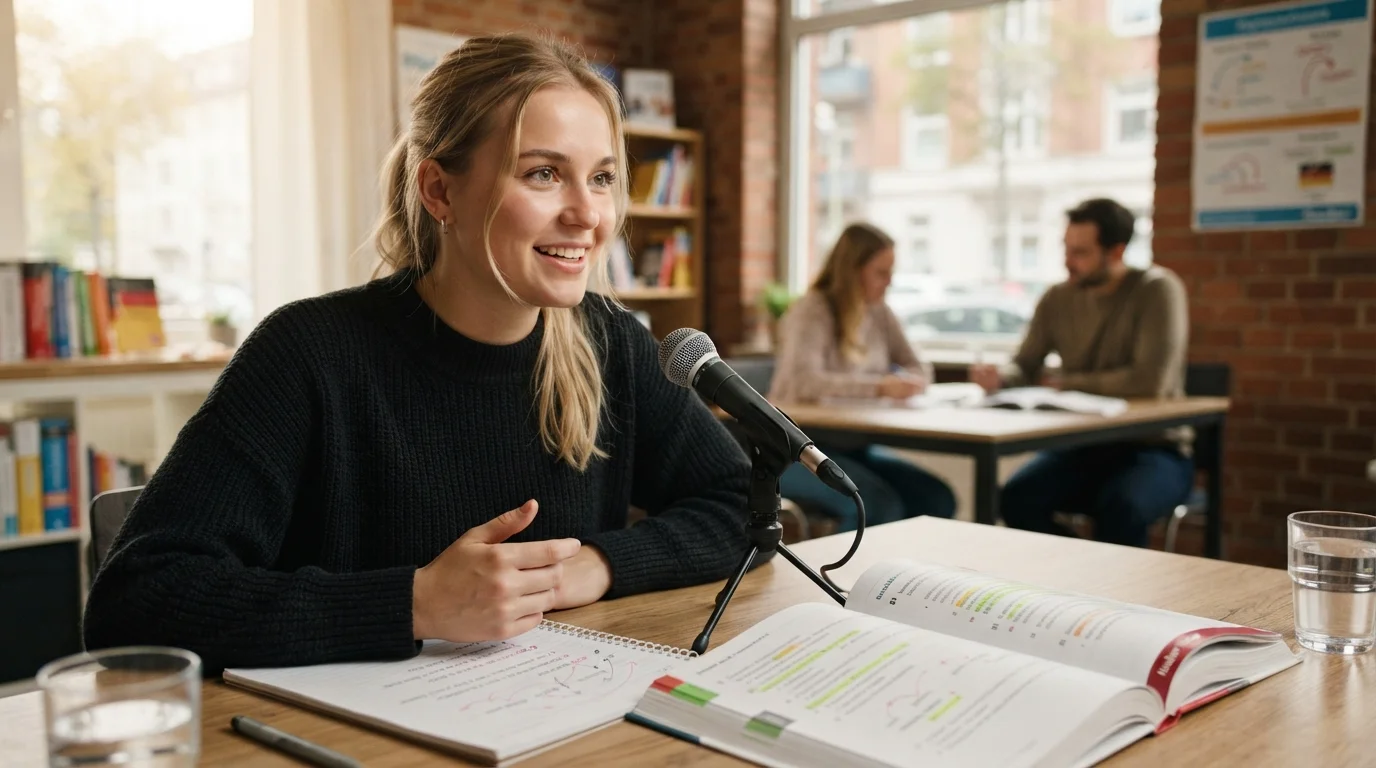
Whether you are chatting over a cup of coffee with a colleague in Berlin, negotiating in a business meeting, or sitting for your B1 or B2 speaking exam (Goethe-Zertifikat, telc, or TestDaF), being able to express what you think clearly and politely is an indispensable skill. In German communication culture, direct yet respectful discussion is highly valued, and relying solely on "Ich finde..." quickly becomes repetitive.
To score high marks on language tests and hold compelling discussions in real life, you need a diverse toolkit of expressions. You must know how to state your perspective, weigh pros and cons, agree constructively, and disagree without causing offense.
In this comprehensive guide, we will break down the most essential German phrases for expressing opinions across different CEFR levels, explain the tricky word order rules that accompany them, and show you how to structure persuasive arguments step by step.
1. The Basics: Stating Your Opinion (A2–B1 Level)
When starting out, most learners learn simple formulas. While these are perfectly functional, mastering the nuances and grammatical implications of each phrase is vital.
Everyday Introductory Phrases
- Ich finde, dass... (I find / think that...): Very natural for daily informal and semi-formal contexts.
Example: Ich finde, dass öffentliche Verkehrsmittel günstiger sein sollten. (I think public transport should be cheaper.)
- Ich glaube, dass... (I believe that...): Used when you hold a view or hunch, but perhaps lack hard statistics.
Example: Ich glaube, dass viele Menschen zu viel Stress haben. (I believe that many people have too much stress.)
- Ich denke, dass... (I think that...): Similar to ich glaube, standard for sharing a general thought.
Example: Ich denke, dass diese Entscheidung richtig war. (I think that this decision was right.)
- Ich bin der Meinung, dass... (I am of the opinion that...): Slightly more formal and standard in exam essays and structured debates.
Example: Ich bin der Meinung, dass Umweltschutz oberste Priorität hat. (I am of the opinion that environmental protection is top priority.)
- Ich bin der Ansicht, dass... (I hold the view that...): A strong synonym for Ich bin der Meinung.
Example: Ich bin der Ansicht, dass Homeoffice die Produktivität steigert. (I am of the view that working from home increases productivity.)
Crucial Word Order Note: The "Meiner Meinung nach" Trap
One of the most frequent mistakes German learners make involves the phrase Meiner Meinung nach (In my opinion). Unlike sentences starting with dass (which kick the conjugated verb to the very end), Meiner Meinung nach occupies Position 1 of the main clause. This means the conjugated verb must come immediately in Position 2.
- ❌ Incorrect: Meiner Meinung nach das Buch ist zu teuer.
- ✅ Correct: Meiner Meinung nach ist das Buch zu teuer.
If you want to master clause structures and avoid losing points on writing exams, check out our guide to mastering German word order in subordinate clauses.
2. Advanced & Nuanced Expressions (B2–C1 Level)
If you are preparing for B2 or C1 examinations (such as DSH or TestDaF), examiners expect you to demonstrate stylistic variation. Higher-level discourse demands expressions that reflect nuance, certainty, or cautious evaluation.
Expressing Firm Conviction
- Ich stehe auf dem Standpunkt, dass... (I take the standpoint that...)
Example: Ich stehe auf dem Standpunkt, dass Bildung für jeden Bürger kostenlos sein muss.
- Ich bin fest davon überzeugt, dass... (I am firmly convinced that...)
Example: Ich bin fest davon überzeugt, dass erneuerbare Energien die Zukunft sind.
- Meines Erachtens (nach)... (In my appraisal / In my view...)
Example: Meines Erachtens erfordert dieses Problem eine sofortige Reform. (Note: Like meiner Meinung nach, the verb takes Position 2).
- Es steht außer Frage, dass... (It is beyond question / indisputable that...)
Example: Es steht außer Frage, dass Digitalisierung im Schulunterricht notwendig ist.
Expressing Personal Perspective & Subjectivity
- Aus meiner Sicht / Aus meiner Perspektive... (From my point of view / perspective...)
Example: Aus meiner Sicht sollten wir die Arbeitszeiten flexibler gestalten.
- Soweit ich das beurteilen kann,... (As far as I can judge / tell...)
Example: Soweit ich das beurteilen kann, sind die Ergebnisse sehr vielversprechend.
- Für mich persönlich spielt ... eine zentrale Rolle. (For me personally, ... plays a central role.)
Example: Für mich persönlich spielt eine gesunde Work-Life-Balance eine zentrale Rolle.
3. Agreeing and Disagreeing: How to React in a Conversation
In oral exams, examiners do not just assess your monologue; they pay close attention to the interactive part (*Gemeinsam etwas planen* or *Diskussion*). You must react spontaneously and naturally to your partner's ideas.
Showing Agreement (Zustimmung)
Do not simply say "Ja". Use these phrases to demonstrate active listening and linguistic competence:
- Da haben Sie / hast du vollkommen recht. (You are completely right there.)
- Dem kann ich nur voll und ganz zustimmen. (I can only completely agree with that.)
- Ich teile Ihre / deine Ansicht vollkommen. (I completely share your view.)
- Das sehe ich ganz genauso. (I see that exactly the same way.)
- Genau das ist der springende Punkt. (That is precisely the crux of the matter / the main point.)
Polite & Partial Disagreement (Teilweise Zustimmung & Widerspruch)
Direct disagreement without diplomatic phrasing can sound harsh. German speakers frequently soften their disagreement by acknowledging the other person's point before countering it.
- Das mag sein, aber... (That may be, but...)
Example: Das mag sein, aber wir dürfen die Kosten nicht unterschätzen.
- Bis zu einem gewissen Grad stimmt das, jedoch... (To a certain extent that is true, however...)
Example: Bis zu einem gewissen Grad stimmt das, jedoch gibt es auch andere Faktoren.
- Da bin ich anderer Meinung / Ansicht. (I am of a different opinion there.)
- Das sehe ich etwas anders, denn... (I see that somewhat differently, because...)
- Ich bezweifle, dass... (I doubt that...)
Example: Ich bezweifle, dass dieser Vorschlag in der Praxis funktioniert.
To refine the tone of your arguments and make diplomatic suggestions during debates, understanding modal auxiliaries is essential. Review our comprehensive guide on German modal verbs and how to use them effectively.
4. Structuring Your Arguments and Linking Reasons
An opinion without reasons is simply a statement. In B1 and B2 speaking evaluations, examiners evaluate your ability to link arguments logically using appropriate causal and coordinating conjunctions.
Causal Connectors (Giving Reasons)
When justifying your stance, vary your sentence structures instead of repeating weil continuously. Make sure you understand the difference between subordinating conjunctions and coordinating conjunctions. For an in-depth breakdown, read our guide on how to use weil, denn, and da in German.
- ...weil... (because — verb at the end)
Example: Ich unterstütze dieses Gesetz, weil es die Sicherheit erhöht.
- ...denn... (for / because — verb in position 2)
Example: Ich unterstütze dieses Gesetz, denn es erhöht die Sicherheit.
- Aus diesem Grund... (For this reason — adverbial connector, verb in position 2)
Example: Viele Städte sind überlastet. Aus diesem Grund sollten wir den Radverkehr fördern.
Weighing Pros and Cons (Abwägen)
Demonstrating that you can see both sides of an argument is a hallmark of upper-intermediate German fluency:
- Einerseits ..., andererseits ... (On the one hand..., on the other hand...)
Example: Einerseits spart Online-Shopping Zeit, andererseits schadet es dem lokalen Handel.
- Auf der einen Seite ..., auf der anderen Seite ... (On the one side..., on the other side...)
- Zwar ..., aber ... (Admittedly..., but...)
Example: Zwar ist ein E-Auto teurer in der Anschaffung, aber man spart langfristig bei den Betriebskosten.
- Ein großer Vorteil / Nachteil ist, dass... (A major advantage / disadvantage is that...)
5. The OREO Formula for Exam Success
When presenting an opinion during a German oral exam, structure is what separates average marks from top scores. A great way to remember the ideal structure is the OREO Formula:
- O - Opinion (Meinung): State your perspective clearly.
"Meiner Ansicht nach ist das Erlernen einer Fremdsprache im Erwachsenenalter unerlässlich."
- R - Reason (Begründung): Explain why you hold this view.
"Denn in einer globalisierten Arbeitswelt verbessern Sprachkenntnisse nicht nur die Berufschancen, sondern fördern auch die interkulturelle Kompetenz."
- E - Example (Beispiel): Give a concrete personal or societal example.
"In meinem Heimatland zum Beispiel verlangen viele internationale Firmen fließende Deutsch- oder Englischkenntnisse."
- O - Opinion Restated / Outcome (Fazit): Conclude by summarizing your main takeaway.
"Zusammenfassend lässt sich sagen, dass Sprachkenntnisse ein entscheidender Schlüssel für den beruflichen Erfolg sind."
6. Practice Makes Fluent: Taking Your Skills into the Real World
Memorizing lists of phrases is only the first step. The real challenge comes in using them spontaneously under time pressure without pausing to translate from your native language.
This is where interactive, real-time practice becomes critical. With the Bretzi app, you can engage in AI-powered conversational simulations tailored specifically to your level. Bretzi offers structured dialogue scenarios covering current exam topics, debate themes, and everyday discussions, complete with instant pronunciation and grammar feedback. By integrating daily conversational drills with Bretzi's spaced repetition system, you can turn these opinion phrases into second nature before exam day.
Summary Cheat Sheet: Essential German Opinion Phrases
- To state an opinion: Meiner Meinung nach (+ Verb), Ich bin der Ansicht, dass..., Aus meiner Sicht...
- To agree: Da stimme ich Ihnen/dir absolut zu, Das sehe ich genauso, Vollkommen richtig
- To disagree politely: Das mag sein, aber..., Da bin ich anderer Ansicht, Das sehe ich nicht ganz so
- To give reasons: Aus diesem Grund..., Daher..., Ein wesentlicher Grund dafür ist, dass...
- To conclude: Zusammenfassend möchte ich sagen..., Alles in allem...
Conclusion
Mastering the art of expressing opinions in German allows you to connect more deeply with native speakers, contribute confidently in professional environments, and pass your German exams with flying colors. Start small: choose two or three new phrases from this guide each day, practice forming sentences with them, and use them in your next German conversation or study session.