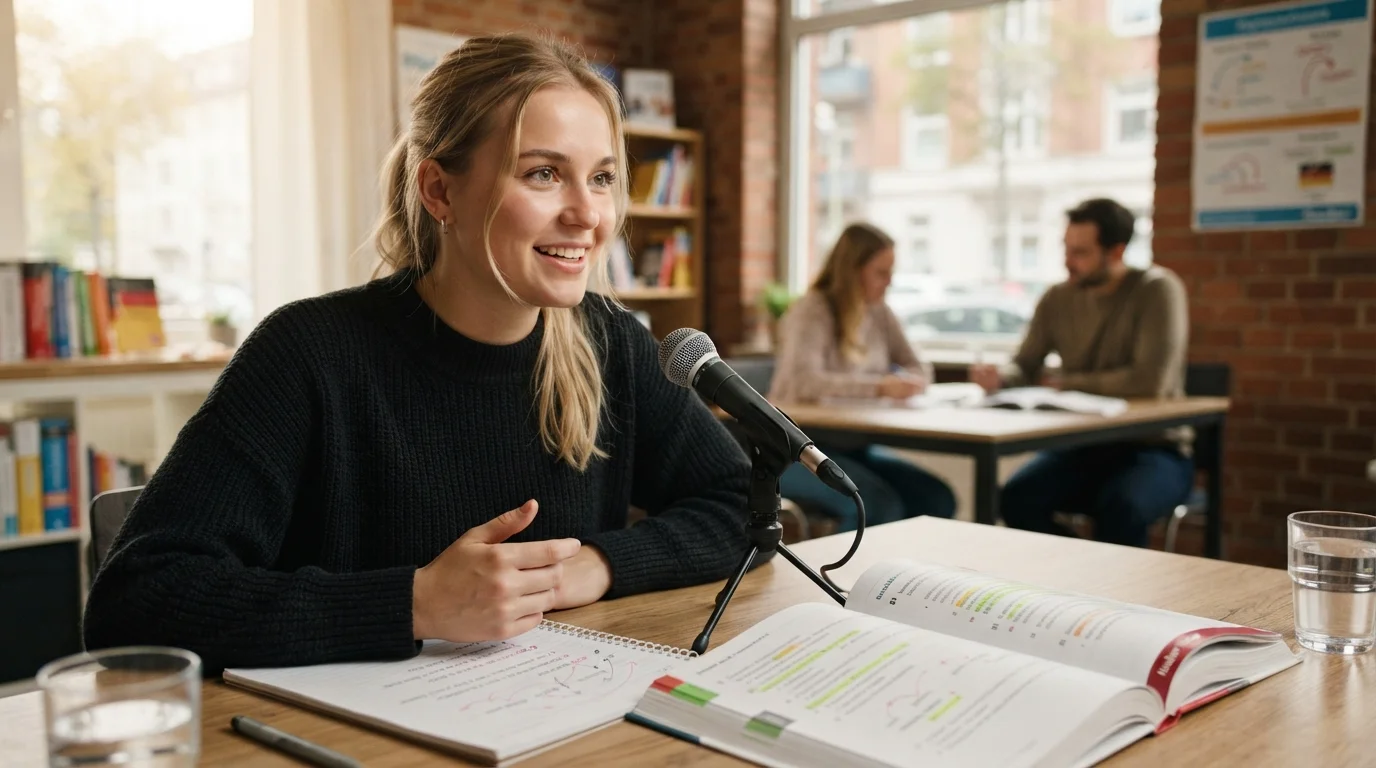
Mastering German Sentence Rhythm and Intonation for B1 Oral Exams
When preparing for the B1 German speaking exam—whether it is the Goethe-Zertifikat B1, telc Deutsch B1, or the Deutsch-Test für Zuwanderer...
Read more
Imagine you are sitting in a cozy café in Berlin. You overhear a conversation at the next table. One speaker says, 'Das ist ja unglaublich!' A few minutes later, another sighs, 'Du weißt ja, wie er ist.' If you translate these sentences literally, you might get confused. Why are they saying 'yes' in the middle of a statement? Is it some secret linguistic code?
It actually is. You have just encountered one of the most powerful elements of spoken German: the modal particle (Modalpartikel). Among these tiny conversational flavor-makers, none is more versatile, frequent, or transformative than the word 'ja'.
While beginners learn 'ja' simply as the translation for 'yes', intermediate and advanced learners discover that it holds the key to authentic, fluid, and emotionally nuanced German. Using 'ja' correctly is the ultimate shortcut to sounding less like a textbook and more like a local. In this comprehensive guide, we will unpack the secrets of the German particle 'ja', explore its different meanings, and show you exactly how to weave it into your daily conversations.
Before we dive into 'ja', let’s establish what modal particles actually are. In German, particles are small, uninflected words that do not change the basic grammatical meaning of a sentence, but radically alter its tone, mood, or intent. They are the linguistic equivalent of a shrug, a wink, or an arched eyebrow.
According to the detailed overview of German modal particles on Wikipedia, these words are unique because they are highly dependent on context and intonation. If you remove them from a sentence, the core information remains exactly the same, but the emotional connection between the speakers is lost. They make your speech sound softer, friendlier, more urgent, or more surprised.
Because they are so subjective, modal particles are notoriously difficult to master through traditional grammar exercises. They require an intuitive grasp of conversational flow—something you can easily build using German word order and sentence structure principles to understand where these tiny words fit in the grand scheme of a sentence.
When used as a modal particle, 'ja' never means 'yes'. Instead, it serves several distinct rhetorical purposes depending on your tone of voice and the context of the conversation. Let’s break down the five most common ways native speakers use 'ja'.
The most common use of the particle 'ja' is to signal that the information you are sharing is already known to both you and the listener. It is a way of saying "as you know," "obviously," or "of course," but in a much softer and less patronizing way.
By using 'ja' here, you create a sense of intimacy and shared understanding. You are treating the listener as an insider who is already up to speed on your life.
When you hear or see something unexpected, adding 'ja' to your exclamation amplifies your surprise. In this context, it functions similarly to "Wow," "My goodness," or "Indeed!" It is often paired with an exclamation mark in writing and spoken with a rising, expressive intonation.
If you shift your tone to something more stern and serious, 'ja' can transform a simple command or statement into a sharp warning. It adds urgency and emphasizes that there will be consequences if the listener does not comply. It is the German equivalent of saying "Make sure you..." or "You'd better..."
Be careful with your pronunciation here. A warning 'ja' is usually stressed and pronounced slowly to convey authority.
Sometimes, 'ja' is used simply to add weight to an assertion, reassuring the listener or making a promise sound more binding. It signals that you are absolutely certain about what you are saying.
In these cases, 'ja' softens the delivery, making the speaker sound empathetic, supportive, and warm.
When something predictable happens (usually something negative), Germans will use 'ja' to express a sense of resignation or a mild "I told you so" attitude. It emphasizes that the outcome was inevitable.
Now that you know what 'ja' means, where do you put it? Fortunately, German modal particles follow a relatively predictable pattern. They almost always live in the middle of the sentence, specifically in the Mittelfeld (middle field), right after the conjugated verb and any pronoun objects, but before the main information or direct objects.
Let's look at a quick structural breakdown:
| Subject | Verb (Position 2) | Pronoun / Object | Particle ('ja') | Rest of the Sentence |
|---|---|---|---|---|
| Du | hast | - | ja | keine Ahnung! (You have no idea!) |
| Das | ist | - | ja | super gelaufen. (That went great!) |
| Ich | habe | es | ja | gesagt. (I told you so.) |
Notice how placing 'ja' in the correct position makes the sentence flow naturally. If you are currently working on more advanced sentence structures, such as mastering Konjunktiv II for hypothetical scenarios, you will find that modal particles like 'ja' are frequently used there too to express longing, regret, or hypothetical surprise (e.g., 'Wenn ich das ja gewusst hätte!' - If only I had known that!).
Because modal particles are primarily a feature of spoken German, you won't find them very often in formal academic writing, newspapers, or official administrative documents. Instead, they thrive in casual conversations, text messages, podcasts, and movies.
Here are three practical ways to start integrating 'ja' into your active vocabulary:
The next time you watch a German series or listen to a podcast, keep your ears peeled for the word 'ja'. Pay close attention to the speaker's intonation. Is it high-pitched and surprised? Or low and warning? Try repeating the sentence exactly as they said it. This technique, called shadowing, helps build muscle memory for native-like pronunciation and rhythm.
Since mastering particles requires active dialogue rather than passive reading, you need a safe space to experiment. This is where the Bretzi app comes in. With Bretzi's real-life German conversation practice with AI, you can chat naturally in real-time. The AI understands context and nuances, allowing you to try out sentences like 'Das ist ja cool!' and receive instant feedback on whether your usage sounds natural. Additionally, Bretzi's interactive dialogue games for practical scenarios let you practice these colloquial expressions in simulated real-world situations, such as ordering food, complaining to a landlord, or chatting with colleagues.
Don't try to force 'ja' into every sentence immediately. Start with a few set phrases that are incredibly common and easy to drop into conversation:
To truly understand 'ja', it helps to see how it contrasts with other heavy-hitting German modal particles like denn, doch, and mal. Let's look at how changing the particle changes the entire meaning of a simple question or statement:
By learning these subtle differences, you will transition from someone who merely translates words in their head to someone who truly feels the emotional landscape of the German language.
Mastering the German particle 'ja' is a major milestone on your language-learning journey. It takes you out of the rigid world of grammar charts and into the vibrant, living reality of daily German conversation. By signaling shared knowledge, expressing surprise, or adding gentle emphasis, you show native speakers that you don't just speak their language—you understand their culture and conversational rhythm.
Are you ready to stop sounding like a textbook and start speaking like a local? Download the Bretzi app today to access personalized learning plans, practice speaking with our advanced AI, and play interactive dialogue games designed to make complex grammar and colloquial particles second nature. Your journey to German fluency starts here!
Share this article:
When preparing for the B1 German speaking exam—whether it is the Goethe-Zertifikat B1, telc Deutsch B1, or the Deutsch-Test für Zuwanderer...
Read moreYou sit down at a German bakery, smile warmly at the server, and confidently declare: "Ich bin voll!" Instead of a polite nod acknowledging your...
Read moreWhen you start learning German, you quickly realize that translating every word literally leads to utter confusion. A German colleague might suddenly...
Read more