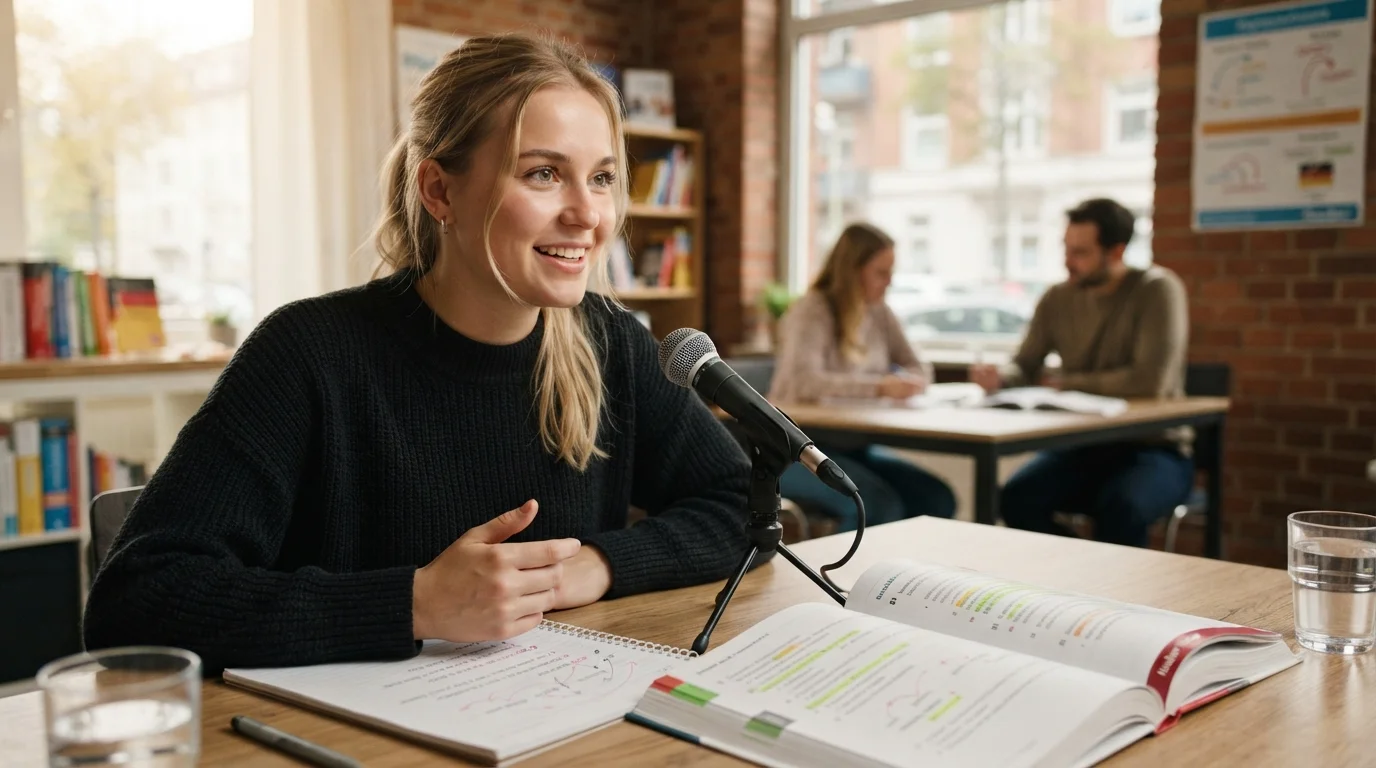
Mastering German Sentence Rhythm and Intonation for B1 Oral Exams
When preparing for the B1 German speaking exam—whether it is the Goethe-Zertifikat B1, telc Deutsch B1, or the Deutsch-Test für Zuwanderer...
Read more
Ask any German learner what keeps them up at night, and you will likely hear a collective groan: Adjektivdeklination (adjective declension). For decades, traditional language schools have forced students to memorize terrifying, multi-colored grid charts. You know the ones—grids containing 48 different cells of -e, -en, -er, -em, and -es endings, categorized by gender, case, and article type.
But here is the truth: memorizing charts does not work for real-time conversation. When you are standing in a bakery in Berlin trying to order a "leckeren Apfelkuchen" (delicious apple cake), your brain does not have the processing power to locate Row 3, Column 2 of the Mixed Declension table. By the time you find the ending, the baker has moved on to the next customer.
To speak German fluently, you need an intuitive system. You need to understand the logic behind the endings, turning them into a muscle memory reaction rather than a mathematical equation. In this comprehensive guide, we will break down the absolute simplest, chart-free method to master German adjective endings once and for all.
To master German adjectives without memorizing charts, you must first understand why these endings exist. German is a case-based language. It relies on signals to tell the listener who is doing what to whom. These signals indicate three things:
The golden rule of German grammar is this: The sentence must clearly display these signals. However, German is also highly efficient. It only wants to display this information once. We call this the Information Carrier Principle.
If the article (like der, die, das, or dem) is already carrying the clear signal of the gender and case, the adjective does not need to do any heavy lifting. It can take a lazy, "weak" ending. But if there is no article, or if the article is vague (like ein), the adjective must step up and carry the signal with a "strong" ending. Once you internalize this concept of "signal sharing," the charts disappear.
Let's start with the easiest scenario: when the article does all the hard work. This happens when you use definite articles (der, die, das, den, dem, des).
Because these articles clearly show the gender and case of the noun, the adjective can relax. It only has two possible endings: -e or -en. That is it! No complicated variations.
To know when to use -e and when to use -en, we use the famous "Saucepan Rule" (often called the Kasserolle rule in German grammar circles). Imagine a visual grid of the Nominative, Accusative, Dative, and Genitive cases across Masculine, Feminine, Neuter, and Plural. If you outline the five positions that take the ending -e, they form the shape of a saucepan:
Every single other position outside of this "saucepan" takes the ending -en. This means:
By visualizing this simple saucepan, you instantly know that any definite-article adjective outside of those five basic singular subject/object positions defaults directly to -en. This rule makes mastering German grammar feel like a logical game rather than a chore.
What happens when there is no article at all? For example, when you talk about "cold water" (kaltes Wasser) or "hot tea" (heißer Tee)?
Because there is no article to carry the gender/case signal, the adjective must become the primary information carrier. To do this, the adjective simply steals the ending of the definite article that would have been there. We call this the "Rese Nese" cheat code, named after the sequence of endings for the Nominative and Accusative cases:
Look at the bold letters at the end of those articles: R-E-S-E. That spells "RESE".
Now look at the Accusative case endings (direct objects):
The endings are N-E-S-E. That spells "NESE".
By remembering the friendly name "Rese Nese", you have instantly memorized the Nominative and Accusative strong adjective endings for every gender! For Dative, the same logic applies: steal the ending of the Dative articles (dem, der, dem, den) to get -em, -er, -em, and -en (e.g., mit frischem Wind).
Understanding this systemic structure is a massive shortcut. It is the same logical flow you use when learning German word order rules; once you see the underlying pattern, you no longer have to guess.
The third and final scenario is the "mixed" declension. This happens after indefinite articles (ein, eine, ein) or possessives/negatives (mein, dein, kein).
Here, the article is present, but it is sometimes "lazy" and does not show the gender clearly. For example, ein can be masculine nominative, neuter nominative, or neuter accusative. Because ein is ambiguous, the adjective must step up to show the gender signal. But once the article does show a clear signal (like einen or einem), the adjective can relax and take the weak -en ending.
Let's look at how this works in practice:
For all Dative, Genitive, and plural forms in the mixed declension, the article always has a strong, highly visible ending (like einem, einer, meinen). Therefore, the adjective always defaults to the weak -en ending (e.g., mit meinem alten Fahrrad).
This case system is highly integrated across the entire German language. Mastering it here will also make it significantly easier to learn complex structures like verbs with Akkusativ and Dativ prepositions.
Now that you understand the logic behind the endings, how do you make them automatic? Here are three actionable strategies to practice without opening a textbook:
Instead of learning isolated vocabulary words, learn them in context with an adjective. Instead of memorizing "der Hund (the dog)," memorize "ein treuer Hund (a loyal dog)." By learning nouns with pre-attached adjectives, your brain naturally records the correct declension patterns as single lexical units.
Staring at a grammar book will only get you so far. To build true conversational fluency, you need interactive feedback. This is where modern tools shine. Using the Bretzi app, you can play targeted article mastery games and complete interactive dialogue scenarios that simulate real-life conversations. Bretzi's AI-powered personalized learning plans adapt to your specific mistakes, giving you real-time pronunciation training and grammar feedback when you use the wrong adjective endings, helping you correct them instantly.
Whenever you are speaking in the Dative case and the noun is plural, the adjective ending is always -en, and the noun itself almost always gets an extra -n at the end (if it doesn't already have one). For example: mit den kleinen Kindern (with the small children). Remembering this "Double-N" shortcut will save you mental energy in fast-paced conversations.
When you want to say a sentence in German, run through this quick, three-step mental checklist instead of trying to visualize a massive table:
To learn more about how German grammar structures fit together historically, you can explore Wikipedia's comprehensive guide on German declension.
Mastering German adjective declension does not require a photographic memory or hours of painful rote learning. By shifting your focus from rigid charts to the logical "Information Carrier" principle, you can naturally predict the correct ending in any conversational scenario.
Remember, making mistakes is a natural part of the language journey. The more you speak and practice, the more these patterns will become second nature. If you are ready to take your German skills to the next level with personalized, AI-driven practice, download the Bretzi app today and start mastering real-life German conversations with instant, intuitive feedback!
Share this article:
When preparing for the B1 German speaking exam—whether it is the Goethe-Zertifikat B1, telc Deutsch B1, or the Deutsch-Test für Zuwanderer...
Read moreYou sit down at a German bakery, smile warmly at the server, and confidently declare: "Ich bin voll!" Instead of a polite nod acknowledging your...
Read moreWhen you start learning German, you quickly realize that translating every word literally leads to utter confusion. A German colleague might suddenly...
Read more