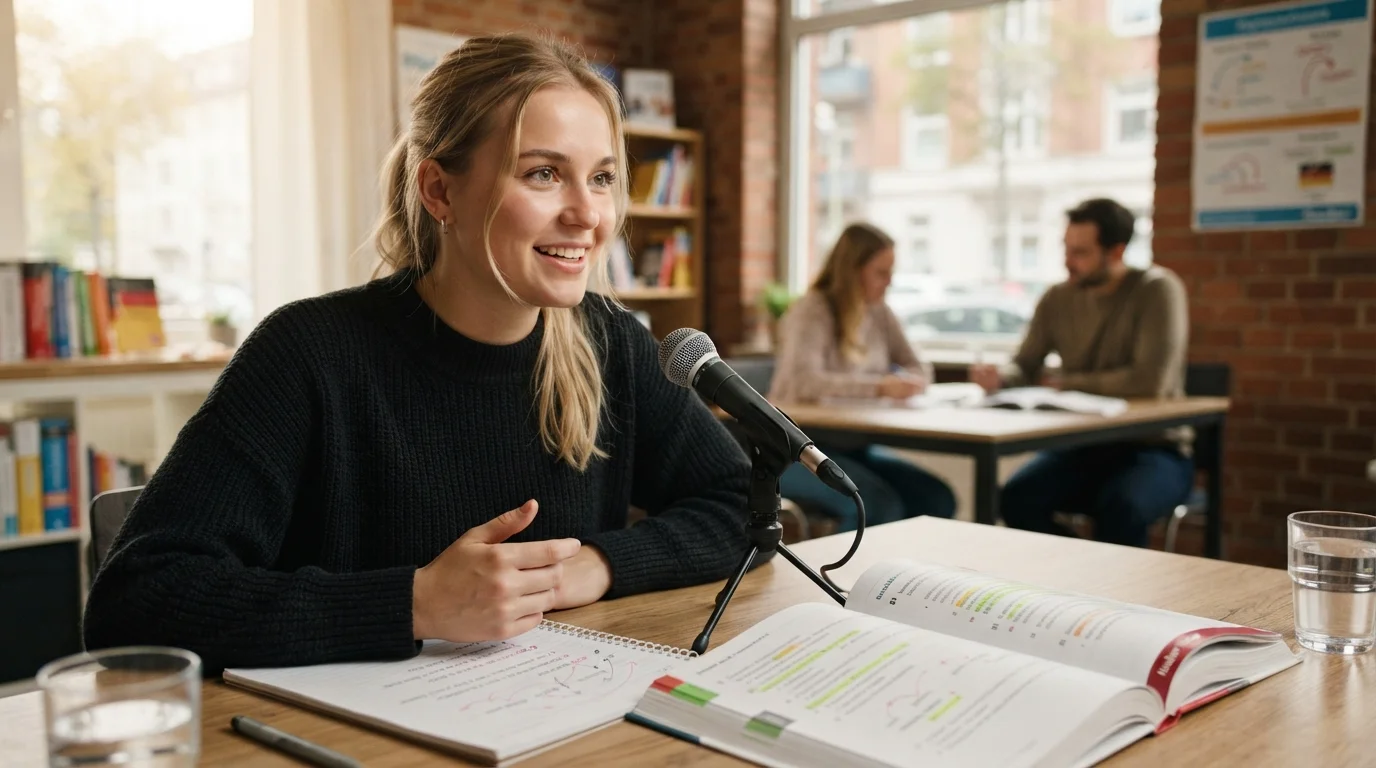
Mastering German Sentence Rhythm and Intonation for B1 Oral Exams
When preparing for the B1 German speaking exam—whether it is the Goethe-Zertifikat B1, telc Deutsch B1, or the Deutsch-Test für Zuwanderer...
Read more
Have you ever struggled to express a wish, a polite request, or a hypothetical scenario in German? You aren't alone. The German Subjunctive II, or Konjunktiv II, is often viewed as a challenging hurdle, but it is the secret ingredient to fluent, nuanced communication. Without it, your German might sound overly direct, leaving you unable to express complex thoughts like "If only I had more time..." or "I would help you if I could."
This guide will demystify Konjunktiv II, breaking down its formation, core functions, and providing practical examples for mastery. By the end, you'll feel significantly more confident in expressing wishes, possibilities, and polite requests, truly elevating your conversational skills.
At its heart, Konjunktiv II is the mood of unreality, possibility, and politeness in German. While the indicative mood describes facts and certainties (e.g., "Ich habe Zeit" - I have time), and Konjunktiv I primarily deals with indirect speech (e.g., "Er sagt, er habe Zeit" - He says he has time), Konjunktiv II steps in when you're talking about things that aren't real, are hypothetical, or are desired but not actual.
Think of it as the German equivalent of English constructions like "I would go," "If I were you," or "I wish I had..." It allows you to express:
The good news is that forming Konjunktiv II is more straightforward than it first appears, though there are a few variations depending on the verb. Let's break it down:
These two verbs are crucial and often irregular. You'll use them constantly:
Example: "Ich hätte gerne einen Kaffee." (I would have a coffee / I would like a coffee.)
Example: "Wenn ich du wäre, würde ich das tun." (If I were you, I would do that.)
For most verbs, especially regular verbs and many irregular verbs, the simplest and most common way to form Konjunktiv II is by using the Konjunktiv II form of werden (würden) followed by the infinitive of the main verb. This is your go-to for clarity and ease.
Structure: würden + [main verb in infinitive]
Examples:
This construction is very versatile and is almost always grammatically correct, making it a safe bet when in doubt.
Some strong (irregular) verbs and most modal verbs form their Konjunktiv II by taking their simple past (Präteritum) stem, adding an Umlaut (ä, ö, ü) if the stem vowel allows, and then adding the standard Konjunktiv II endings (-e, -est, -e, -en, -et, -en).
Common examples:
Example: "Wenn er käme, würden wir reden." (If he came, we would talk.)
Modal Verbs (often used without würden):
Note: For wollen, würde wollen is often preferred to avoid confusion with the simple past form.
To express hypothetical situations or wishes in the past, you combine the Konjunktiv II of haben (hätte) or sein (wäre) with the past participle of the main verb. This functions similarly to the English "would have + past participle."
This is perhaps the most common and intuitive use of Konjunktiv II. It allows you to express what you wish were true, but isn't.
The phrase "Wenn doch..." or "Wenn nur..." often introduces these strong wishes.
When you talk about what would happen if something else were true, you're in Konjunktiv II territory. These are often introduced by "wenn" (if) and involve two clauses.
To soften a request or suggestion and make it sound more polite, Konjunktiv II is your best friend. This is particularly useful in formal settings or when speaking to strangers.
These phrases mean "as if" or "as though" and always trigger Konjunktiv II because they describe something that isn't true but is being compared as if it were.
While Konjunktiv I is the primary mood for indirect speech, sometimes the Konjunktiv I form of a verb is identical to its indicative form (e.g., "wir machen," "sie haben"). In such cases, using Konjunktiv II or the würden-construction ensures that it's clear you're reporting speech and not stating a fact.
For more on indirect speech and Konjunktiv I, you can refer to Wikipedia's comprehensive overview of German verbs and moods.
Here are some phrases you'll frequently encounter and can easily integrate into your speech:
Mastering Konjunktiv II is a significant step toward expressing yourself with greater nuance, politeness, and complexity. It unlocks a new layer of communication, allowing you to move beyond simple statements and delve into the world of possibilities and desires. Ultimately, mastering this mood transforms your German from functional to truly expressive.
Don't let the intricacies of German grammar intimidate you. Approach Konjunktiv II systematically, starting with the most common forms and gradually incorporating more complex structures. With consistent practice, perhaps even with the help of Bretzi's comprehensive grammar lessons from A0 to C1 level and its AI-driven feedback, you'll soon be expressing your wishes, hypotheticals, and polite requests with confidence and ease. Remember, the key takeaway is that Konjunktiv II is your primary tool for navigating the "what ifs" of life—so start using it in your daily practice today!
Ready to put your knowledge into practice? Download the Bretzi app today and start mastering German Konjunktiv II with personalized lessons and real-time feedback!
Share this article:
When preparing for the B1 German speaking exam—whether it is the Goethe-Zertifikat B1, telc Deutsch B1, or the Deutsch-Test für Zuwanderer...
Read moreYou sit down at a German bakery, smile warmly at the server, and confidently declare: "Ich bin voll!" Instead of a polite nod acknowledging your...
Read moreWhen you start learning German, you quickly realize that translating every word literally leads to utter confusion. A German colleague might suddenly...
Read more