How to Ace the Oral Picture Description in the DTZ B1 German Exam
Standing outside the exam room, heart thumping, waiting for the oral portion of the Deutsch-Test für Zuwanderer (DTZ) is an experience thousands of...
Read more
This article was written by AI and published by Bretzi.
AI can get things wrong. For anything official, check the source it points to.
AI-generated image
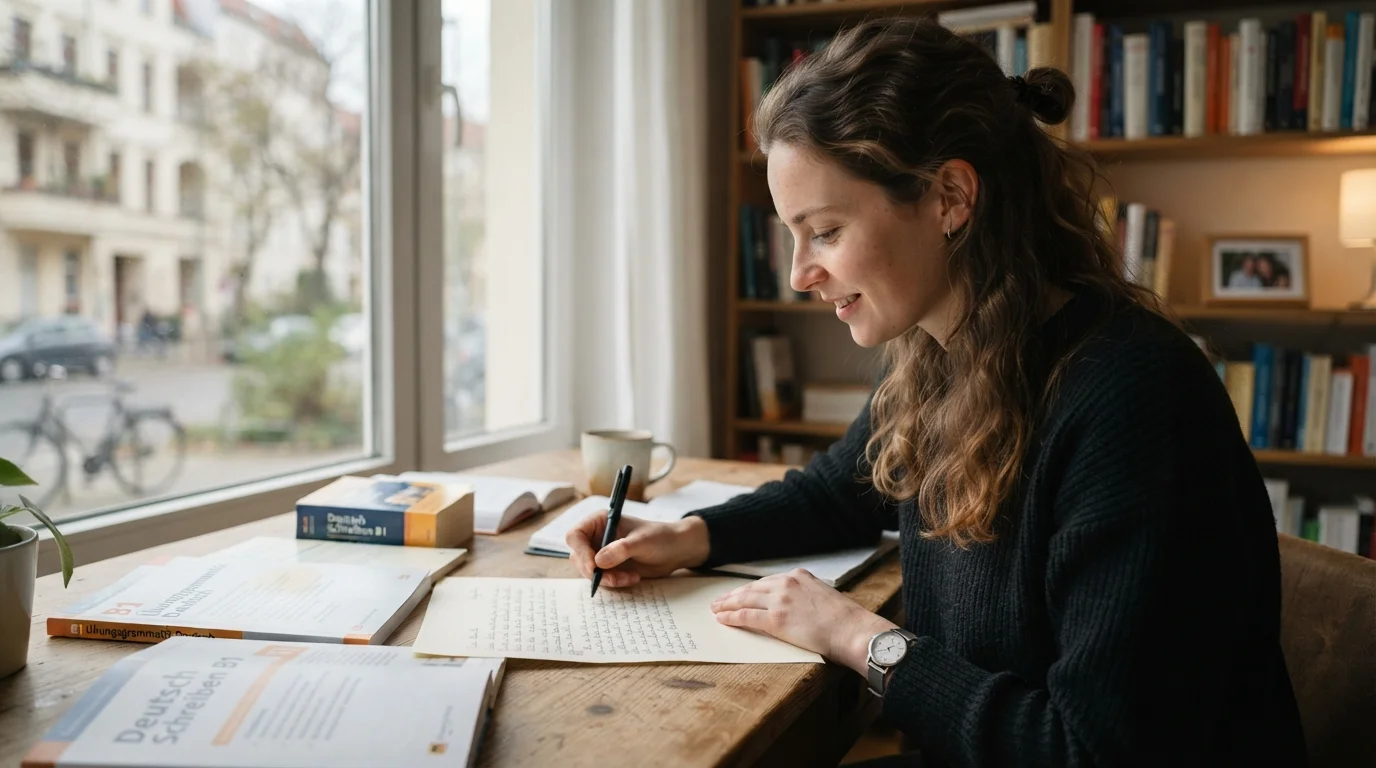
Writing a formal or informal letter in German can feel intimidating, especially when you are working against the clock. The good news is that the B1 German letter writing exam is highly structured. You do not need poetic language or perfect grammar to succeed. You need to understand the task, cover every point, organize your message clearly, and use polite, accurate German.
This step-by-step guide explains how to write a successful B1 German letter, email, or message. You will learn how to analyze the prompt, choose the correct level of formality, use useful phrases, avoid common mistakes, and manage your time. The sample templates can also help you prepare for the DTZ, telc B1, and other German integration exams.
In most B1 German exams, the writing task asks you to produce a short letter or email based on a realistic everyday situation. You may need to write to a friend, a landlord, a school, a company, an employer, or an authority. Typical topics include canceling an appointment, requesting information, complaining about a service, inviting someone, apologizing, or asking for help.
The task usually contains several bullet points. For example, you might be asked to:
Each bullet point is important. Examiners assess whether you have communicated the required information, whether your text is understandable, and whether your vocabulary and grammar are appropriate for B1 level. A short, clear answer that covers every point is normally better than a long answer that ignores part of the task.
If you are preparing for the DTZ, it is useful to review the full exam format and create a study schedule. Our guide to planning for DTZ B1 success can help you organize your preparation alongside writing practice.
Do not begin writing immediately. Spend two or three minutes reading the prompt carefully. First, identify who will receive the message. Then underline the reason for writing and mark every required content point.
Use a simple planning formula: purpose, details, request, closing. Write one or two keywords beside each point. This prevents you from forgetting information and makes your final text easier to organize.
For additional integration-exam preparation, you may also want to check this integration exam document checklist. Knowing the practical context behind common exam scenarios can make the vocabulary easier to remember.
The relationship with the recipient determines your greeting, pronouns, and closing. This is one of the easiest ways to demonstrate control of German communication.
Use formal German when writing to an unknown person, a company, a landlord, a school, an office, or an employer. Use Sie, Ihnen, and Ihr, always with a capital letter.
After Sehr geehrte Damen und Herren, use a comma and begin the next sentence with a lowercase letter if it is grammatically connected to the greeting. In exam writing, consistency matters more than complicated punctuation, so follow one clear format.
Use informal German with friends, relatives, and people you know well. Use du and the matching forms dir, dich, and dein.
A common mistake is mixing formal and informal language. Do not begin with Sehr geehrte Frau Schmidt and later write Kannst du mir helfen? Decide on the relationship before writing your first sentence.
A clear structure helps the examiner find your ideas and helps you avoid missing a task point. A practical B1 letter normally has four parts.
Start by stating why you are writing. Useful formal phrases include:
Useful informal phrases include:
Deal with the bullet points in a logical order. Use one paragraph for each main idea when possible. Connect your sentences with simple words such as zuerst, außerdem, deshalb, aber, weil, and trotzdem.
Make it clear what you want the recipient to do. For example:
End with a polite closing that matches the greeting. Add your name even if the task does not specifically require it. A complete ending makes the message look natural and professional.
Memorizing flexible phrases is more effective than memorizing one complete answer. Learn sentence patterns that you can adapt to different topics.
Do not try to use advanced vocabulary if you are not sure how to spell or construct it. Accurate basic German is valuable at B1. Short sentences with correct word order are safer than very long sentences with several errors.
Situation: You have an appointment at a language school but cannot attend. Explain why, suggest another date, and ask what you need to bring.
Sehr geehrte Damen und Herren,
leider kann ich meinen Termin am 14. Mai nicht wahrnehmen, weil ich an diesem Tag arbeiten muss. Deshalb möchte ich Sie bitten, mir einen neuen Termin vorzuschlagen. Wäre ein Termin in der nächsten Woche möglich?
Außerdem möchte ich gern wissen, welche Dokumente ich zum neuen Termin mitbringen muss. Bitte antworten Sie mir per E-Mail.
Vielen Dank für Ihr Verständnis.
Mit freundlichen Grüßen
Maria Petrova
Notice the useful sequence: reason, alternative, question, and polite closing. The language is simple but covers all the important points.
Situation: Invite a friend to your new apartment. Explain the date, give directions, and ask what your friend would like to eat.
Liebe Sofia,
ich möchte dich gern zu einer kleinen Einweihungsparty in meiner neuen Wohnung einladen. Die Party findet am Samstag, den 20. Juni, um 18 Uhr statt. Meine Adresse ist Hauptstraße 25. Du kannst mit der Straßenbahn bis zur Haltestelle Rathaus fahren; von dort sind es nur fünf Minuten zu Fuß.
Kannst du mir bitte sagen, was du gern essen möchtest? Ich freue mich sehr auf dich. Bitte gib mir bis Mittwoch Bescheid.
Liebe Grüße
Nadia
Situation: You ordered a product online, but it arrived damaged. Explain the problem and request a replacement or refund.
Sehr geehrte Damen und Herren,
am 3. April habe ich bei Ihnen einen Wasserkocher bestellt. Leider ist das Gerät gestern beschädigt angekommen. Der Deckel ist kaputt, und der Wasserkocher funktioniert nicht.
Ich möchte Sie deshalb bitten, mir ein neues Gerät zu schicken. Falls das nicht möglich ist, möchte ich mein Geld zurückbekommen. Die Bestellnummer lautet 45821. Bitte teilen Sie mir mit, wie ich das beschädigte Gerät zurückschicken kann.
Ich hoffe auf eine schnelle Lösung und danke Ihnen im Voraus.
Mit freundlichen Grüßen
Ahmed Hassan
Reserve at least five minutes for proofreading. First check content: did you answer every bullet point? Then check language. At B1 level, focus on the mistakes that most affect clarity.
Pronunciation does not directly affect a writing score, but speaking and listening practice can improve your overall confidence with sentence patterns. Bretzi combines personalized learning plans, grammar lessons from A0 to C1, and realistic AI conversation practice, so you can reinforce the phrases you use in your letters through practical dialogue.
Practice under realistic conditions. Choose a topic, set a timer for 25 to 30 minutes, and write without using a dictionary. Then compare your answer with a checklist rather than correcting only individual words.
Keep a notebook of recurring errors. If you often forget the verb at the end of a weil clause, write five original examples. If articles are difficult, group useful nouns with their articles and plural forms. Spaced repetition is especially helpful for memorizing greetings, connectors, and polite requests. Bretzi can support this routine with vocabulary review, instant feedback on pronunciation, and interactive dialogue games based on everyday situations.
For broader civic and integration preparation, you can also combine writing practice with resources for the Leben in Deutschland test. A balanced plan will help you build both exam knowledge and practical German for life in Germany.
Read the task twice and circle the required points. Plan briefly, write a complete first draft, and leave time to check it. If you do not know a word, explain the idea with simpler words instead of stopping. For example, if you forget a specific word for a household object, describe what it is used for.
Stay focused on communication. You are not expected to write like a native speaker. You are expected to express yourself clearly, politely, and in a way that a German reader can understand. A reliable structure and a small collection of flexible phrases can make the writing section much less stressful.
Passing the B1 German letter writing exam is achievable when you treat the task as a process: analyze the prompt, choose the correct tone, cover every point, organize your message, and proofread systematically. Practice formal and informal templates until the structure feels automatic, but adapt the details to each new situation.
Start today with one timed letter and use the checklist in this guide to review it. With regular practice and targeted feedback, you can write more accurately and confidently. Explore Bretzi to create a personalized German learning routine and practice the real-life conversations that make B1 writing vocabulary easier to use.
Share this article:
Standing outside the exam room, heart thumping, waiting for the oral portion of the Deutsch-Test für Zuwanderer (DTZ) is an experience thousands of...
Read moreGermany's modernized citizenship law has transformed how long-term foreign residents build their futures in the country. Following landmark updates...
Read moreSecuring a German B1 language certificate is one of the most critical milestones for anyone building a life in Germany. Whether you are aiming for a...
Read more