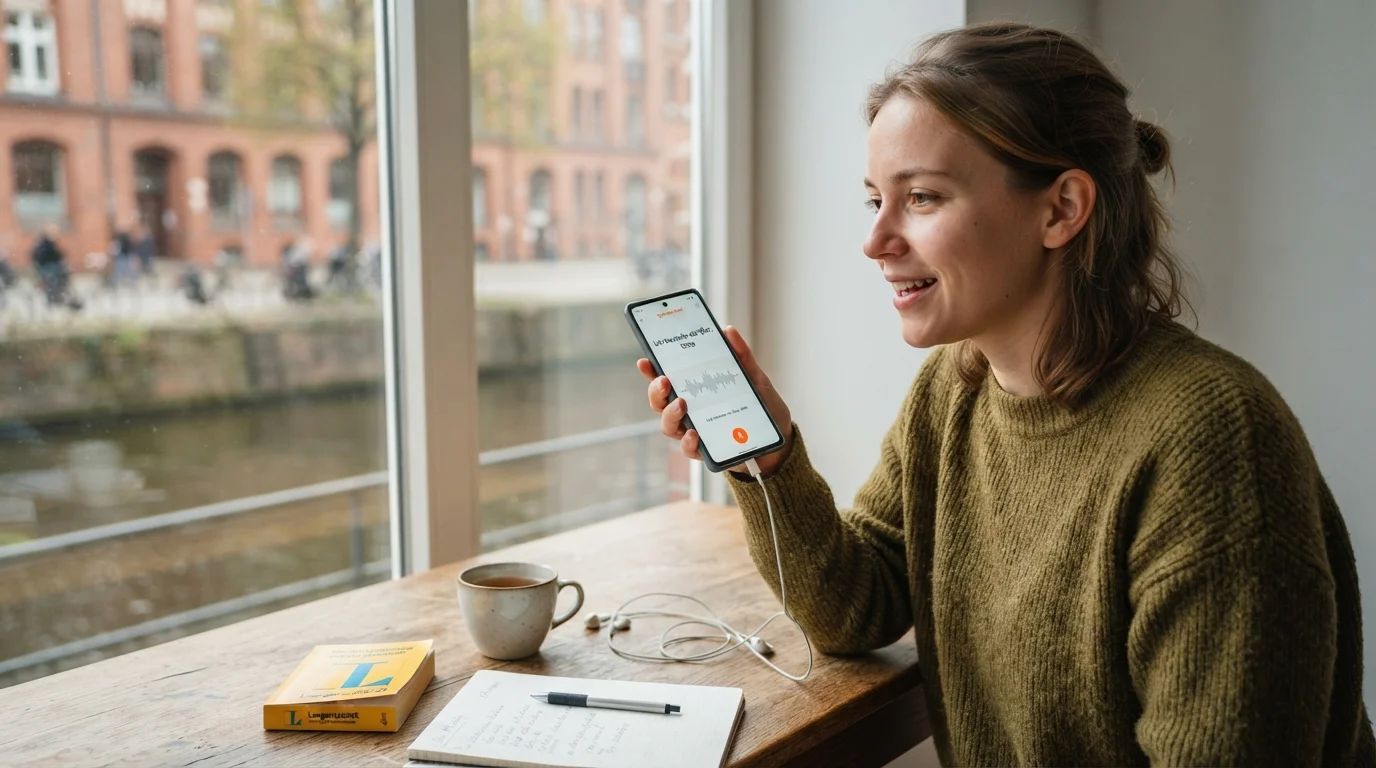
How to Practice German Pronunciation: Best App Features and Voice Recognition Tools
When you start learning German, the grammar often gets the lion's share of the attention. You wrestle with cases, memorize noun genders, and...
Read more
Learning German has a reputation for being notoriously tough. Between navigating three grammatical genders (der, die, das), deciphering four noun cases, and untangling sentences where the verb sits miles away at the end, beginners and expats often hit a wall within weeks. Fortunately, language learning technology has evolved dramatically over the last few years.
Today, learners no longer have to rely solely on rigid evening courses or repetitive flashcards. The app market in 2026 offers sophisticated, adaptive tools designed to fit diverse learning styles. But with dozens of platforms competing for your screen time, which one actually delivers fluency?
In this in-depth comparison, we analyze the three biggest contenders in the German language learning space: Bretzi, Duolingo, and Babbel. Whether you are an expat striving to handle the Bürgeramt on your own, a professional climbing the corporate ladder in Munich or Zurich, or an aspiring student aiming to pass an official certification according to the CEFR scale, this breakdown will help you pick the best tool for your journey.
To provide a fair and thorough assessment, we evaluated each platform across five fundamental pillars essential for mastering German:
Duolingo remains the most recognizable language app globally. Its colorful interface, friendly mascot Duo, and bite-sized lessons make it exceptionally accessible for complete novices dipping their toes into German for the first time.
While Duolingo excels at getting you started, its methodology struggles when learners attempt to reach intermediate communication. The curriculum heavily relies on rote translation of disconnected sentences (e.g., "The owl does not eat pizza") rather than functional communication.
Furthermore, German grammar is rarely explained in depth. Instead of explaining why an adjective ending changes in the dative case, Duolingo relies on pattern induction, which frequently leaves learners confused. If your goal is to handle real workplace discussions or prepare for residency exams, Duolingo alone is rarely sufficient. For a broader look at free options, explore our guide on the best free and paid German learning apps for expats.
Babbel represents the traditional language classroom re-engineered for mobile devices. Developed in Berlin by linguistic experts, its German curriculum is structured, logical, and deeply rooted in practical European language pedagogy.
Despite its pedagogical strength, Babbel can feel static. The exercise formats—fill-in-the-blanks, multiple choice, and dialogue listening—rarely require spontaneous language production. While it teaches you how German works mechanically, it provides limited spontaneous speaking practice to overcome the psychological barrier of actually talking to native speakers.
Bretzi is built from the ground up to solve the single greatest problem in German learning: bridging the gap between theoretical grammar exercises and confident, real-life conversational fluency. By leveraging interactive AI dialogue technology, Bretzi functions like a patient, private German tutor available in your pocket 24/7.
By blending personalized learning plans with immersive scenarios, Bretzi excels at mastering real-life German dialogues so you can step into any official appointment or social gathering with confidence.
Here is how the three platforms stack up across essential features for 2026:
You are a casual hobbyist who wants a free, game-like experience to learn a few dozen German words before a weekend vacation in Berlin. It is great for building initial curiosity, though not intended for professional proficiency.
You prefer a classical, textbook-style learning path with well-curated grammar tables and standardized linear lessons. It suits learners who enjoy reading through rule explanations and following a traditional study progression.
You are an expat, student, or professional who needs to actually speak German in real life. If you struggle with noun genders, feel nervous speaking German in public, or are actively comparing German B1 exam preparation apps, Bretzi offers a strong combination of AI conversation, pronunciation feedback, and practical grammar training.
No matter which platform you select, your study habits determine your long-term success. Here are four proven strategies to accelerate your German fluency:
While Duolingo makes language learning playful and Babbel provides solid grammatical blueprints, Bretzi bridges the final, crucial gap: conversational mastery and speaking confidence in authentic German environments.
Ready to experience the future of language learning? Download Bretzi today to get your personalized AI study plan, conquer German grammar, and start speaking fluent German with confidence.
Share this article:
When you start learning German, the grammar often gets the lion's share of the attention. You wrestle with cases, memorize noun genders, and...
Read moreAnyone who has attempted to learn German knows the infamous 'motivation cliff.' You start with immense enthusiasm, eager to master words like...
Read moreMoving to Germany, Austria, or Switzerland is an exciting milestone, but for many expats, the initial excitement quickly collides with linguistic...
Read more