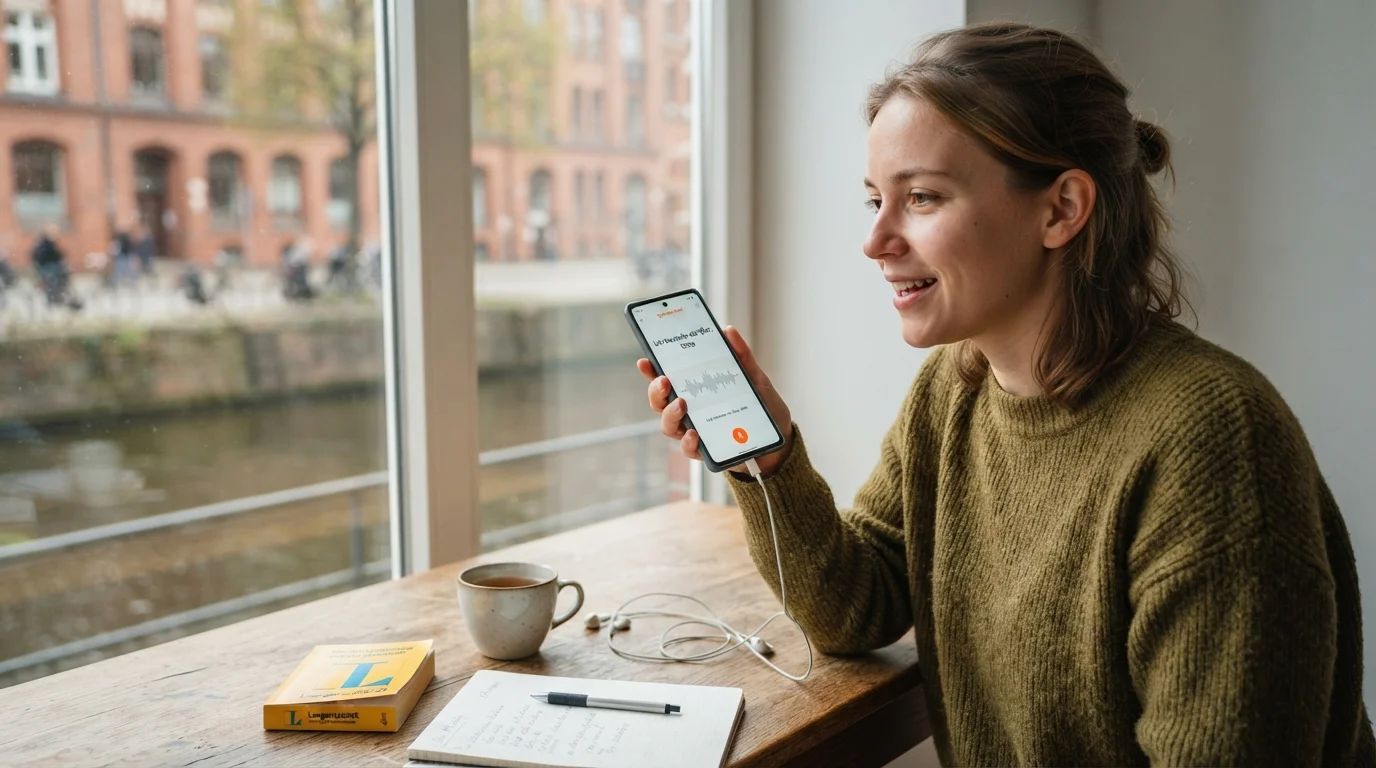
How to Practice German Pronunciation: Best App Features and Voice Recognition Tools
When you start learning German, the grammar often gets the lion's share of the attention. You wrestle with cases, memorize noun genders, and...
Read more
Moving to a German-speaking country is an exciting milestone filled with new opportunities, rich cultural experiences, and fresh beginnings. However, for many expats, the initial excitement is quickly met with a daunting reality: textbook German doesn't sound like the spoken language you encounter every day. You might spend months memorizing conjugation tables, only to freeze when trying to order a coffee at a local Bäckerei, open a bank account, or negotiate details with your Vermieter (landlord).
The gap between formal language education and real-life conversational German can feel overwhelming. Traditional classes often focus heavily on grammatical theory, leaving learners ill-equipped for spontaneous, fast-paced dialogue. To settle into life in Germany, Austria, or Switzerland, expats need a practical, speaking-focused approach that builds confidence in authentic scenarios.
In this comprehensive guide, we will explore why traditional methods fall short for expats, outline practical strategies to build conversational fluency, and examine how modern AI-powered tools like Bretzi are revolutionizing language learning for newcomers.
For decades, traditional language learning has relied on standardized textbooks, classroom lectures, and repetitive grammar exercises. While these methods provide a basic framework, they rarely mirror the reality of daily expat life. Here is why conventional approaches often struggle to deliver practical fluency:
When evaluating language apps for expat needs, it becomes clear that dynamic, adaptive learning models are far better suited for rapid real-world adaptation than static textbook courses.
One of the most persistent hurdles for expats is the psychological barrier known as language anxiety. Many native German speakers quickly switch to English at the first sign of hesitation, which can be frustrating for learners trying to practice. This creates a challenging cycle: learners hesitate because they fear making mistakes, native speakers switch to English to save time, and the learner loses valuable practice opportunities.
To break this cycle, expats must create a safe space to practice spoken German without fear of judgment. Developing phonetic confidence in a low-stakes environment allows you to speak more assertively in public. Focusing on mastering German pronunciation at home gives you the muscle memory and phonetic foundation needed to speak clearly when interacting with locals.
Achieving conversational confidence doesn't require living in a library or memorizing dictionary pages. By shifting your focus toward functional, scenario-based learning, you can fast-track your path to real-world communication. Here are five practical strategies every expat should implement:
Rather than learning isolated vocabulary words, memorize functional chunks of language. Phrases like "Ich hätte gerne..." (I would like...) or "Könnten Sie mir bitte helfen?" (Could you please help me?) can be adapted to dozens of daily situations. Combining daily phrase immersion with targeted flashcards by using spaced repetition for rapid vocabulary retention ensures that high-priority words move directly into your long-term memory.
Mental preparation reduces anxiety. Before going to the pharmacy, the supermarket, or the government office, rehearse the conversation beforehand. Anticipate what the other person might ask and outline your potential responses. Rehearsing these dialogue paths builds cognitive familiarity, making live interactions far less intimidating.
Consistency trumps intensity when acquiring a new language. Studying for 15 to 20 minutes every day creates tighter neural pathways than attending a single three-hour class once a week. Short, daily interactions keep the language fresh in your mind and help embed listening comprehension into your subconscious routine.
German grammar—with its four cases, three genders, and flexible word order—can cause analysis paralysis. In everyday situations, clear communication matters far more than perfect grammar. If you use the wrong article (e.g., saying *der Buch* instead of das Buch), native speakers will still understand your intent. Focus on conveying your meaning first; refine your grammar as your confidence grows.
Train your ear to natural speaking tempos by listening to German podcasts, radio stations, and TV shows. Even background exposure helps you internalize the natural cadence, rhythm, and intonation of the spoken language. Over time, words that once sounded like a continuous blur will separate into clear, recognizable phrases.
Modern technology offers innovative ways to bridge the gap between structured study and real-world execution. The Bretzi app was specifically engineered to solve the practical challenges faced by expats, providing a comprehensive ecosystem designed around real-world application rather than abstract theory.
Here is how Bretzi helps expats navigate daily life in Germany:
The core feature of the Bretzi platform is its real-life conversation practice powered by intelligent AI. Expats can engage in interactive, non-judgmental spoken dialogues that simulate everyday scenarios—such as ordering food, speaking with colleagues during Feierabend, or explaining symptoms to a doctor. Because the AI adapts to your responses, you experience realistic conversation practice in a low-pressure environment.
Bretzi transforms routine study into interactive dialogue games tailored for practical situations. Rather than working through generic exercises, you navigate real-life situations with immediate, actionable feedback. Integrated pronunciation training analyzes your speech cadence and phonetics on the spot, helping you refine your accent and be understood clearly by native speakers.
Every expat journey is unique. A professional working at a tech startup needs a different vocabulary set than a parent navigating the local school system. Bretzi builds AI-powered personalized learning plans that tailor lessons to your current proficiency level and goals—spanning structural grammar lessons from A0 all the way to C1 fluency.
Mastering German genders (der, die, das) is notoriously difficult for English speakers. Bretzi addresses this challenge with dedicated article mastery games and spaced-repetition vocabulary tools. Daily streaks and gamified progress metrics help maintain continuous motivation, turning long-term learning into an engaging daily routine.
Language does not exist in a vacuum; it is deeply intertwined with culture. Understanding social etiquette, regional nuances, and formal customs is essential for feeling truly at home in a new country. Official bodies like the Federal Office for Migration and Refugees (BAMF) emphasize that language proficiency and cultural knowledge are key pillars of successful integration.
Bretzi integrates cultural insights directly into its language lessons. You won't just learn what to say; you'll learn when and how to say it appropriately. Whether mastering formal register (Sie) versus informal conversation (du) or preparing for official integration and B1/B2 level language certification exams, contextual cultural learning helps you integrate smoothly into your local community.
Learning conversational German as an expat doesn't have to mean struggling through endless grammar tables or enduring nerve-wracking public encounters. By focusing on practical, high-frequency communication, breaking down speaking anxiety, and leveraging intelligent learning tools, you can build conversational confidence rapidly.
With features like AI-powered conversation practice, personalized study plans, instant pronunciation feedback, and practical scenario games, the Bretzi app provides everything you need to navigate daily life in German with clarity and poise. Start incorporating smart, daily practice into your routine today, and transform your expat experience into a truly connected journey.
Share this article:
When you start learning German, the grammar often gets the lion's share of the attention. You wrestle with cases, memorize noun genders, and...
Read moreAnyone who has attempted to learn German knows the infamous 'motivation cliff.' You start with immense enthusiasm, eager to master words like...
Read moreMoving to Germany, Austria, or Switzerland is an exciting milestone, but for many expats, the initial excitement quickly collides with linguistic...
Read more