Reaching the B1 threshold in German is often described as the great plateau. At A1 and A2, you can get by with basic vocabulary, simple subject-verb-object patterns, and memorized phrases. Once you hit B1, however, the linguistic landscape shifts dramatically. You must master subordinate clauses that send verbs tumbling to the end of the sentence, navigate passive voice constructions, untangle relative pronouns in three distinct cases, and express hypothetical scenarios using Konjunktiv II.
For independent learners, finding the right digital tool to conquer these intermediate grammar hurdles is critical. Two mobile-first contenders frequently recommended by intermediate learners in 2026 are Seedlang and Bretzi. While both move beyond the gamified trivialities of generic flashcard apps, they take distinctly different pedagogical paths to help you internalize German grammar rules.
In this comprehensive guide, we compare Seedlang and Bretzi across the specific grammar challenges of the B1 level to help you determine which tool best fits your study routine.
The B1 Grammar Hurdle: Why Intermediate German Requires a Dedicated Approach
According to the Common European Framework of Reference for Languages (CEFR), B1 learners are expected to understand the main points of clear standard input on familiar matters regularly encountered in work, school, and leisure. But understanding is only half the battle; producing clear, connected text and speech requires a structural leap.
Many learners who relied on casual language apps find that their foundation begins to crack at this stage. If you have explored whether Duolingo is enough for B1 German, you already know that implicit guessing games rarely provide the structural clarity needed for complex syntax.
At B1, you must actively control several demanding grammar concepts:
- Complex Word Order: Multi-clause sentences combining coordinating and subordinating conjunctions (e.g., obwohl, weil, trotzdem, deshalb).
- Two-Part Conjunctions: Structures such as nicht nur ... sondern auch and sowohl ... als auch.
- Passiv (Passive Voice): Both process passive (Vorgangspassiv) with werden and state passive (Zustandspassiv) with sein.
- Konjunktiv II: Expressing politeness, dreams, wishes, and hypothetical conditions using forms like hätte, wäre, and würde + infinitive.
- Relative Clauses (Relativsätze): Choosing the correct relative pronoun based on gender, number, and internal clause case.
- Adjective Endings: Applying weak, strong, and mixed declensions automatically in fast conversation.
Seedlang: The Video-First, Intuitive Approach
Developed in close collaboration with the creators of the popular Easy German YouTube project, Seedlang is built around real-world video clips of native speakers filmed across German streets. Its primary philosophy centers on immersive audiovisual drills.
Key Features of Seedlang
- Bite-Sized Video Prompts: Rather than reading robotic text, you watch real native speakers utter phrases, complete with regional cadences, everyday facial expressions, and natural speech rhythm.
- Interactive Story Tracks: Lessons often follow episodic narratives, making context crystal clear.
- Grammar Breakdowns: Grammatical gender and cases are frequently highlighted with intuitive color-coding schemes to help visualize sentence mechanics.
- Recording Drills: You are prompted to record your own voice against the native speaker clips to check rhythm and inflection.
Where Seedlang Excels for B1 Grammar
Seedlang shines at training your ear to absorb how grammar sounds in genuine spoken German. If you struggle with recognizing word order variations when native speakers talk at regular speed, Seedlang provides exceptional listening comprehension. It helps bridge the gap between sterile textbook rules and the colloquial shortcuts heard on the streets of Berlin, Munich, or Hamburg.
Where Seedlang Falls Short
While Seedlang offers grammar notes, its structure relies heavily on inductive learning—expecting you to absorb patterns through repetition. When dealing with difficult B1 topics like dative relative pronouns (denen, dem, der) or nuanced passive constructions, inductive learning can leave gaps. Learners who thrive on systematic rule explanations, explicit tables, and structured writing exercises may find the video-centric flashcard loop somewhat open-ended.
Bretzi: Systematic CEFR Progression and Real-Life Situations
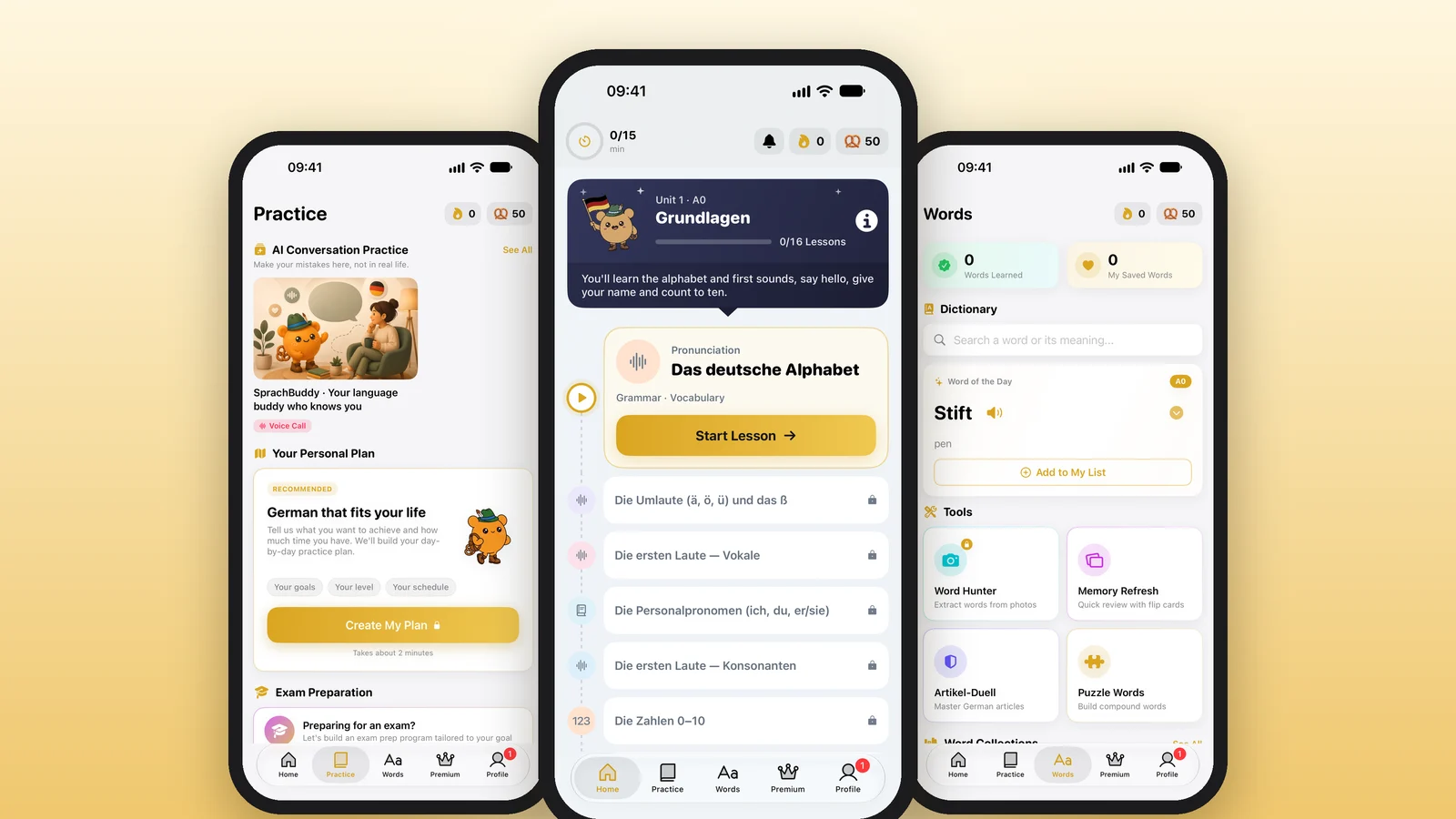
Bretzi approaches language acquisition through an organized, sequential curriculum designed specifically around life, work, and examinations in Germany. Spanning from complete beginner (A0) all the way to C1, its lessons follow the CEFR framework in strict order.
Key Features of Bretzi
- Sequential Lesson Paths: Every CEFR stage is structured as an ordered progression of concise lessons. Learners complete diverse interactive exercises: choosing and typing answers, rearranging words into correct syntax, filling gaps, dictation, spotting grammatical errors, and speaking out loud.
- Integrated Grammar Support: Rather than hiding rules behind ambiguous prompts, Bretzi embeds grammar tips, illustrative examples, and clear conjugation tables directly into the lessons. Crucially, after every single answer, the app displays an explanation clarifying why that choice is right or wrong.
- Spaced Repetition & Words Review: Vocabulary and past mistakes automatically cycle back into short review sessions, timed to reappear just as memory traces begin to fade. The Words tab features a built-in dictionary, word puzzles, flashcards, and a dedicated game for learning noun genders and articles.
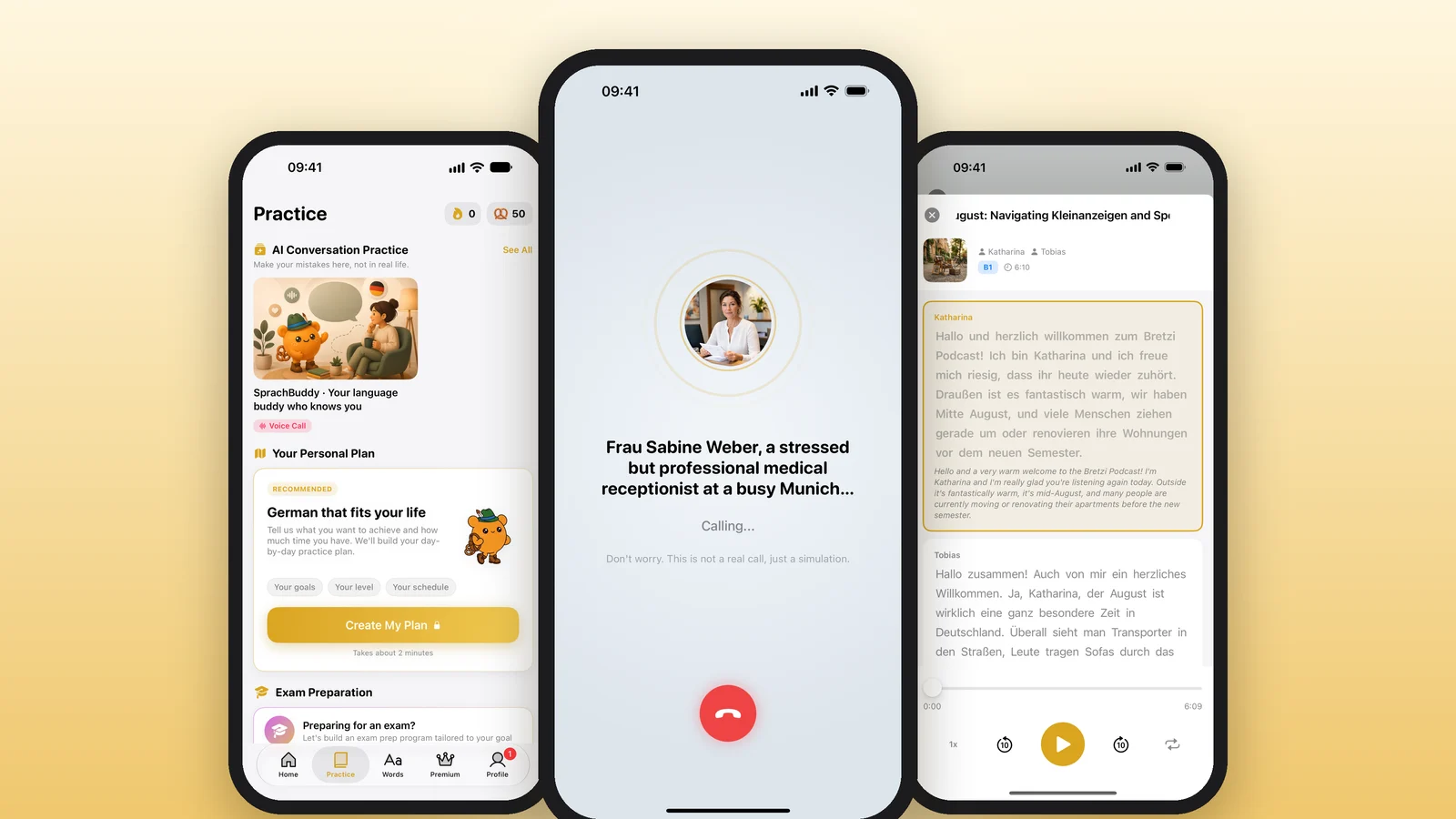
- SprachBuddy (AI Conversation Partner): With Bretzi Premium, learners can place voice calls to SprachBuddy, an AI software conversation partner (clearly identified as software before you begin). This tool lets you hold real-time spoken conversations about everyday German life or practice specific scenarios, such as visiting a doctor or interviewing for a job, followed by full written transcripts and pronunciation scoring.
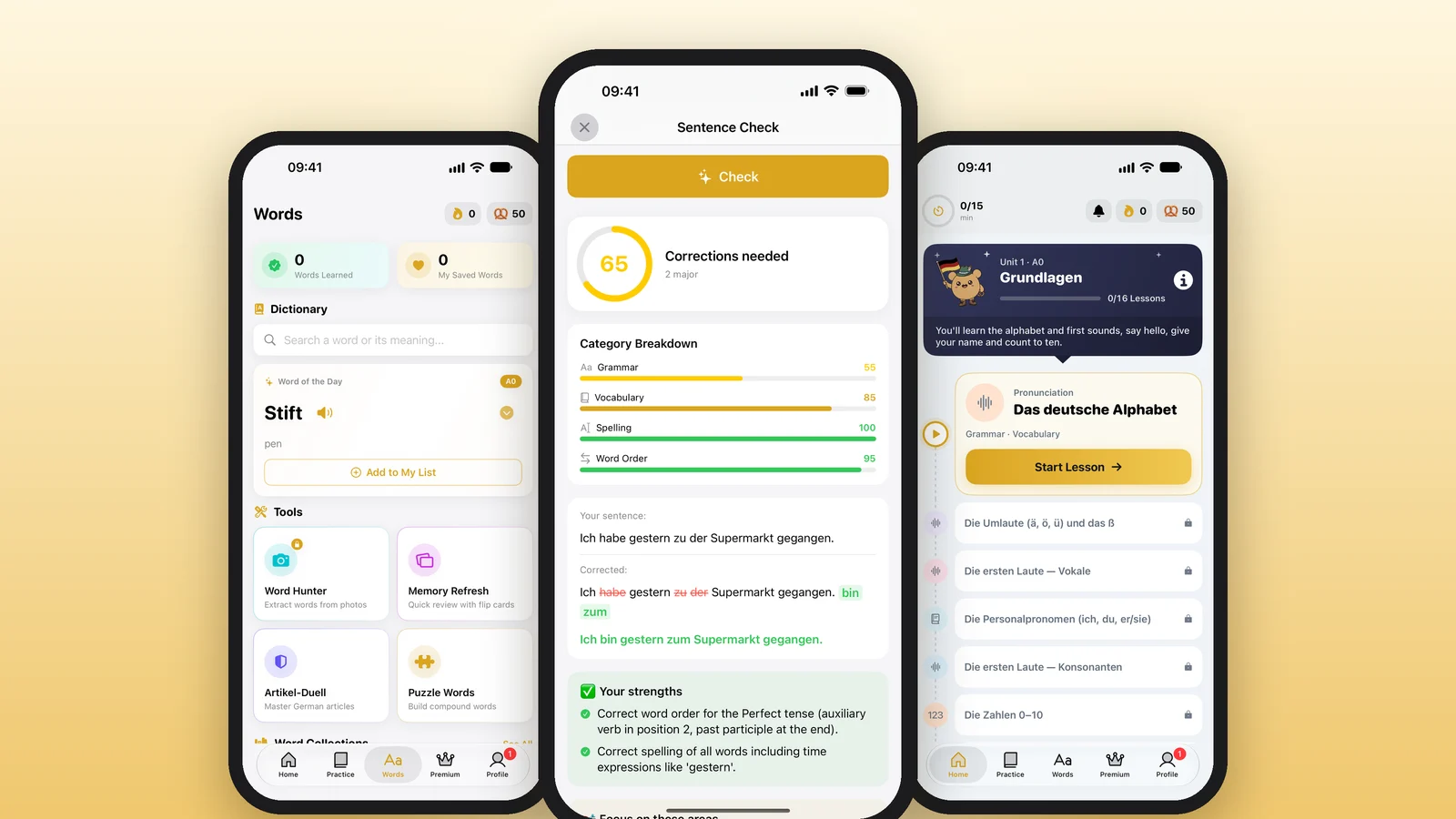
- Targeted Sentence Correction: With Bretzi Premium, the Sentence Check tool corrects custom sentences you write and provides detailed explanations of grammatical errors.
If you are exploring the broader landscape of language tools, our guide comparing top German learning apps provides a helpful birds-eye perspective on how structured paths differ from open sandboxes.
Direct Comparison: Tackling Core B1 Grammar Challenges
To understand how each app functions in day-to-day study, let us examine how Bretzi and Seedlang handle the most notorious B1 grammar bottlenecks.
1. Subordinate Clauses and Word Order (Nebensätze)
In B1 German, you must master the rule that subordinate conjunctions (such as dass, weil, ob, wenn, and obwohl) kick the conjugated verb to the very end of the clause. When auxiliary or modal verbs are involved, sentence endings become complex puzzles.
- Seedlang's Approach: You observe native speakers forming these sentences in short video clips. Word order tiles allow you to rearrange the sentence structure to match the audio. This helps develop an intuitive feel for word cadence, though it can take many exposures to cement subtle modal verb order rules.
- Bretzi's Approach: Bretzi uses targeted word-ordering tasks, gap-fills, and typing drills paired with immediate feedback. Because Bretzi explains why an answer is correct or incorrect after every attempt, you quickly identify why an auxiliary verb belongs at the final position. Furthermore, each unit ends with an everyday dialogue demonstrating these clauses in practical situations.
2. Konjunktiv II (Hypotheticals and Polite Requests)
At B1, you are expected to express polite requests ("Könnten Sie mir bitte helfen?"), wishes ("Ich wünschte, ich hätte mehr Zeit"), and hypothetical conditions ("Wenn ich reich wäre, würde ich...").
- Seedlang's Approach: Focuses heavily on the practical everyday usage of würde + infinitive and common irregular forms like wäre and hätte through dialogue sketches. It excels at showing how native speakers sound polite without being overly formal.
- Bretzi's Approach: Integrates conjugation tables directly into the lesson path so you can see the structural relationship between past tense forms and their umlauted Konjunktiv II counterparts. Through typing exercises and dictation, you internalize both formal written variants and everyday conversational forms. For active usage, you can initiate a voice chat with SprachBuddy to practice asking polite questions in realistic roleplay settings.
3. Passive Voice (Vorgangspassiv & Zustandspassiv)
The passive voice is vital for official paperwork, workplace correspondence, and news in Germany (e.g., "Der Antrag wurde abgelehnt" or "Das Gesetz wird geändert").
- Seedlang's Approach: Passive constructions are introduced inside conversational contexts, but video snippets can sometimes make passive voice feel less prominent, as everyday spoken German often prefers active constructions or indefinite pronouns like man.
- Bretzi's Approach: Because Bretzi's curriculum is deliberately aligned with practical life, work, and integration in Germany, passive voice receives direct, systematic attention. Learners practice transforming active statements into passive structures across various tenses, reinforced by error-spotting exercises that highlight common confusion between werden (future/passive) and worden (past passive).
Active Application: Writing, Speaking, and Exam Readiness
Mastering grammar rules on paper is only half the journey; you must be able to deploy them under time constraints, whether handling official administrative tasks or sitting for an exam. This transition is vital for mastering conversational German for daily expat life.
Writing Practice
Seedlang primarily focuses on sentence assembly through card taps and short phrase typing. Bretzi, however, offers dedicated typing and dictation exercises across its lesson path. For learners who want to write original paragraphs, Bretzi Premium includes Sentence Check, which inspects the sentences you type, corrects syntax mistakes, and provides explanations for each correction.
Speaking and Pronunciation
Seedlang allows you to compare your voice recording with native video clips, which is valuable for mimicking inflection and natural pacing. Bretzi approaches spoken grammar via two features in its Premium tier: pronunciation scoring that assesses a spoken word or sentence and points out areas for improvement, and live AI voice calls with SprachBuddy. You can speak freely about real-world scenarios (such as an appointment at the Bürgeramt or a job interview) and read through the entire written transcript afterward to review how your spoken grammar held up.
Integration and Exam Practice
If your B1 milestone is tied to formal residency or citizenship in Germany, exam preparation is a primary concern:
- Seedlang does not feature dedicated exam preparation modules for standardized German tests.
- Bretzi Premium includes specific practice for the Einbürgerungstest at B1, covering reading, writing, listening, speaking, and questions on life in Germany (Leben in Deutschland). For academic paths, it also offers section-by-section timed practice for the TestDaF (B2 and C1). Bretzi's AI evaluates your writing and speaking submissions during these timed sections and generates a readiness score for each component.
Side-by-Side Overview: Bretzi vs Seedlang
- Core Methodology: Seedlang uses authentic native speaker videos and inductive drills; Bretzi uses a structured CEFR-aligned lesson path with explicit grammar rules, interactive exercises, and contextual everyday dialogues.
- Grammar Explanations: Seedlang uses color-coded grammar hints and short notes; Bretzi provides immediate post-answer explanations, embedded grammar tips, and full conjugation tables.
- Target Dialect: Seedlang features various speakers from across Germany; Bretzi focuses exclusively on the German of Germany.
- Speaking Practice: Seedlang uses audio comparisons with native clips; Bretzi features real-time voice conversations via SprachBuddy (AI software) and pronunciation scoring.
- Platforms: Seedlang is available on iOS, Android, and web browsers; Bretzi is available on iPhone/iPad (iOS 18+), Android (8.0+), and Apple Watch for quick word practice (requires an internet connection; no web or desktop version).
Which App Should You Choose in 2026?
Both applications represent modern approaches to language study, but they serve different learner priorities.
Choose Seedlang if:
- You are an auditory or visual learner who absorbs syntax most effectively by watching real human faces and hearing conversational speech rhythms.
- You prefer studying across devices, including a desktop web browser.
- You already understand the underlying grammar rules from a classroom course and want engaging listening drills to reinforce natural conversational patterns.
Choose Bretzi if:
- You want a clear, step-by-step path from A0 through C1 that never leaves you guessing why an answer is right or wrong.
- You value clear grammar tables, immediate explanations for every mistake, and structured writing exercises.
- You are living in or moving to Germany and want your vocabulary, dialogues, and review routines focused directly on daily life, administrative situations, and work environments.
- You want interactive voice practice via an AI partner (SprachBuddy) to test your spoken grammar in realistic roleplay scenarios, alongside tools like Sentence Check and timed B1 Einbürgerungstest practice.
Summary: Building a Resilient B1 Grammar Foundation
Conquering intermediate German grammar requires a balance between input and active output. While video-based immersion like Seedlang offers a window into everyday street German, systematic command of B1 syntax—from subordinate clause word order to passive voice—demands structured practice, immediate error feedback, and active sentence construction.
By pairing consistent daily practice with tools that explicitly unpack grammar rules and provide meaningful conversational application, you can turn complex German grammar from a frustrating obstacle into an intuitive, reliable toolkit for everyday life in Germany.