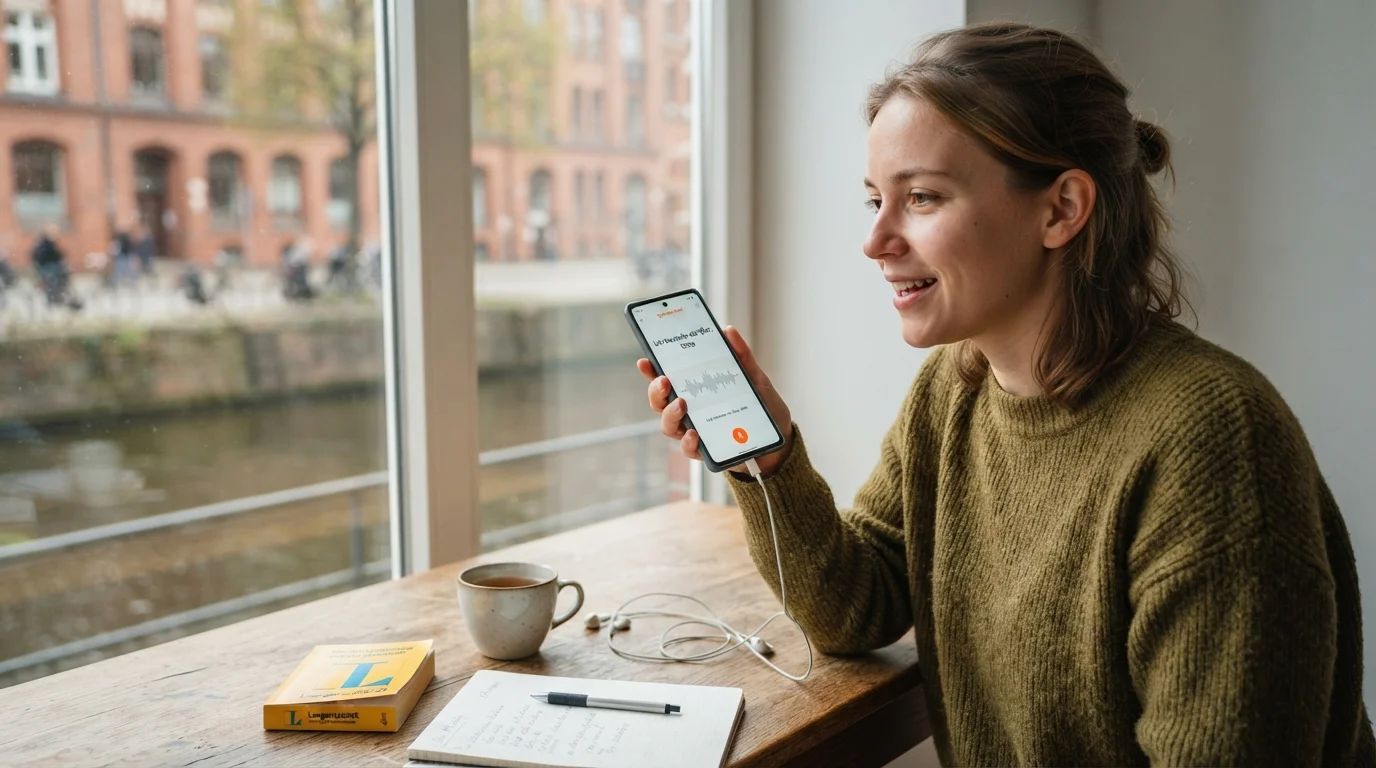
How to Practice German Pronunciation: Best App Features and Voice Recognition Tools
When you start learning German, the grammar often gets the lion's share of the attention. You wrestle with cases, memorize noun genders, and...
Read more
You have maintained a 300-day streak, collected thousands of XP, and you can reliably translate "Der Bär trinkt Bier" into English in under two seconds. But when you step into a Bürgeramt in Berlin, open an official letter from the tax office, or attempt to explain a plumbing issue to your landlord, words completely fail you.
If this sounds familiar, you are not alone. Thousands of language learners ask the same question every single day: Is Duolingo enough for B1 German?
The short answer is no. While gamified green-owl exercises provide a low-friction entry point for absolute beginners, reaching the B1 intermediate threshold requires conversational flexibility, grammatical accuracy, and functional fluency that casual tapping games simply cannot deliver. In this comprehensive guide, we will break down what the B1 level actually demands, examine where traditional apps fall short, and explore how specialized, AI-driven tools can bridge the gap.
To understand why casual mobile apps struggle to prepare you for intermediate German, it helps to examine what the Common European Framework of Reference for Languages (CEFR) actually requires for B1 proficiency.
According to the CEFR guidelines, an independent user at the B1 level can:
Furthermore, if you live in Germany, Austria, or Switzerland, B1 is the gold standard benchmark required for permanent residency (Niederlassungserlaubnis) and naturalization (Einbürgerung). Achieving this level is not about memorizing isolated vocabulary; it is about spontaneous production and practical real-world comprehension.
Gamified apps are undeniably popular, but when comparing options in our guide on the best German learning apps compared, clear systemic limitations emerge once you move beyond the absolute basics (A1/A2).
Most popular apps rely heavily on multiple-choice questions, word banks, and matching tiles. These formats test passive recognition rather than active production. Choosing the correct word from a list of four options uses a completely different neurological pathway than formulating a sentence from scratch in the middle of a spontaneous conversation.
German is famous—or perhaps notorious—for its precise grammatical architecture. To pass a B1 exam like the Goethe-Zertifikat B1 or the Deutsch-Test für Zuwanderer (DTZ), you must confidently handle:
Implicit learning through repetition works well for vocabulary, but German grammar often demands explicit rules, structured breakdowns, and targeted application.
Repeating recorded audio clips into your phone microphone does not build conversational confidence. Real dialogue requires listening to unfamiliar accents, thinking on your feet, structuring your thoughts under time pressure, and self-correcting mistakes in real time.
To reach genuine intermediate fluency, learners require modern solutions that replicate real immersion while providing structured guidance. This is where modern language platforms change the game.
Instead of rigid, predetermined multiple-choice paths, dedicated platforms like Bretzi combine structured curriculum with interactive intelligence. For instance, learners preparing for official certifications often use dedicated workflows—as detailed in our guide on how to use AI-powered language apps to pass your DTZ exam—to simulate actual speaking modules before exam day.
Here is what specialized training delivers that basic gamified platforms lack:
If your goal is to pass an official B1 test or comfortably handle daily life in Germany, relying exclusively on one casual app will waste valuable months. Here is a balanced, multi-faceted study framework you can implement immediately:
Dedicate regular sessions to systematic grammar study. Focus on mastering verb placement in subordinate clauses, two-way prepositions (Wechselpräpositionen), and modal particles. Ensure you are practicing written production, writing full sentences by hand or typing them out without automatic spellcheck assistance.
Speaking must become a daily habit, not an afterthought. Use Bretzi's AI conversation modules to simulate daily scenarios, practice debating current events, and receive immediate corrections on word order and gender agreements. Supplement this with local language exchanges (Sprachtandem) whenever possible.
Immerse yourself in authentic German content calibrated to an intermediate level:
Focus on thematic vocabulary clusters: workplace discussions, housing issues, banking, healthcare, and environmental topics. Always learn German nouns with their respective definite articles (der, die, das) and plural forms to avoid stumbling over case declensions later.
Duolingo is a fun way to spark an initial interest in German or maintain a low-effort daily habit. However, if your goal is true conversational independence, career advancement, or passing a certified B1 exam, you must upgrade your toolkit.
By pairing focused grammar study with specialized tools like Bretzi—which offers real-time conversational AI, structured A0-C1 grammar paths, and interactive dialogue games—you can bridge the gap between casual tapping and true German fluency.
Share this article:
When you start learning German, the grammar often gets the lion's share of the attention. You wrestle with cases, memorize noun genders, and...
Read moreAnyone who has attempted to learn German knows the infamous 'motivation cliff.' You start with immense enthusiasm, eager to master words like...
Read moreMoving to Germany, Austria, or Switzerland is an exciting milestone, but for many expats, the initial excitement quickly collides with linguistic...
Read more