How to Practice German Pronunciation: Best App Features and Voice Recognition Tools
When you start learning German, the grammar often gets the lion's share of the attention. You wrestle with cases, memorize noun genders, and...
Read more
We have all seen the bold advertisements: "Learn a new language in just 15 minutes a day!" It sounds incredibly tempting, especially for busy expats, working professionals, and those juggling family life while trying to settle into Germany. But when faced with compound words like Rindfleischetikettierungsüberwachungsaufgabenübertragungsgesetz or the complexities of German cases (Nominativ, Akkusativ, Dativ, and Genitiv), it is easy to feel skeptical. Can you really make meaningful progress in German with such a minimal time investment?
The short answer is yes, but only if you use those 15 minutes strategically. Simply scrolling passively through flashcards while watching TV won't get you far. However, if you leverage cognitive science, high-yield learning techniques, and modern AI tools, 15 minutes of highly focused, daily microlearning can yield results that rival hours of sporadic, traditional classroom study.
In this comprehensive review, we will dissect the science behind microlearning, explore what you can realistically achieve in a quarter of an hour daily, and evaluate how the Bretzi app acts as a force multiplier to make every single minute of your German study count.
To understand why short daily sessions are so effective, we have to look at how the human brain processes and retains new information. Language acquisition is not about cramming; it is about building neural pathways through consistent exposure and retrieval practice.
In the late 19th century, psychologist Hermann Ebbinghaus discovered the "Forgetting Curve," which demonstrates how rapidly our brains discard newly acquired information if no attempt is made to retain it. If you attend a three-hour German class on Saturday, you will likely forget up to 80% of what you learned by Tuesday unless you review it.
Microlearning solves this by utilizing the Spaced Repetition System (SRS). By reviewing vocabulary and grammar rules at scientifically calculated intervals—just as you are about to forget them—you push the information deeper into your long-term memory. A 15-minute daily routine is the perfect cadence for this continuous, high-efficiency review loop.
Your brain has a limited capacity for working memory. When you try to study German grammar for two hours straight after a long day at work, your brain hits a point of cognitive overload. Information stops sticking, frustration sets in, and you are more likely to burn out. Keeping your sessions to a crisp, high-intensity 15 minutes keeps your focus sharp, your motivation high, and your cognitive load manageable.
The hardest part of learning German isn't the grammar; it's the consistency. Finding a free two-hour block in your weekly schedule is difficult, but finding 15 minutes is incredibly easy. You can study during your morning commute, while waiting for your coffee to brew, or right before bed. By linking your German study to an existing daily habit (a concept known as "habit stacking"), you build a streak that becomes automatic over time.
Let's set realistic expectations. You will not become a C2-level literary critic or a master of complex legal German by spending only 15 minutes a day for a few months. However, you can make extraordinary progress across the standard Common European Framework of Reference for Languages (CEFR) scale if you maintain consistency.
If you are an expat living in Germany, consistency is key, especially when preparing for German integration exams with Bretzi. The integration exam requires not just linguistic competence, but also a solid grasp of German history, society, and laws—knowledge that is best absorbed in daily, bite-sized pieces rather than rushed cramming sessions.
To get the absolute most out of your 15-minute daily German block, you must avoid passive learning. Reading a grammar book or listening to a podcast in the background does not count toward your active 15 minutes. Instead, your routine should be highly interactive, balanced, and dynamic. Here is a highly effective weekly blueprint you can follow:
Spend these days acquiring new vocabulary and understanding structural patterns. Focus on high-frequency nouns, verbs, and adjectives. Do not just memorize words in isolation; learn them within the context of full sentences. This is where comparing different tool philosophies becomes useful. For instance, when looking at vocabulary acquisition efficiency, you might wonder how it stacks up against other tools. Our deep dive comparing Bretzi vs Memrise for German vocabulary highlights how targeted, contextual learning beats simple flashcard drills when you are on a tight daily schedule.
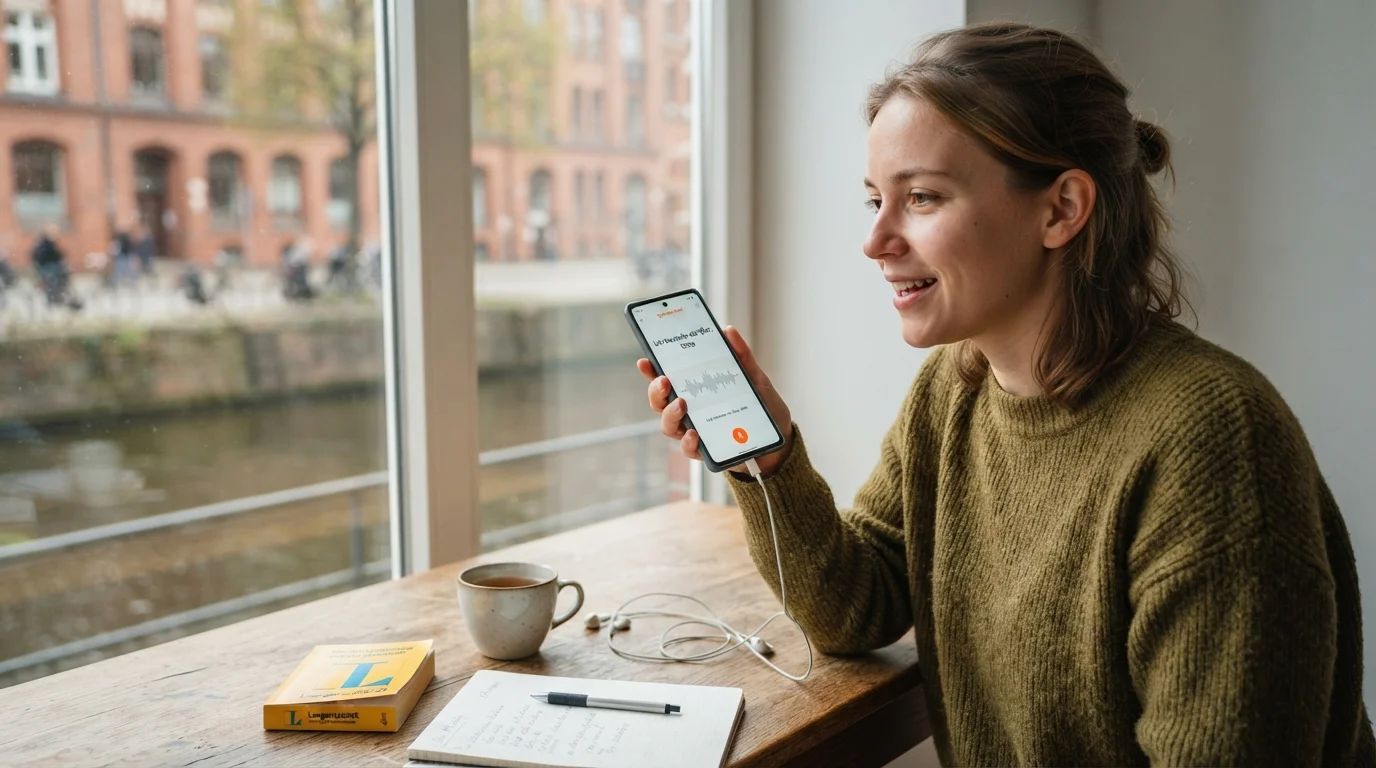
German pronunciation can be tricky, particularly with the ch-sounds, umlauts (ä, ö, ü), and the glottal stop (Knacklaut). Spend your Wednesday session speaking out loud. Repeat sentences, record your voice, and get immediate feedback on your pronunciation to build muscle memory in your jaw and tongue.
Simulate real-world scenarios. Practice ordering a coffee, booking a doctor's appointment (Arzttermin), or talking to a landlord. Roleplaying these scenarios builds the cognitive agility needed to recall German words under pressure during real-life encounters.
End your week by reviewing everything you have learned. Play quick, interactive games that test your recall of German articles (der, die, das) and sentence structure. This keeps your learning fun, rewarding, and deeply ingrained.
The biggest challenge of the 15-minute method is organization. If you spend 5 of your 15 minutes deciding what to study, finding your physical notebook, or looking up grammar tables, you have wasted a third of your session. This is where Bretzi, an AI-powered German language learning app, becomes an absolute game-changer.
Bretzi is built specifically to optimize every second of your study time. It eliminates the friction of planning, providing a streamlined, hyper-personalized learning experience that adapts to your unique pace and goals.
To ensure your daily microlearning sessions deliver maximum cognitive return on investment (ROI), implement these five actionable strategies:
Treat your 15 minutes as sacred. Put your phone on "Do Not Disturb" mode (unless you are using the Bretzi app), close your email tabs, and find a quiet space. Fifteen minutes of deep, uninterrupted focus is worth more than an hour of distracted, fragmented study.
Never study in silence. Even if you are just reviewing vocabulary on your phone, whisper or speak the words and sentences out loud. This activates your vocal cords, builds pronunciation muscle memory, and strengthens the neural connections associated with speech production.
Do not waste time memorizing obscure words you will rarely use. Focus on the Pareto Principle (the 80/20 rule): 80% of daily German communication uses only 20% of the vocabulary and grammar structures. Master modal verbs (können, müssen, wollen), basic present and perfect tenses, and everyday conversational phrases first.
Many learners fail to progress because they are terrified of making grammatical errors, especially with German cases or adjective endings. Remember that communication always trumps perfection. Germans will easily understand you if you say "Ich trinke ein kalte Bier" instead of "Ich trinke ein kaltes Bier." Use your daily sessions to build confidence first, and let the AI-powered corrections fine-tune your grammar over time.
While your 15-minute session is your dedicated *active* study time, you can supercharge your progress by layering passive German exposure throughout the rest of your day. Switch your phone's operating system language to German, listen to German music or podcasts during your workout, or watch Netflix with German subtitles turned on. This keeps your brain primed for the language without requiring extra cognitive effort.
Can you learn German in 15 minutes a day? Absolutely. While you won't become a master orator overnight, a highly focused, daily 15-minute microlearning routine is infinitely more effective than studying for two hours once a week. Consistency is the ultimate superpower when it comes to language acquisition.
By leveraging the power of cognitive science, habit stacking, and cutting-edge technology, you can turn those spare 15 minutes of your day into a fast-track ticket to German fluency. With its AI-driven personalization, real-life conversation simulations, and engaging gamification, the Bretzi app is the perfect companion to help you stay consistent, motivated, and continuously progressing on your German language journey.
Ready to turn your spare moments into fluent German conversations? Download Bretzi today, set your daily 15-minute goal, and watch your language skills transform week after week. Viel Erfolg!
Share this article:
When you start learning German, the grammar often gets the lion's share of the attention. You wrestle with cases, memorize noun genders, and...
Read moreAnyone who has attempted to learn German knows the infamous 'motivation cliff.' You start with immense enthusiasm, eager to master words like...
Read moreMoving to Germany, Austria, or Switzerland is an exciting milestone, but for many expats, the initial excitement quickly collides with linguistic...
Read more