How to Practice German Pronunciation: Best App Features and Voice Recognition Tools
When you start learning German, the grammar often gets the lion's share of the attention. You wrestle with cases, memorize noun genders, and...
Read more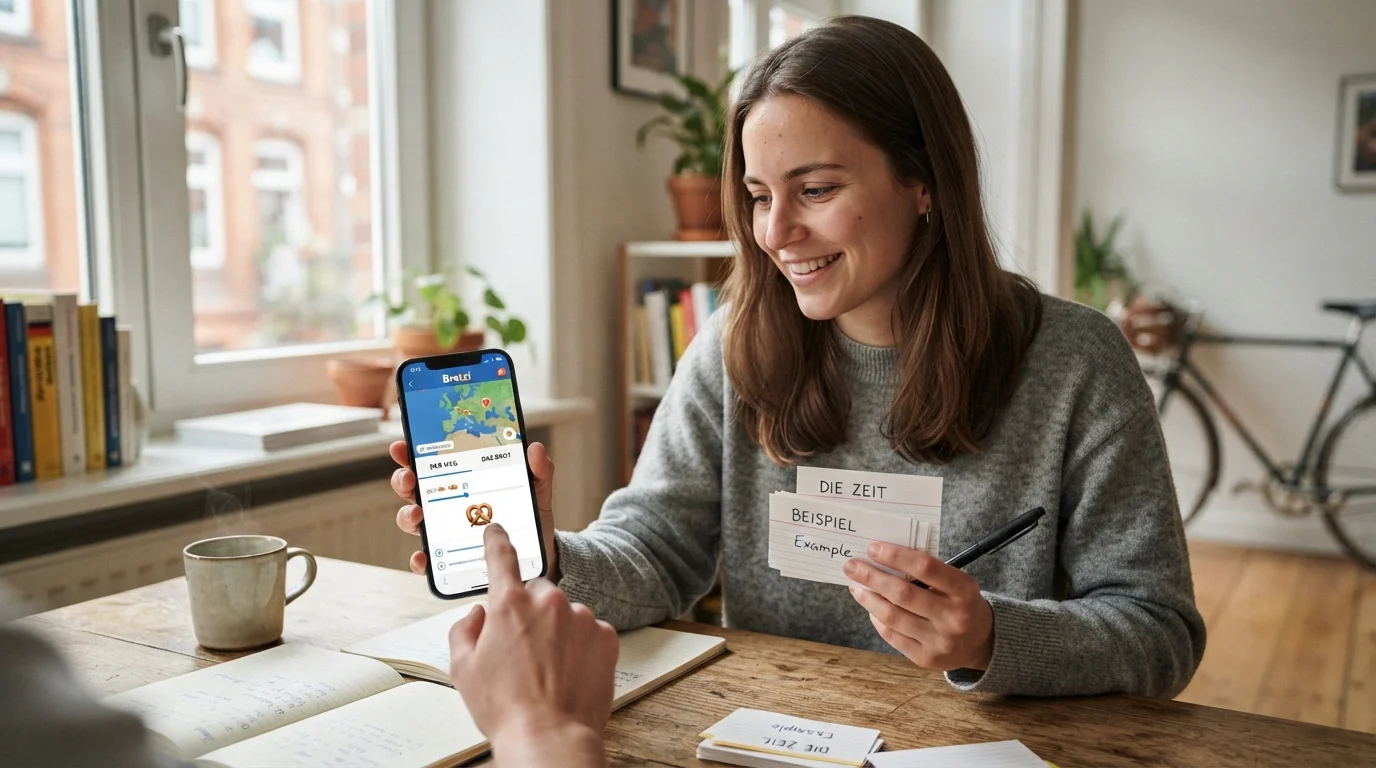
You sit on the U-Bahn with your phone in hand, diligently tapping through hundreds of digital flashcards. Der Hund, das Haus, die Katze. You have a 100-day streak, you can translate isolated nouns in a split second, and you feel like a vocabulary master. But then you walk into a local Berlin Bäckerei, the baker asks you a rapid-fire question about what kind of roll you want, and your mind goes entirely blank. Sound familiar?
For decades, traditional flashcard apps have been the go-to tool for German learners. While flashcards are excellent for memorizing individual words, they create a major illusion of competence. Flipping digital cards rarely translates into actual spoken fluency, fluid conversation, or real-life confidence. In this guide, we will break down why static flashcard apps fail to turn language learners into fluent German speakers—and why modern, AI-driven platforms like Bretzi offer a vastly superior pathway to real-world language mastery.
Traditional flashcards operate on a simple principle: prompt and response. You see a German word on one side, and you try to remember its English translation on the other side. Many popular apps enhance this using algorithms based on spaced repetition, which optimizes when you review a word right before you are about to forget it. While this mechanism is scientifically proven for raw data retention, learning a dynamic human language like German requires much more than memorizing static word pairs.
Here is why relying solely on traditional flashcards creates a wall for German learners:
To move past simple word recall, learners need to explore effective spaced repetition techniques that embed vocabulary directly into actionable grammar and real-world conversation.
Language acquisition theory, pioneered by linguists like Merrill Swain (Output Hypothesis), emphasizes that second language acquisition occurs most effectively when learners are pushed to produce spoken or written language. Recognizing a word on a screen (input) uses a totally different cognitive pathway than constructing a grammatically correct sentence during a real-life conversation (output).
When preparing for official language benchmarks recognized by the Goethe-Institut or preparing for German integration exams, examiners do not just test your vocabulary size. They evaluate your communicative competence: your ability to handle unpredictable dialogue, apply correct word order (like sending conjugated verbs to the end of subordinate clauses with weil or dass), and pronounce words clearly enough to be understood.
This is where standard flashcards completely fall short. They provide input without requiring contextual output. You spend hours reviewing words, yet you remain frozen when asked to hold a simple conversation with a landlord, employer, or government official.
Bretzi was built specifically to solve the limitations of traditional flashcard apps. Instead of treating German as a static list of words to be memorized, Bretzi treats language as an active, living skill. By combining advanced AI technology with proven pedagogical frameworks, Bretzi bridges the gap between learning vocabulary and actually speaking German confidently.
Unlike standard flashcard apps that throw massive pre-made decks at every user, Bretzi creates an AI-powered personalized learning plan tailored to your specific goals, current level (from absolute beginner A0 up to fluent C1), and learning speed. Whether you are an expat navigating official paperwork, a professional aiming to excel in corporate environments, or a student preparing for an upcoming language certification, your curriculum adapts dynamically to focus on what you actually need.
Instead of just flipping a card to reveal a word, Bretzi puts you into simulated real-life German conversations. You can interact with an intelligent AI partner that responds naturally to your spoken or typed input. If you make a grammatical error or select an incorrect article, Bretzi gives you instant, non-judgmental feedback. This real-time interaction helps you build muscle memory for sentence structure and builds the psychological confidence needed to speak in public without fear.
Pronouncing German correctly—with its unique vowel umlauts (ä, ö, ü), sharp consonants, and subtle rhythms—is something static flashcards simply cannot teach. Bretzi incorporates specialized pronunciation training that listens to your voice and offers detailed, immediate feedback on your speech patterns. If you are struggling with tricky phonetic sounds, you can practice mastering German pronunciation at home before trying it out in daily life.
Bretzi does not ignore the undeniable benefits of spaced repetition—it enhances them. Rather than relying on boring flashcard decks, Bretzi uses interactive dialogue games and dedicated article mastery games. You retain vocabulary faster because every word is connected to an article, an audio sample, a visual cue, and a full example sentence. Gamification features, including daily streaks and reward milestones, ensure that learning remains engaging and addicting.
When evaluating tools for your language learning toolkit, comparing top German language apps based on practical outcomes is essential. Here is how static flashcard software stacks up directly against Bretzi's multi-dimensional approach:
If you have spent months relying heavily on standard flashcards and feel stuck on a learning plateau, do not worry—your effort has not been wasted. You already possess a strong foundation of passive vocabulary. Now, you simply need to convert that passive knowledge into active communicative skill. Here are four actionable strategies to upgrade your learning routine:
Never memorize a noun by itself. Instead of learning "Termin" (appointment), learn "einen Termin vereinbaren" (to schedule an appointment). When learning German, always pair the noun with its correct article (der, die, das) and a common verb. Bretzi enforces this contextual approach automatically throughout all vocabulary modules.
Force yourself to produce spoken German every single day, even if it is only for five minutes. Describe what you are making for breakfast out loud, speak to your pet in German, or utilize Bretzi's interactive dialogue games to engage in low-stakes conversational practice. The key is reducing the cognitive delay between thinking of a word and physically pronouncing it.
When reviewing new phrases, test your ability to construct the entire German sentence from an idea rather than translating German words back into English. If you use Bretzi's real-life conversation practice, the AI prompts you with natural scenarios where you must actively formulate appropriate responses on the fly.4. Combine Grammar Lessons with Immediate Application
Studying grammar rules in abstract isolation can be overwhelming. When you learn a new grammatical rule—such as using two-way prepositions (Wechselpräpositionen)—apply it immediately in a spoken or written scenario. Bretzi integrates comprehensive A0–C1 grammar explanations directly alongside practical exercises so you immediately embody every concept you learn.
Flashcard apps certainly have a place in early memorization, but they are only a tiny piece of the language learning puzzle. If your goal is to truly integrate into life in Germany, pass your B1/B2 exams, communicate effortlessly with colleagues, or simply feel confident ordering food without stress, you need a dynamic solution that goes beyond digital flashcards.
By integrating personalized AI learning plans, dynamic spaced repetition, article mastery games, and real-time conversation practice with pronunciation feedback, Bretzi offers a comprehensive platform designed for real-world German fluency. Stop flipping static cards and start speaking real German today!
Share this article:
When you start learning German, the grammar often gets the lion's share of the attention. You wrestle with cases, memorize noun genders, and...
Read moreAnyone who has attempted to learn German knows the infamous 'motivation cliff.' You start with immense enthusiasm, eager to master words like...
Read moreMoving to Germany, Austria, or Switzerland is an exciting milestone, but for many expats, the initial excitement quickly collides with linguistic...
Read more