How to Pass DTZ B1 Listening: Hörverstehen Tips
Why the DTZ B1 listening section feels difficult You can understand German in a quiet classroom and still feel lost when a recording begins. In the...
Read more
This article was written by AI and published by Bretzi.
AI can get things wrong. For anything official, check the source it points to.
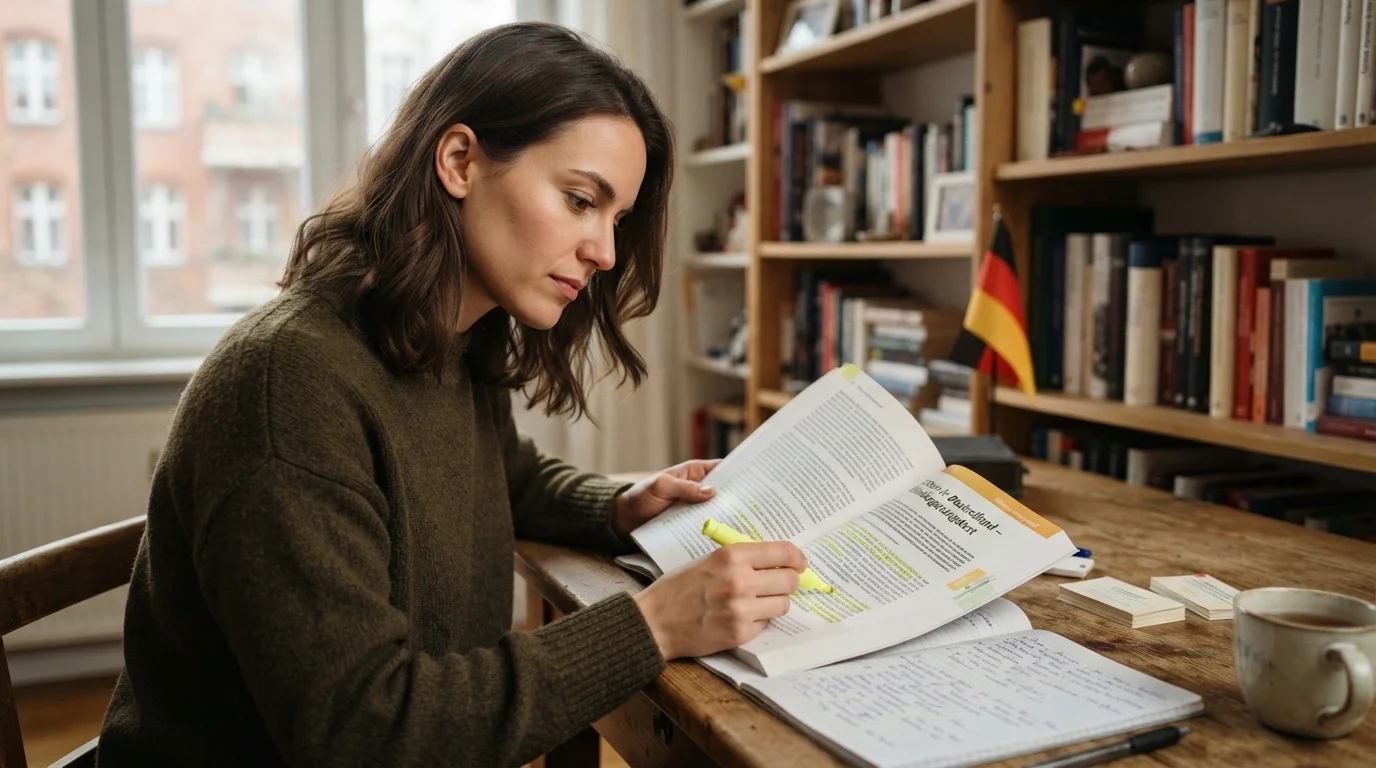
AI-generated image

The first moments of the DTZ B1 speaking exam can feel more stressful than they really are. You sit opposite the examiner, hear a simple question such as Stellen Sie sich bitte vor, and suddenly even familiar German words seem difficult to remember. The good news is that this part of the exam follows a clear pattern. With a short structure, useful phrases and regular speaking practice, you can prepare a confident German self-introduction without memorising a complicated speech.
This guide explains how to handle DTZ Exam B1 Speaking Part 1, what information to include, which grammar structures are useful and how to react when you do not understand a question. The aim is not to sound perfect. Your aim is to communicate clearly, answer the task and show that you can speak about your personal life in German.
The Deutsch-Test für Zuwanderer, usually called the DTZ, is the language examination at the end of an integration course. It assesses German at A2 or B1 level. The speaking section includes several communication tasks, and the opening task generally asks you to provide personal information and introduce yourself.
In this first part, the examiner may ask about topics such as:
You may also receive a form or prompts to help organise your information. The precise procedure can depend on the examination centre, so use the instructions you receive on the day. For an overview of the complete exam, including its speaking, listening, reading and writing components, see this guide to DTZ preparation.
Remember that the DTZ is a language test, not a citizenship test. The naturalization test, also known as Leben in Deutschland, is a separate test about life and society in Germany. You can read more about that distinction in this guide to the Leben in Deutschland test and the Einbürgerungstest.
A reliable structure helps you speak naturally instead of searching for ideas. Prepare information in the following order, but do not try to recite every sentence exactly as you wrote it.
Start politely and calmly:
A short introduction is enough. You do not need to give a long speech before the examiner asks the next question.
Useful sentences include:
Use kommen aus for your country or city of origin. Use wohnen in for your current home. These verbs describe different ideas, so do not confuse Ich komme aus Berlin with Ich wohne in Berlin.
You can add your current location and one simple detail:
To say how long you have lived somewhere, use seit with the present tense: Ich lebe seit drei Jahren in Deutschland. Do not normally use the past tense in this sentence. If you moved at a specific time, you can say: Ich bin 2023 nach Deutschland gekommen.
Choose details that are easy for you to explain:
You do not need to provide private information that you do not want to share. A simple sentence is enough. If you have no children, you can say Ich habe keine Kinder and move on to another topic.
Work and education are common B1 conversation topics. Prepare two or three sentences that match your situation:
If you are unemployed, you can answer neutrally and positively: Zurzeit arbeite ich nicht. Ich besuche einen Deutschkurs und suche eine passende Stelle. This gives the examiner a clear answer and demonstrates useful vocabulary.
Hobbies allow you to show that you can use verbs and give a reason. For example:
At B1 level, try to extend one answer with weil, deshalb or aber. This is more useful than listing ten hobbies without any detail.
Here is an example you can adapt. Do not copy it if the details are not true for you.
Guten Tag. Ich möchte mich kurz vorstellen. Ich heiße Elena Petrova und komme aus Bulgarien. Ich bin 31 Jahre alt und wohne seit vier Jahren in Deutschland. Jetzt lebe ich mit meinem Mann und unserer Tochter in Köln. Zurzeit besuche ich einen Deutschkurs. Früher habe ich in einem Hotel gearbeitet, und in Zukunft möchte ich wieder im Tourismus arbeiten. In meiner Freizeit koche ich gern und treffe mich mit Freunden. Am Wochenende gehen wir oft im Park spazieren. Ich lerne Deutsch, weil ich im Alltag sicherer sprechen und später wieder arbeiten möchte.
This example is effective because it has a clear order, mostly familiar grammar and a few connected ideas. It includes the present, the past and the future, but it does not try to use difficult structures simply to impress the examiner.
Create your own version with six or seven key facts. Then make a shorter version of three or four sentences. The shorter version is useful if the examiner interrupts you or asks a direct question before you finish.
Several basic patterns appear repeatedly in personal introductions:
Pay attention to the preposition in Ich interessiere mich für Musik. The phrase requires für, not an. Also remember that möchte is followed by an infinitive: Ich möchte besser Deutsch sprechen.
Short sentences are completely acceptable, but connectors make your speech easier to follow:
After weil, the conjugated verb usually goes to the end: ..., weil ich Deutsch lernen möchte. After deshalb at the beginning of a sentence, the verb comes directly after it: Deshalb lerne ich jeden Tag.
Time expressions help you give precise answers:
Practise these expressions in complete sentences. For example: Vor drei Jahren bin ich nach Deutschland gekommen, und seitdem lerne ich Deutsch.
Memorising a complete text can cause problems. If the examiner asks a question in a different order, you may forget the next sentence. Instead, prepare a keyword card for practice only:
Look at one keyword and speak for 20 to 30 seconds. Then repeat the exercise without looking. Change one detail each time so that you learn to communicate, not just reproduce sounds.
Record yourself on your phone and listen for three points: Can you understand every word? Are your sentences connected? Do you pause after each idea rather than after every word? You do not need to eliminate every accent. Focus on clear pronunciation, an audible voice and a steady pace.
Practise answering follow-up questions as well. The examiner may ask Warum lernen Sie Deutsch?, Was machen Sie am Wochenende? or Was haben Sie früher gemacht? Prepare ideas, not fixed answers. For example, for the question about learning German, you could say: Ich lerne Deutsch, weil ich im Alltag selbstständig sein möchte. Außerdem brauche ich Deutsch für meine Arbeit.
Asking for clarification is a communication skill, not a failure. If you do not hear or understand the question, use a polite phrase:
Listen carefully to the repeated question and answer only what was asked. If you forget a word, explain it in another way. Instead of stopping because you do not know Fahrradwerkstatt, you might say: Ich arbeite in einer Werkstatt. Dort reparieren wir Fahrräder. The ability to describe an idea with simpler language is valuable at B1 level.
A long, complicated biography increases the chance of grammar mistakes. Select relevant facts and develop one or two of them with a reason or example.
Many learners rush because they are nervous. Take a short breath between ideas and pronounce word endings. A calm answer is usually easier to understand than a fast answer with many corrections.
Do not answer only Berlin or zwei Kinder when you can say a complete sentence: Ich wohne in Berlin and Ich habe zwei Kinder. Complete sentences give you more practice with word order.
B1 performance is not about using the most impressive grammar. Accurate present-tense sentences, clear past-tense statements and simple subordinate clauses are more useful than structures you cannot control.
Practise difficult sounds in words you actually need, such as sprechen, Deutschland, arbeiten and Familie. Pay attention to sentence stress and make the final sounds audible, especially in words such as kommt and lebt.
A short daily routine can make your preparation more organised:
For extra speaking practice, Bretzi includes lessons with speaking activities and, with Premium, SprachBuddy, an AI conversation partner for everyday topics and situations such as appointments or job interviews. You can read the conversation afterwards and practise pronunciation with scores for words or sentences you say. Remember that it is software, not a human teacher.
Use a timer occasionally, but do not turn every practice session into a test. Bretzi also brings words and past mistakes back in spaced reviews, which can help you retain useful phrases between speaking sessions.
Check the latest practical information with your exam provider and consult the Federal Office for Migration and Refugees for official information about integration courses and the DTZ. Exam arrangements can vary, so follow the instructions from your centre.
DTZ B1 Speaking Part 1 is an opportunity to start the oral exam with familiar topics. Organise your ideas around your name, origin, home, family, work, hobbies and reasons for learning German. Use short connected sentences, speak at a comfortable speed and ask for clarification when necessary.
Start today by writing six keywords and speaking about each one aloud. Then practise the same information in a different order. The more flexibly you can talk about your real life, the less dependent you are on memorisation and the more prepared you are for a natural conversation in German.
Rules, fees and dates change. Check the current version on the official pages before you act.
Share this article:
Why the DTZ B1 listening section feels difficult You can understand German in a quiet classroom and still feel lost when a recording begins. In the...
Read morePreparing for the Leben in Deutschland (LiD) test or the German citizenship test (Einbürgerungstest) can feel overwhelming. While the full BAMF...
Read moreSecuring German citizenship is one of the most rewarding milestones for expats living in Germany. However, before gathering certified translations or...
Read more