
German Private Pension Guide: Choosing Rürup vs Riester in 2026
Moving to Germany comes with plenty of administrative milestones: registering your address at the Bürgeramt, securing health insurance, and...
Read more
This article was written by AI and published by Bretzi.
AI can get things wrong. For anything official, check the source it points to.
AI-generated image
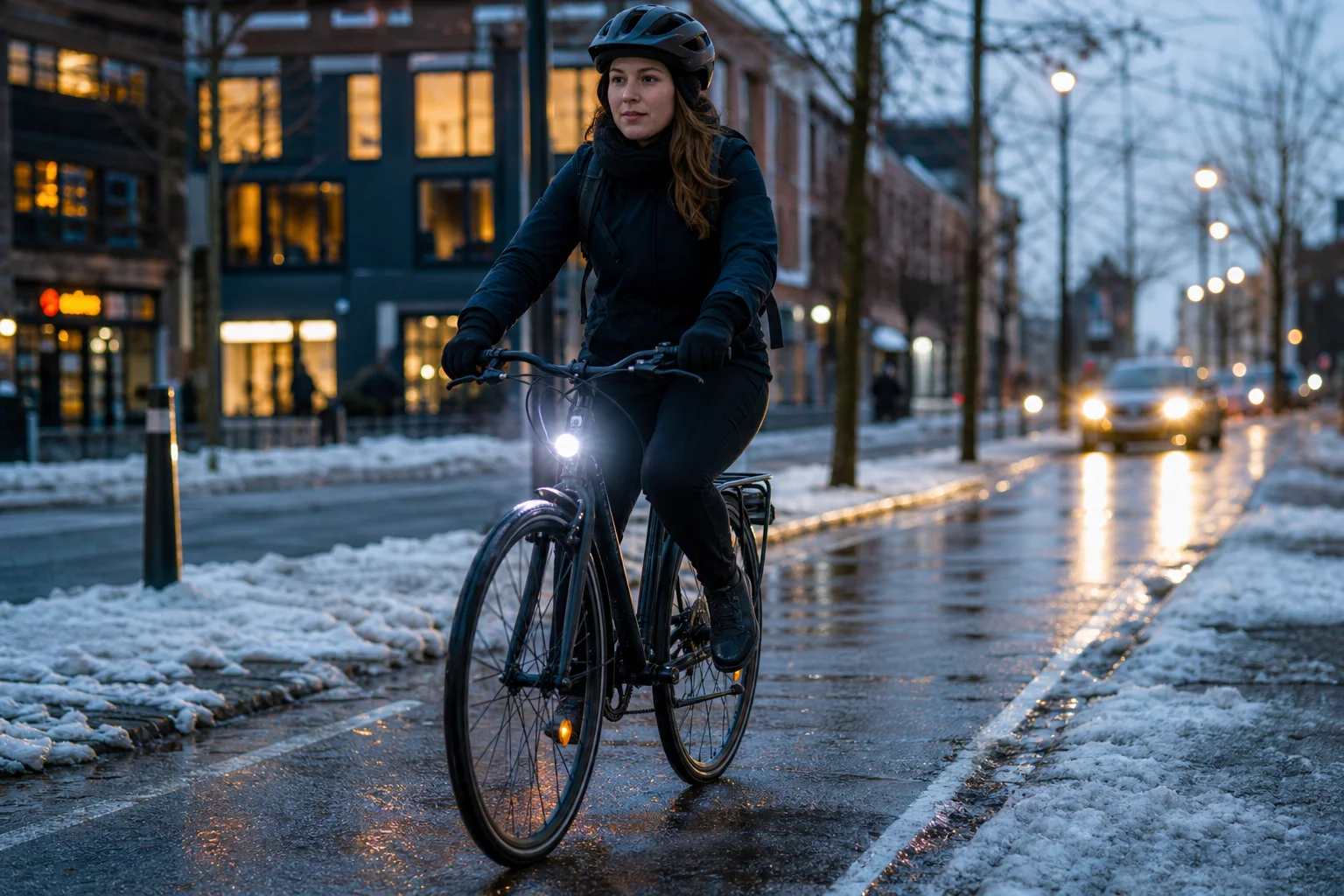
When autumn turns to winter in Germany, the days grow noticeably shorter, and temperatures regularly dip below freezing. Yet across Berlin, Munich, Hamburg, and smaller university towns, millions of people continue to rely on their bicycles for daily commuting. In Germany, cycling is not just a seasonal leisure activity; it is a fundamental part of the transportation system.
However, winter cycling in Germany is governed by strict, legally binding traffic regulations. German police regularly conduct unannounced bicycle checks (Fahrradkontrollen) during the darker months, targeting commuters whose bicycles lack mandatory safety equipment. Riding without the right lights or failing to equip your bike according to the law can result in an unexpected stop by the police, administrative fines, and serious liability issues if an accident occurs.
Whether you are an expat adapting to your first German winter, a student commuting to lectures, or a language learner preparing for life and exams in Germany, understanding these road laws is essential. In this detailed guide, we break down what the law requires under the German Road Traffic Licensing Regulations, how winter road rules apply to cyclists, and how to keep your ride safe and compliant.
In Germany, bicycle technical standards are primarily laid down in Section 67 of the Road Traffic Licensing Regulations (§ 67 Straßenverkehrs-Zulassungs-Ordnung, or StVZO). This statute governs everything related to lighting and reflection on bicycles ridden on public streets.
German traffic law treats bicycles as vehicles (Fahrzeuge). As such, they must fulfill rigorous roadworthiness requirements. It is a widespread misconception among newcomers that basic clip-on novelty lights are sufficient; German law requires specific, certified technical standards.
According to § 67 StVZO, your bicycle must be equipped with at least one forward-facing headlight emitting steady white light. Key legal requirements include:
Your rear lighting system must consist of at least one red light mounted between 25 cm and 120 cm above the road surface:
Every light and reflector attached to a bicycle used on German public roads must be officially approved by the Federal Motor Transport Authority (Kraftfahrt-Bundesamt). You can verify if your bicycle light is legally compliant by inspecting the plastic casing or lens for the official approval mark:
If you purchase lights online from foreign retailers that lack this German certification mark, they do not fulfill § 67 StVZO, even if they are exceptionally bright.
Lights alone do not make a bicycle road-legal in Germany. The StVZO mandates a comprehensive network of passive reflectors to ensure your bike is visible from all angles if active lights fail:
In addition to lighting, the StVZO mandates two completely independent braking systems (e.g., front handbrake and rear handbrake, or a front handbrake paired with a coaster/backpedal brake) and an easily audible, clear-sounding bell (helltönende Glocke). Squeeze horns, sirens, or electronic sound makers are not legal substitutes for a standard bell.
Cycling during winter in Germany introduces severe environmental challenges: packed snow, slush (Schneematsch), and dangerous invisible black ice (Glatteis). These conditions alter how certain general traffic regulations apply to you.
In Germany, cyclists are generally required to use designated cycle paths if they are marked with blue circular signs displaying a white bicycle icon (Signs 237, 240, or 241). Under normal conditions, riding on the adjacent car lane when a marked path exists can result in an administrative warning.
However, winter conditions create an important legal exception under court precedent and the German Road Traffic Act (Straßenverkehrs-Ordnung, or StVO):
Germany enforces a strict seasonal requirement for motor vehicles, known as the situational winter tire rule. If you drive a car, you must equip certified winter tires bearing the Alpine symbol whenever winter conditions occur, a topic explored in depth in our guide to winter tire regulations in Germany.
For standard bicycles, there is no legal winter tire mandate. You are permitted to ride on standard all-season tires throughout the coldest months. Nevertheless, specialized winter bicycle tires featuring soft rubber compounds or even embedded metal spikes (Spikereifen) are completely legal on standard bicycles in Germany (unlike on passenger cars, where metal spikes are forbidden). If you commute daily in icy regions, studded bicycle tires provide unmatched grip on hard-packed snow and ice.
During November, December, and January, local police forces (Landespolizei) throughout German federal states stage high-visibility bicycle inspection blitzes. Officers monitor major intersections, university entry points, and central transit hubs in the early morning and late afternoon.
If an officer stops you on an unlit or non-compliant bicycle, you will face an administrative fine (Verwarnungsgeld). The exact penalties for lighting violations, riding on the wrong side of the road (Geisterradler), or using unroadworthy equipment are governed by the federal catalogue of fines (Bundeseinheitlicher Tatbestandskatalog). The enforcement authority or local police department sets and issues the fine based on the specific violation, with higher amounts applied if your infraction causes endangerment (Gefährdung) or results in a traffic collision.
To view statutory road traffic details and statutory authorities, review the official provisions published at gesetze-im-internet.de.
Beyond municipal fines, cycling without proper lights in winter carries significant civil liability consequences. Under German civil law (Bürgerliches Gesetzbuch), if you are involved in a collision during darkness and your bicycle lacked approved front or rear lighting, the other party's insurance company may argue contributory negligence (Mitschuld).
Even if an automobile driver violated your right of way, your compensation for personal injury or property damage can be substantially reduced if you were riding without lights, because you were difficult to spot in winter darkness.
Winter in Germany also coincides with the holiday season and Christmas markets (Weihnachtsmärkte). Remember that cycling under the influence of alcohol (Trunkenheit im Verkehr) is a criminal offense under § 316 of the German Criminal Code (StGB):
Understanding the vocabulary used by German authorities, repair shops (Fahrradwerkstätten), and local news outlets will make winter commuting much simpler. Here are the key terms you need to know:
If you are learning the language to settle comfortably into German life, practicing these real-world terms helps you navigate routine situations like buying the correct replacement bulb or talking to a mechanic. With the Bretzi app, you can build your everyday vocabulary step by step across levels from A0 to C1. You can save words directly to your personal review list in Bretzi's Words tab, or practice realistic conversations about bike repairs and transport rules out loud with SprachBuddy, the app's AI conversation partner.
Even the most experienced winter cyclists encounter days when cycling becomes impossible due to sudden freezing rain (Blitzeis) or extreme blizzards. On those days, parking your bicycle and switching to regional trains, subways, or buses is the sensible choice.
Commuting across Germany remains accessible thanks to national transit passes. The Deutschlandticket costs €63 per month from 1 January 2026 (it was €58 per month in 2025). Having an active ticket allows you to smoothly transfer from your bicycle to local buses, trams, S-Bahn, and regional trains without worrying about individual zone fares. However, winter storms frequently cause rail delays and cancellations, so it pays to know your passenger rights by reading our guide on navigating German public transport winter delays.
Road salt and sub-zero temperatures take a heavy toll on bicycle components. To keep your bike road-legal and prevent breakdowns, follow this practical winter maintenance routine:
Cycling through a crisp, snowy German morning can be a refreshing and efficient way to commute, provided your bicycle satisfies the law. Ensure your lights bear the required K-number approval, verify that your reflectors are clean and complete, and adjust your speed the moment temperatures approach freezing.
Mastering German traffic terminology, street signs, and municipal rules is an integral part of settling into life in Germany. If you are preparing for long-term integration or exams, working through structured daily lessons on apps like Bretzi will help you gain the confidence you need to communicate at the bike shop, speak with municipal officials, and handle daily German conversations with ease.
Rules, fees and dates change. Check the current version on the official pages before you act.
Share this article:
Moving to Germany comes with plenty of administrative milestones: registering your address at the Bürgeramt, securing health insurance, and...
Read moreWhen you first moved to Germany, signing up for public health insurance (Gesetzliche Krankenversicherung, or GKV) was likely a hurried administrative...
Read moreMoving to Germany with a family—or welcoming a new child after arriving—comes with plenty of paperwork. Fortunately, Germany offers one of the...
Read more