
German Winter Blackout Guide: Emergency Prep for Expats
Winter in Germany brings festive Christmas markets, snow-dusted forests, and crisp alpine air. However, sub-zero temperatures, icy rain, and severe...
Read more
This article was written by AI and published by Bretzi.
AI can get things wrong. For anything official, check the source it points to.
AI-generated image
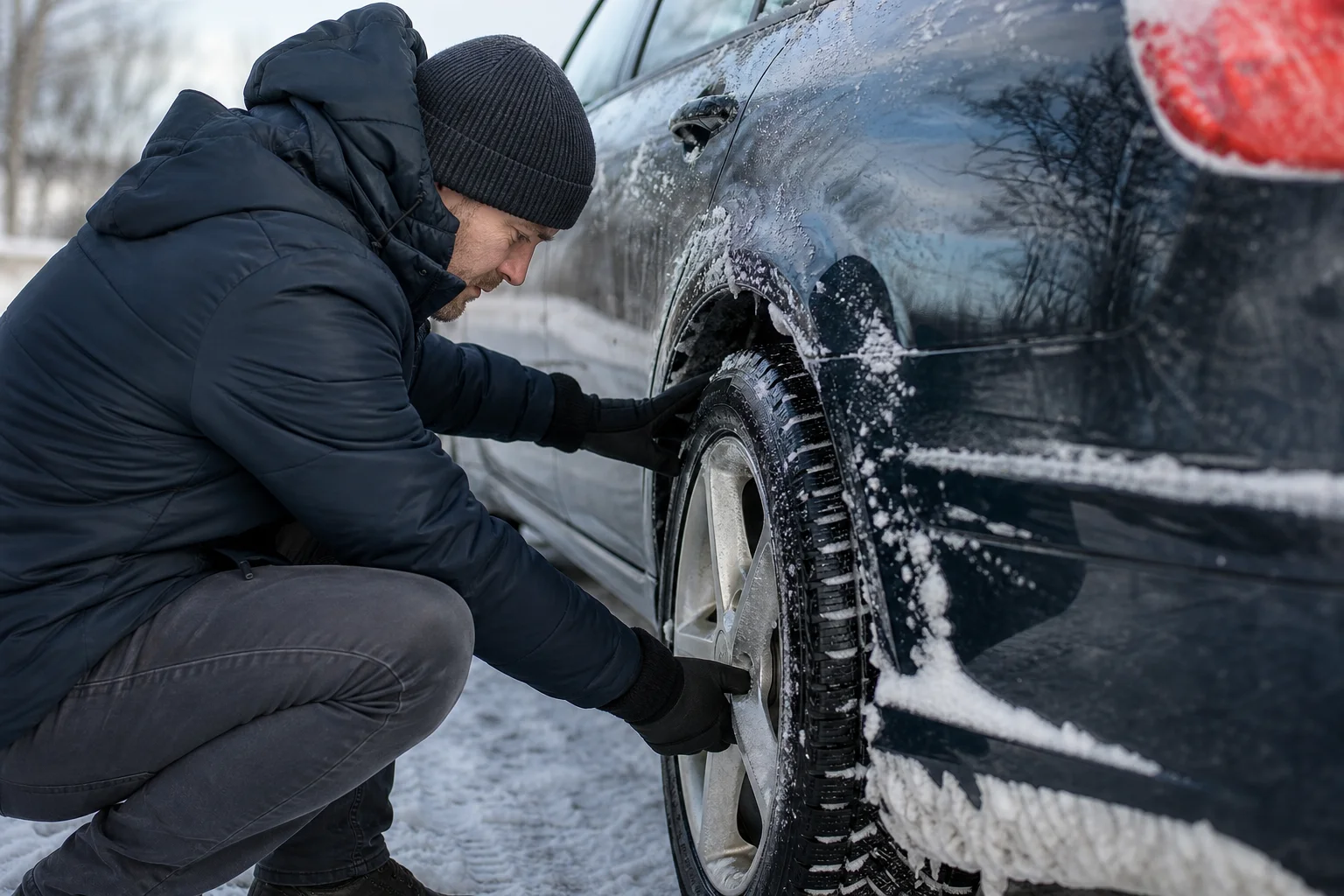
When autumn settles across Germany and temperatures plunge below freezing, life shifts outdoors. Morning frost glazes windshields, cobblestones become slippery, and driving conditions change rapidly. For international residents, navigating German road regulations can feel daunting. Germany is renowned for its well-maintained Autobahnen and strict safety expectations, and winter tire requirements are among the most strictly enforced vehicle standards in the country.
Whether you own a car, lease one, or rely on car-sharing services, understanding Germany's winter tire regulations is essential for road safety, legal compliance, and insurance coverage. This comprehensive guide explains how the legal requirement works, what the famous German rule of thumb means, how to ensure your tires meet current standards, and the key German vocabulary you need when booking an appointment at a local garage.
A widespread misconception among newcomers is that German law designates specific calendar dates—such as November 1 to March 31—during which winter tires must be mounted on your vehicle. In reality, German federal law does not impose a fixed calendar deadline. Instead, Germany enforces a situative Winterreifenpflicht (situational winter tire requirement).
According to Section 2, Paragraph 3a of the German Road Traffic Regulations (Straßenverkehrs-Ordnung – StVO § 2 Abs. 3a), motor vehicles may only be operated in winter weather conditions if fitted with appropriate tires. The law explicitly defines winter road conditions as:
If you drive in any of these conditions with standard summer tires, you are committing a traffic violation. Conversely, if sunny, mild conditions prevail in mid-January and the roads are dry and clear of frost, driving on summer tires is technically permitted by the letter of the law. However, German weather is notoriously unpredictable. An unexpected overnight freeze or a sudden morning snow shower can instantly transform a dry morning commute into an illegal and dangerous drive. For that reason, relying on day-to-day forecasts is practically unfeasible for anyone who depends on a vehicle.
To help drivers plan ahead and avoid sudden roadside dilemmas, automobile associations and driving instructors across Germany promote a practical mnemonic: "Von O bis O" (von Oktober bis Ostern)—from October until Easter.
This rule of thumb is not a statute, and police officers will not fine you simply because you have summer tires on your car on a dry day in November. Nevertheless, the "O bis O" guideline aligns closely with historical weather patterns in Central Europe. Ground frost and sudden cold snaps frequently strike Germany between mid-October and April, particularly in higher elevations like the Black Forest, the Harz mountains, the Bavarian foothills, and the Erzgebirge.
Following "Von O bis O" also saves practical headaches. Independent garages (freie Werkstätten) and dealership service centers experience enormous spikes in demand as soon as the first freezing rain hits the forecast. Scheduling your wheel swap (Reifenwechsel) in early or mid-October ensures you secure an appointment before the rush and remain fully compliant whenever winter decides to arrive.
Not every tire marketed with winter capabilities meets the current statutory criteria in Germany. For decades, tires stamped with the manufacturer abbreviation M+S (Matsch und Schnee / Mud and Snow) were standard. However, the M+S designation was never legally protected or subject to standardized independent testing.
Under the revised road safety standards, all winter and all-weather tires used during winter conditions must feature the official Alpine symbol—a three-peaked mountain pictogram containing a snowflake (known internationally as 3PMSF, or Three-Peak Mountain Snowflake). Tires bearing solely the old M+S stamp without the Alpine pictogram no longer meet the legal definition of winter tires under German traffic regulations.
Many drivers living in flat urban areas or milder regions of Germany prefer all-season tires (Ganzjahresreifen or Allwetterreifen) to avoid swapping and storing wheels twice every year. All-season tires are completely legal for winter driving in Germany, provided they bear the embossed Alpine mountain-and-snowflake symbol. If your all-season set carries only an M+S mark, it does not fulfill the legal requirements for driving on icy or snowy roads.
The condition of your tire tread is just as critical as the symbol stamped on the sidewall. Under Section 36 of the Road Traffic Licensing Regulations (StVZO), the absolute legal minimum tread depth (Mindestprofiltiefe) for passenger car tires across Germany is 1.6 millimeters across the entire circumference.
However, safety organizations, mechanics, and consumer groups universally advise against running winter tires down to the legal minimum. While 1.6 mm may prevent a ticket on dry asphalt, slush and snow require deep grooves to channel moisture away from the contact patch and grip icy surfaces. Road safety experts strongly recommend a minimum tread depth of 4.0 millimeters for winter tires. Once your tread drops below 4 mm, winter performance degrades sharply, dramatically increasing stopping distances.
You do not need a specialized depth gauge to monitor your tire tread at home. A quick everyday trick involves using a standard 2-Euro coin:
Disregarding the situational winter tire requirement carries consequences beyond the immediate risk of a collision. German law enforcement actively checks tire suitability during routine traffic stops and accident investigations during cold months.
The federal catalog of fines (Bußgeldkatalog) establishes penalties for driving with non-compliant tires in winter road conditions. Fines are levied not only against the driver who operates the vehicle in the snow with summer tires, but also scale upward if you hinder other traffic, create an endangerment (Gefährdung), or cause an accident. In addition to monetary fines set by the authorities, driving on non-compliant tires in winter conditions results in penalty points registered in the central driver fitness register (Fahreignungsregister) in Flensburg.
Moreover, the vehicle owner (Fahrzeughalter) can face separate penalties if they permitted the vehicle to be operated in winter weather without compliant tires, even if someone else was driving.
The financial consequences of driving on improper tires become most severe when an accident occurs. While your mandatory third-party liability insurance (Kfz-Haftpflichtversicherung) will generally compensate the injured third party, your insurer may pursue partial reimbursement under certain circumstances.
More critically, your comprehensive coverage (Vollkasko or Teilkasko) can legally reduce or completely deny payment for the damage to your own vehicle. Under German insurance law, operating a car on summer tires through ice or packed snow can be deemed gross negligence (grobe Fahrlässigkeit). Furthermore, if another motorist hits your vehicle, courts may assign you partial fault (Mitschuld) simply because your car lacked adequate winter equipment, which contributed to an inability to stop or maneuver in time.
What if you do not own a vehicle, but occasionally rent a car or use car-sharing services like Miles, Share Now, or Sixt? Who bears the responsibility?
If adverse winter weather strikes while your vehicle is not equipped with the proper tires, leaving the car parked and utilizing public transportation is the safest and only lawful option. For frequent travel across regional lines, having an active transit pass like Germany's Deutschlandticket provides a dependable alternative when driving conditions are unsafe.
Communicating your car needs in German can be intimidating if you have only studied academic vocabulary. When autumn arrives, you will encounter specific terms when contacting a local garage (Kfz-Werkstatt). Here are the primary terms to know:
When booking a seasonal service, you can practice concise, everyday phrases like:
"Guten Tag, ich möchte einen Termin für einen Reifenwechsel vereinbaren. Können Sie meine Sommerräder auch über den Winter einlagern?"
(Hello, I would like to make an appointment for a tire change. Can you also store my summer wheels over the winter?)
Building confidence in practical German for real-world interactions—whether booking a garage appointment or handling municipal paperwork—is a core focus of the Bretzi app. Bretzi teaches the practical German used across daily life and work in Germany, guiding learners systematically through CEFR levels from complete beginner (A0) up to C1. With short interactive lessons, immediate explanations for every exercise, and conversational speaking practice with SprachBuddy—its AI conversation partner—you can rehearse everyday situations out loud before speaking with local service providers.
Equipping your car with Alpine-marked tires is the cornerstone of winter road safety, but Germany's vehicle regulations mandate other seasonal precautions:
Under German road regulations, driving with only a small peephole cleared in a frosted windshield (referred to colloquially as Guckloch-Fahren) is strictly prohibited. You are legally required to clear all ice and snow from all windows and side mirrors before starting your trip. Snow on the hood or roof must also be brushed off, as loose snow can slide forward onto your windshield during braking or fly into the windshield of following drivers on the Autobahn.
Ensure your windshield washer reservoir is filled with winter-grade fluid containing adequate antifreeze (Scheibenfrostschutz). If your washer jets freeze on a salted highway, road grime will instantly smear across your glass, leaving you with zero visibility.
If you plan to drive in alpine regions or ski resorts in southern Germany, you may encounter circular blue road signs displaying a tire fitted with snow chains (Traffic Sign 268). When this sign is posted, driving past that point is permitted only if snow chains are mounted on the drive wheels, regardless of whether you have the best winter tires on the market. Always keep a set of compatible chains in the trunk if traveling through mountain passes in winter.
If you decide to swap your wheels or clean your car yourself at home, remember that residential areas in Germany are governed by noise protection rules. Be mindful of established community standards such as Sunday quiet hours and Ruhezeit, which prohibit noisy mechanical work, pressure washers, or loud tire compressors on Sundays and public holidays.
Preparing your vehicle for a German winter requires planning ahead rather than waiting for the first blizzard. Keep these principles in mind:
By staying informed about German road standards and learning the everyday language needed to navigate vehicle maintenance, you ensure that winter in Germany remains safe, comfortable, and completely stress-free.
Rules, fees and dates change. Check the current version on the official pages before you act.
Share this article:
Winter in Germany brings festive Christmas markets, snow-dusted forests, and crisp alpine air. However, sub-zero temperatures, icy rain, and severe...
Read moreArriving in Germany and moving into an unfurnished flat (Wohnung) is an exciting milestone, but it often comes with a classic shock for newcomers:...
Read moreFinding an apartment in Germany is notoriously competitive, but navigating your exit from one can feel just as daunting. Whether you are relocating...
Read more