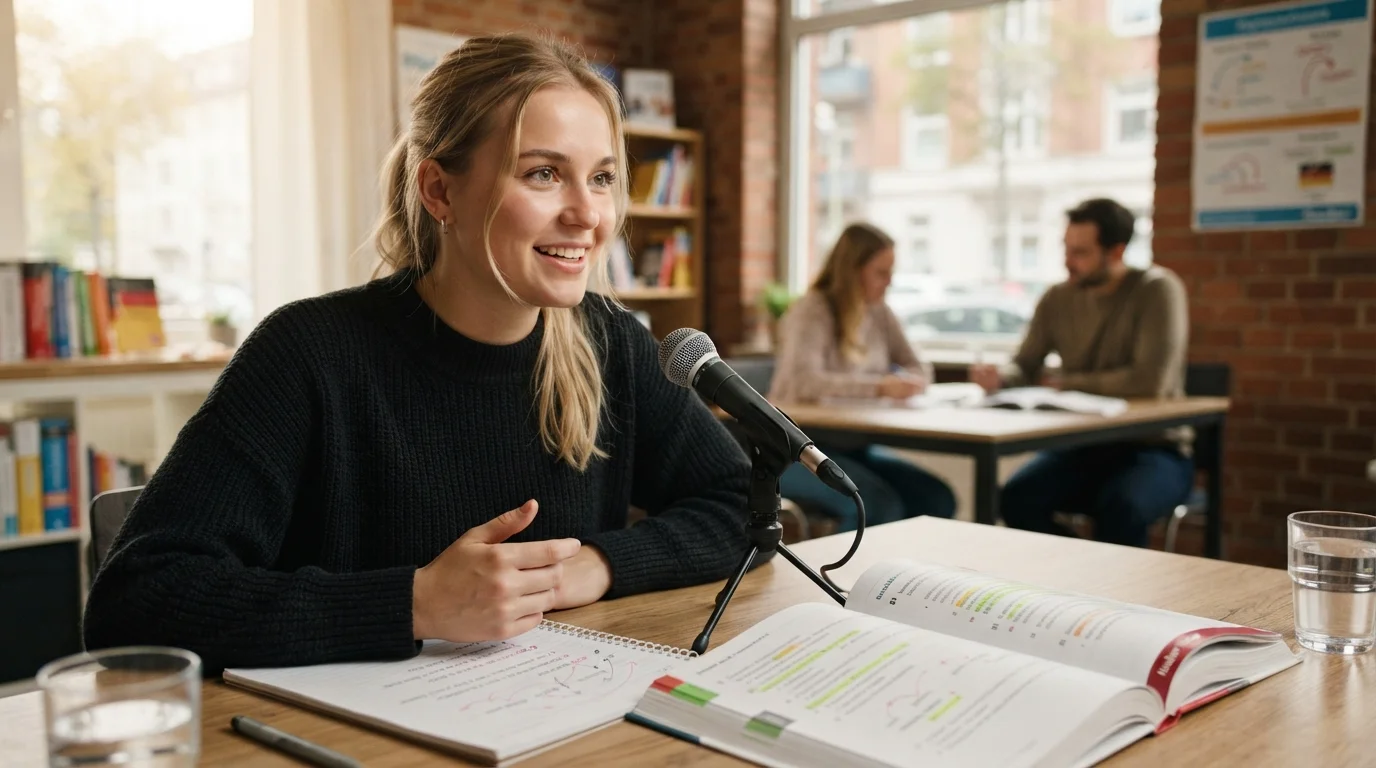
Mastering German Sentence Rhythm and Intonation for B1 Oral Exams
When preparing for the B1 German speaking exam—whether it is the Goethe-Zertifikat B1, telc Deutsch B1, or the Deutsch-Test für Zuwanderer...
Read more
Whether you want to describe which train route is faster, discuss why one apartment is quieter than another, or explain why coffee is your favorite drink, comparative and superlative adjectives are essential tools in the German language. Comparing things allows you to express nuances, weigh options, and articulate precise opinions in everyday life and language exams.
At first glance, forming comparisons in German looks remarkably similar to English. In English, we say fast → faster → the fastest; in German, you say schnell → schneller → am schnellsten. However, German introduces a few specific twists: vowel shifts (umlauts), irregular stems, and adjective declension endings depending on whether the adjective sits before a noun or stands on its own.
In this guide, you will learn the exact step-by-step rules to form comparatives and superlatives effortlessly, recognize tricky exceptions, and decline these adjectives accurately in full sentences.
German comparative and superlative structures follow straightforward base patterns when adjectives are regular.
The base form of the adjective is known as the positive degree (der Positiv):
To state that something has more of a quality than something else, add the suffix -er to the base adjective:
Note that unlike English, which uses "more" for long adjectives (e.g., "more interesting"), German almost always adds -er regardless of length: interessanter, komplizierter, faszinierender.
When an adjective is used after a verb (predicatively or adverbially) to denote the highest degree, use the construction am + [adjective] + -sten:
If an adjective base ends in -d, -t, -s, -ß, -z, or -x, adding just -sten creates a combination of consonants that is difficult to pronounce. In these cases, an extra -e- is inserted before -sten:
Exception: Participles ending in -d or -t that act as adjectives (like dringend) usually do not take the extra -e-: am dringendsten.
One of the most characteristic features of German comparative morphology is the umlaut shift. Many short, one-syllable adjectives with stem vowels a, o, or u shift to ä, ö, or ü in both the comparative and superlative.
| Positive | Comparative | Superlative | Meaning |
|---|---|---|---|
| alt | älter | am ältesten | old |
| jung | jünger | am jüngsten | young |
| groß | größer | am größten | big / tall |
| stark | stärker | am stärksten | strong |
| kurz | kürzer | am kürzesten | short |
| warm | wärmer | am wärmsten | warm |
Not every single-syllable adjective receives an umlaut. The following common groups keep their plain vowels:
Just like in English, several high-frequency words in German undergo complete stem modifications or minor spelling changes when compared. Memorizing these irregular forms will give you an immediate boost in fluency.
| Positive | Comparative | Superlative | English |
|---|---|---|---|
| gut | besser | am besten | good / better / best |
| viel | mehr | am meisten | much / more / most |
| gern(e) | lieber | am liebsten | gladly / prefer / like most |
| hoch | höher | am höchsten | high / higher / highest |
| nah | näher | am nächsten | near / closer / nearest |
When an adjective ends in an unstressed -el, it drops the inner -e- in the comparative form:
Adjectives ending in -er preceded by a vowel also frequently drop the -e-:
If you are discussing topics in an exam setting or formulating arguments, combining these irregular comparatives with structured phrases for expressing your opinion will make your communication sound natural and convincing.
Once you know how to modify the adjective, you need the right connecting words to build complete comparison sentences. According to standard grammar recorded in linguistic resources like the German grammar reference on Wikipedia, there is a clear distinction between expressing equality and inequality.
When two things share the same degree of a quality, use the base adjective (positive form) surrounded by so ... wie (or genauso ... wie / ebenso ... wie):
When one element exceeds the other, use the comparative form (-er) followed by als:
Crucial Rule: Avoid using wie after a comparative form in formal German (e.g., *schneller wie is colloquial and grammatically incorrect in standard writing).
So far, we have looked at predicate adjectives (e.g., Das Haus ist kleiner, Das Auto ist am schnellsten). But what happens when the comparative or superlative stands directly in front of a noun?
When adjectives are placed directly before a noun, they are attributive and must take case endings according to gender, number, and case (Nominative, Accusative, Dative, or German genitive case). The comparative marker (-er) or superlative marker (-st / -est) is added first, followed by the normal adjective ending.
Formula: [Stem] + [er] + [Declension Ending]
In the attributive position, you do not use am. Instead, you use the definite article (der, die, das) plus the superlative stem ending in -st- / -est-, followed by the regular adjective ending (often -e or -en):
Practicing these endings in everyday contexts helps solidify the patterns. On Bretzi, lessons from A0 to C1 guide you step by step through grammar rules with clear explanations, conjugation and declension tables, and real-life examples from daily life in Germany.
When you construct complex sentences, you often combine adjectives with time expressions. Understanding the correct word order—such as positioning German adverbs of time before comparative elements—will help your sentences sound natural and clear.
For example:
Incorrect: Er ist größer wie ich.
Correct: Er ist größer als ich.
Rule: Always use als after a comparative adjective (-er) and wie for equal comparisons (so ... wie).
Incorrect: Das ist mehr besser.
Correct: Das ist besser. / Das ist viel besser.
Rule: Do not put mehr before an adjective to make it comparative. To say "much better", use viel besser.
Incorrect: Er läuft schnellsten.
Correct: Er läuft am schnellsten.
Rule: Standalone superlative adverbs require am before the adjective.
Whenever you write your own sentences or practice speaking, tools like Sentence Check or voice conversations with SprachBuddy on the Bretzi app can help you review your comparative sentences and ensure your endings and vowel shifts are accurate.
Start applying these comparison structures today in your daily conversations, emails, and language practice to express your thoughts with clarity and precision!
Share this article:
When preparing for the B1 German speaking exam—whether it is the Goethe-Zertifikat B1, telc Deutsch B1, or the Deutsch-Test für Zuwanderer...
Read moreYou sit down at a German bakery, smile warmly at the server, and confidently declare: "Ich bin voll!" Instead of a polite nod acknowledging your...
Read moreWhen you start learning German, you quickly realize that translating every word literally leads to utter confusion. A German colleague might suddenly...
Read more