How to Set Up a German Bank Account: Best Free and Online Options for Expats

This article was written by AI and published by Bretzi.

AI can get things wrong. For anything official, check the source it points to.

How Bretzi uses AI

AI-generated image

How to Set Up a German Bank Account: Best Free and Online Options for Expats

Arriving in Germany comes with a thrilling mix of excitement and paperwork. Between deciphering your rental agreement, navigating train schedules, and learning why recycling bins come in four distinct colors, one priority tops the relocation checklist: setting up a German bank account (ein deutsches Bankkonto).

Whether you are receiving your monthly salary, paying rent for your flat, or setting up a monthly transport ticket, having a local IBAN (International Bank Account Number) starting with DE makes life significantly smoother. In this comprehensive guide, we will walk you through everything you need to know about the German banking system, compare the best free and online banking options for expats, review the essential German vocabulary you will encounter, and explain how to open your account without unnecessary bureaucratic hurdles.

Why You Need a German Bank Account (Girokonto)

In Germany, your primary checking account is called a Girokonto. While the Single Euro Payments Area (SEPA) technically allows you to use any EU bank account across member states, the reality on the ground in Germany can be tricky. Many local landlords, employers, telecom providers, and gym memberships still insist on a German IBAN (or experience 'IBAN discrimination' with foreign virtual accounts).

Furthermore, setting up automated payments—known as a SEPA-Lastschriftmandat (direct debit mandate)—for everyday essentials like setting up electricity and utility contracts or internet providers is vastly simpler with a German bank.

Essential German Banking Vocabulary

Before diving into bank comparisons, familiarizing yourself with standard German financial terms will give you confidence whether you are applying online or stepping into a local branch:

  • Das Girokonto: Current/checking account used for day-to-day transactions.
  • Die Kontoführungsgebühr: Monthly or quarterly account maintenance fee.
  • Die Girocard (formerly EC-Karte): The domestic German debit card widely used across smaller shops and bakeries.
  • Die Überweisung: Bank transfer.
  • Der Dauerauftrag: Standing order (frequently used for monthly rent payments).
  • Die Lastschrift / SEPA-Lastschrift: Direct debit authorized by you for recurring utility and subscription bills.
  • Der Kontoauszug: Bank statement.
  • Der Dispokredit (Dispositionskredit): Overdraft facility on your current account.
  • Die SCHUFA: Germany's leading credit rating agency. Most traditional banks check your SCHUFA score before opening an account or granting overdrafts.
  • Der Freistellungsauftrag: An exemption order for capital gains tax on interest earned.

If you want to master these terms along with realistic conversational phrases before visiting a bank branch, Bretzi offers interactive dialogue games and vocabulary building with spaced repetition to help you speak with financial clerks without breaking a sweat.

What Documents Do You Need to Open an Account?

Under regulations enforced by the Federal Financial Supervisory Authority (BaFin), financial institutions in Germany must verify your identity rigorously before opening an account (Know Your Customer or KYC procedures).

To open a standard German bank account, you typically need the following documents:

  1. Valid Passport or National ID Card: Driver's licenses are not accepted as proof of identity in Germany.
  2. Proof of Address (Meldebescheinigung): Obtained after registering your address through the Anmeldung process at your local Bürgeramt.
  3. German Tax ID (Steueridentifikationsnummer): Mailed to you automatically after your Anmeldung (you can often submit this within 90 days after account opening).
  4. Residence Permit / Visa: Required for non-EU/EEA citizens showing legal residency in Germany.
  5. Proof of Income or Student Status: Salary slips, employment contract, or a university enrollment certificate (Immatrikulationsbescheinigung) if applying for fee waivers.

Can You Open an Account Without an Anmeldung?

If you have just arrived and are still in temporary housing while finding an apartment in Germany, you might not have your Meldebescheinigung yet. In this case, standard branch banks will usually turn you away. However, digital banks like N26 or international multi-currency accounts (like Revolut or Wise) allow you to open an account using an address in your home country or temporary EU residence, provided you hold a supported passport.

Types of Banks in Germany: Branch Banks vs. Direct/Neobanks

When selecting a banking partner, you will choose between two distinct models:

1. Traditional Branch Banks (Filialbanken)

These banks maintain brick-and-mortar locations across German cities. Examples include Sparkasse, Volksbank / Raiffeisenbank, Commerzbank, and Deutsche Bank.

  • Pros: In-person consultations, easy cash and coin deposits, extensive dedicated ATM networks.
  • Cons: Monthly maintenance fees (€3 to €10/month), paper-heavy procedures, and English support is rarely guaranteed at the counter.

2. Online Direct Banks & Neobanks (Direktbanken & Smartphone-Banken)

Operating completely online or through dedicated mobile apps, these banks pass their lower overhead costs to customers in the form of zero monthly fees and competitive interest rates.

  • Pros: Fast digital sign-up, sleek English apps, lower foreign transaction fees, free basic accounts.
  • Cons: Cash deposits can be cumbersome or incur fees; no physical branches for in-person support.

Top Free and Online Bank Accounts for Expats Compared

1. N26 — The Most Expat-Friendly Digital Bank

N26 is a fully licensed German bank operating on a 100% digital model. It remains the gold standard for newcomers due to its seamless onboarding in English, German, French, Spanish, and Italian.

  • Cost: Free standard tier (N26 Standard); paid tiers with insurance and perks from €4.90/month.
  • Card: Virtual Mastercard included for free; physical card available for a one-time delivery fee (~€10).
  • ATM Access: 3 free ATM withdrawals in Euros per month in Germany.
  • Key Highlights: Real-time push notifications, sub-accounts (Spaces) for budgeting, built-in Wise transfers for international remittances, no Anmeldung needed for eligible EU passport holders during initial registration.
  • Best for: Expats who want an English-first mobile experience and rapid account activation.

2. C24 Bank — The High-Interest Powerhouse

C24 is the banking arm of Germany's major comparison portal, CHECK24. It has quickly become one of the top-rated digital checking accounts in the country due to its generous interest rates on checking and savings accounts.

  • Cost: Free basic account (C24 Smart).
  • Card: Free physical Mastercard debit card and optional Girocard.
  • ATM Access: 4 free ATM withdrawals per month.
  • Key Highlights: Automatic categorization of expenses, interest paid directly on the checking balance, and open integration with other German bank accounts via Open Banking.
  • Best for: Expats with German residency who want a modern app with solid interest yields and a traditional Girocard.

3. DKB (Deutsche Kreditbank) — Best for Global Travelers

DKB is a veteran German direct bank with millions of customers. Its DKB Girokonto is revered by locals and long-term expats alike.

  • Cost: Free if you deposit at least €700 per month (or for anyone under 28 years old); otherwise €4.50/month.
  • Card: Free Visa Debit card. (Physical Girocard available for a small monthly fee).
  • ATM Access: Free worldwide ATM withdrawals with "Aktivkunde" (active customer) status.
  • Key Highlights: Excellent exchange rates worldwide, reliable customer service, full German banking features. App and support are predominantly in German.
  • Best for: Working expats and frequent travelers who deposit a regular monthly salary and are comfortable with a German-language interface.

4. ING Deutschland — The Reliable All-Rounder

ING is Germany's largest direct bank by customer count. It bridges the gap between digital convenience and established institutional security.

  • Cost: Free with an incoming transfer of at least €700 per month (or under 28 years old); otherwise €4.90/month.
  • Card: Free Visa Debit card.
  • ATM Access: Free withdrawals at virtually any ATM in Germany and the Eurozone accepting Visa (for amounts of €50 or more).
  • Key Highlights: Intuitive banking app, strong mortgage and investment depot options, top-tier customer satisfaction ratings.
  • Best for: Working professionals planning long-term residency in Germany.

5. Commerzbank (Basic Free Account Option)

If you insist on having a traditional branch network to deposit cash notes and coins without paying heavy fees, Commerzbank's Kostenloses Girokonto is the premier choice among high-street institutions.

  • Cost: Free with a minimum active monthly deposit of €700; otherwise €9.90/month.
  • Card: Free Girocard / Debit Mastercard.
  • ATM Access: Free withdrawals at all Cash Group ATMs (Commerzbank, Deutsche Bank, Postbank, HypoVereinsbank).
  • Best for: Expats who want access to physical teller desks, safety deposit boxes, and physical cash deposit machines.

Step-by-Step: How to Open Your Account Online

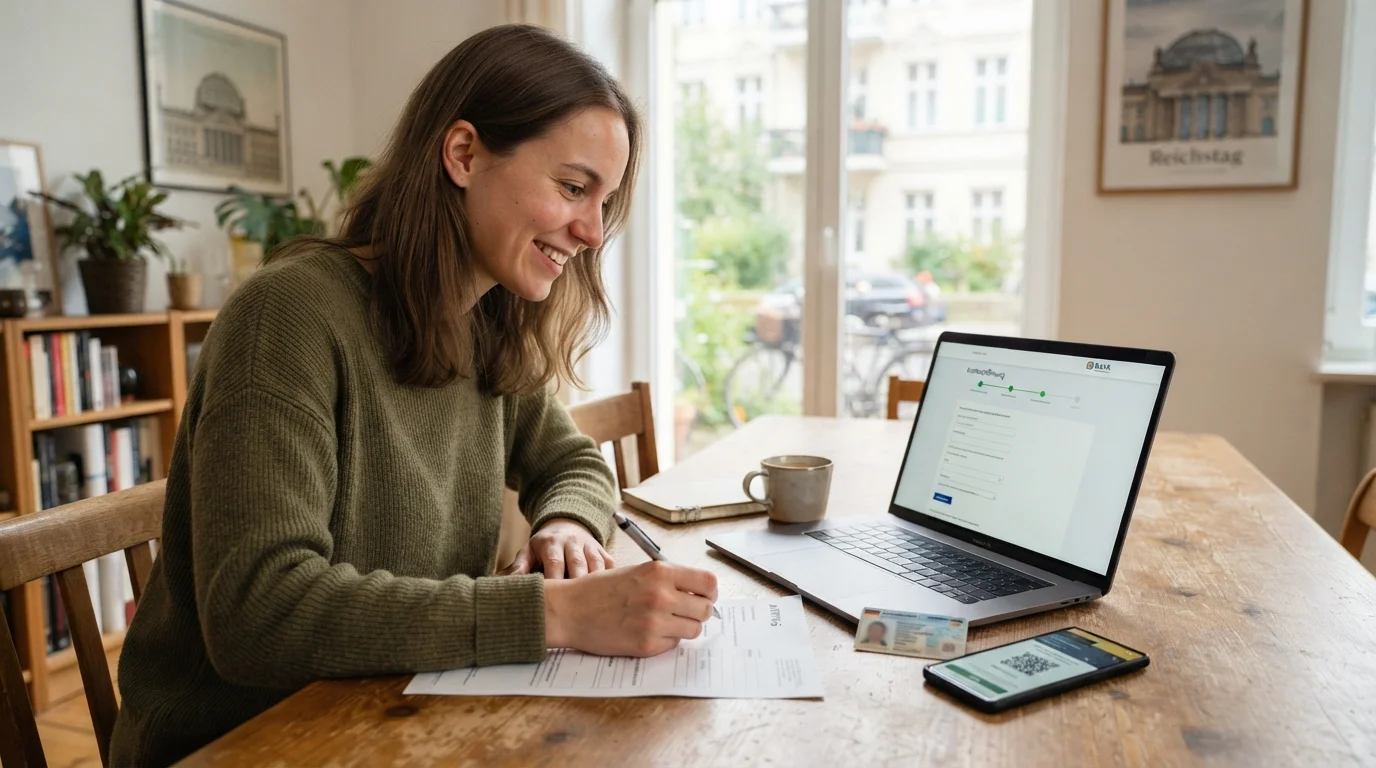
Opening an online bank account in Germany takes between 10 and 20 minutes from the comfort of your desk. Here is the standard workflow:

Step 1: Complete the Online Application

Navigate to the bank's website or download their smartphone app. You will fill in your personal details: full name (matching your passport exactly), date of birth, current residential address, nationality, tax residency, and email address.

Step 2: Verify Your Identity

German law requires positive identity authentication. Online banks provide two main methods:

  • VideoIdent: A 5-minute video call with an agent (often handled through third-party services like IDnow or WebID). You will hold up your passport, tilt it under the light to show holographic security features, and confirm an SMS verification code. Many agents speak fluent English.
  • PostIdent: If your passport's security features cannot be verified via camera, you can print a PostIdent coupon and present it alongside your original passport at any Deutsche Post branch. The postal clerk scans your documents and securely transmits the verification to the bank.
  • eID (Elektronischer Personalausweis): If you hold an EU ID or German electronic residence permit (eAT) with enabled online chip functionality, you can verify instantly using NFC on your smartphone.

Step 3: Receive Your Account Details and Cards

Once verified, your IBAN is generated immediately. In classic German security fashion, physical cards and their corresponding PIN codes are never sent together. You will receive two or three separate letters over the course of 3 to 7 business days: one with your card, one with your initial PIN, and another with online activation credentials.

German Banking Culture: Quirks and What to Expect

Even in a digitized world, banking in Germany has distinct cultural characteristics that surprise many international residents:

1. "Bargeld lacht" (Cash is King)

While card and contactless phone payments have grown substantially, small cafes, traditional beer gardens, flea markets, and doctor offices still frequently display signs reading "Nur Barzahlung" (Cash only). Always keep €20–€50 in your wallet for emergencies.

2. Girocard vs. Credit/Debit Cards

In many other countries, Visa and Mastercard dominate all merchant terminals. In Germany, the proprietary Girocard network was historically dominant. While major supermarkets accept foreign credit cards, smaller bakeries, government offices, and local boutiques may only accept a Girocard. If you choose an online bank that only issues a Visa/Mastercard debit card, check whether you can add an optional Girocard.

3. The Sacred Separation of PINs

Do not be alarmed when your welcome mail arrives piecemeal. German banks adhere to strict data-protection and anti-fraud protocols, meaning cards, activation letters, and PIN reminders arrive in staggered envelopes.

Useful Phrases for Banking in German

If you visit a branch or speak to telephone customer service, here are several practical phrases:

  • "Ich möchte ein Girokonto eröffnen." (I would like to open a checking account.)
  • "Welche Unterlagen benötigen Sie von mir?" (Which documents do you need from me?)
  • "Gibt es eine monatliche Kontoführungsgebühr?" (Is there a monthly account maintenance fee?)
  • "Ich habe meine PIN vergessen. Können Sie mir eine neue zusenden?" (I forgot my PIN. Can you send me a new one?)
  • "Ich möchte eine Überweisung ins Ausland tätigen." (I would like to make an international bank transfer.)
  • "Wie kann ich meine Karte sperren lassen?" (How can I block my card?) — Tip: Germany has a central nationwide emergency number to block lost bank cards: 116 116.

Practicing these spoken interactions with Bretzi's AI conversation trainer helps you build natural speaking fluency and pronunciation confidence before interacting with German financial authorities.

Final Checklist for New Expats

To ensure a smooth transition into the German financial ecosystem, keep this checklist handy:

  • [ ] Complete your local address registration (Anmeldung) as early as possible.
  • [ ] Choose a bank tailored to your situation (e.g., N26 for instant English setup, or C24/ING/DKB for long-term salary deposits).
  • [ ] Keep your passport and tax identification number ready for identity verification.
  • [ ] Set up standing orders (Daueraufträge) for rent and regular bills.
  • [ ] Submit a tax exemption form (Freistellungsauftrag) through online banking so interest earned isn't automatically taxed.

Setting up your German bank account is a major milestone in your expat journey. Once your IBAN is in hand, you are fully empowered to work, live, and thrive in Germany with complete peace of mind.

Frequently Asked Questions

Can I open a German bank account before arriving in Germany?
Yes, some digital neobanks like N26 allow citizens of EU/EEA countries and select other nations to open an account before arriving, provided they have a valid passport and an accepted address. Traditional German branch banks, however, require in-person verification and proof of local German address registration (Anmeldung).
What is the difference between a Girocard and a Debit Mastercard/Visa?
A Girocard is Germany's proprietary domestic debit card system, which connects directly to your Girokonto and is accepted by virtually all German merchants, including small shops and government offices. Debit Mastercards and Visas work globally online and in international terminals, but some smaller local German shops still only accept the Girocard.
Is my money safe in a German online bank?
Yes. All fully licensed German banks (including online banks like N26, DKB, ING, and C24) are covered by the German Statutory Deposit Guarantee Scheme (Entschädigungseinrichtung deutscher Banken GmbH - EdB), which legally protects customer deposits up to €100,000 per individual depositor.