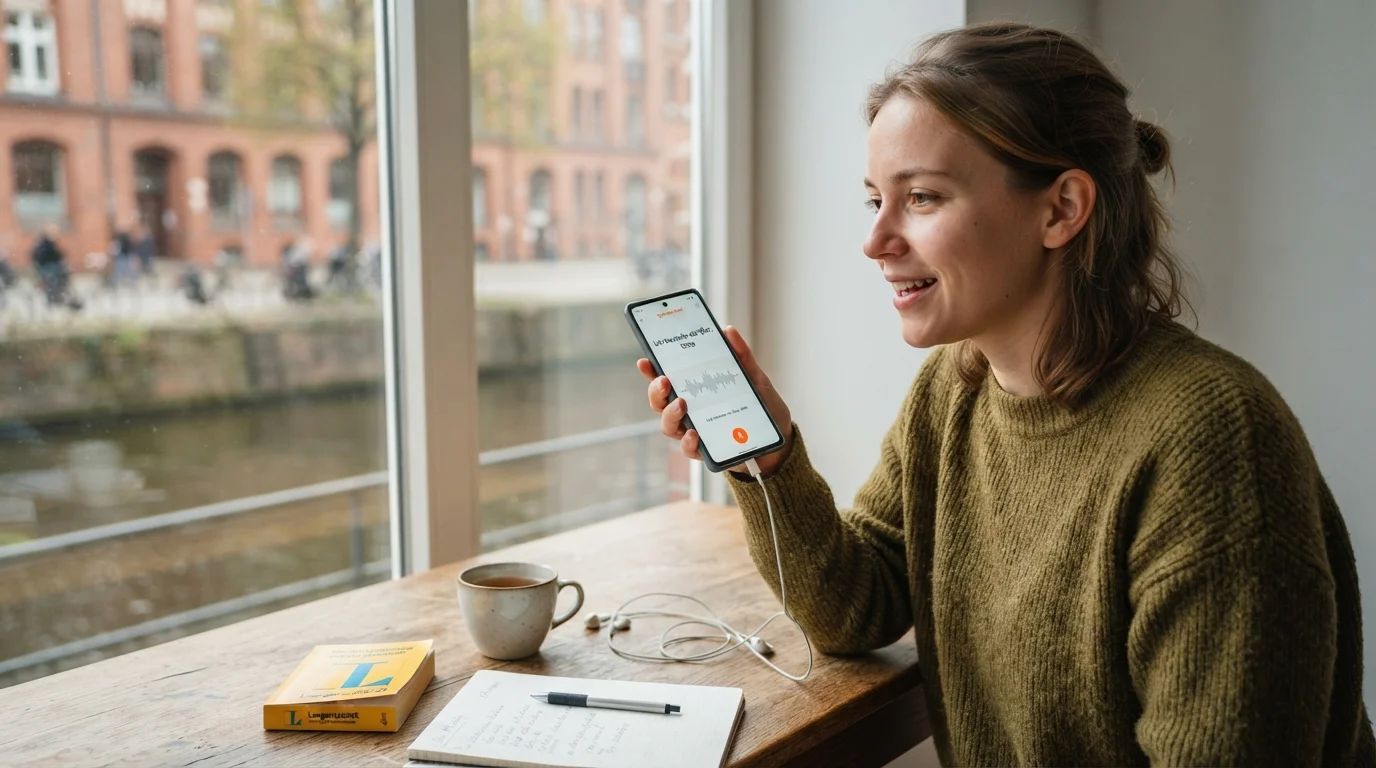
How to Practice German Pronunciation: Best App Features and Voice Recognition Tools
When you start learning German, the grammar often gets the lion's share of the attention. You wrestle with cases, memorize noun genders, and...
Read more
Learning German vocabulary often feels like an uphill battle. Between grappling with three distinct grammatical genders (der, die, das), unpredictable plural endings, and massive compound nouns like Geschwindigkeitsbegrenzung (speed limit), traditional memorization techniques can quickly overwhelm even the most enthusiastic learners.
For decades, language learners relied on static flashcard decks, rote word lists, and mechanical workbook drills. While these methods can yield short-term gains, they frequently fail when it comes to long-term memory retention and real-world conversational fluency. You might remember a word during a Tuesday morning flashcard review, only to completely draw a blank when speaking to a clerk at the local Bürgeramt on Friday.
Fortunately, the advent of artificial intelligence is fundamentally transforming second-language acquisition. Modern AI-powered German language apps are not merely digital versions of paper flashcards; they are intelligent cognitive tutors designed to optimize every stage of memory encoding, consolidation, and retrieval. In this guide, we explore the science behind how AI accelerates German vocabulary acquisition and how you can leverage these cutting-edge tools to achieve lasting fluency faster.
To understand why AI-driven learning is so effective, we must first examine how the human brain retains information. In the late 19th century, German psychologist Hermann Ebbinghaus pioneered the study of memory, discovering what is now famously known as the Ebbinghaus Forgetting Curve. His research demonstrated that humans lose approximately 50% to 70% of newly acquired information within 24 to 48 hours unless actively reviewed.
Traditional language learning methods struggle against the forgetting curve for three main reasons:
This is precisely where dynamic systems make a difference. When why dynamic AI tools beat static flashcards is analyzed, the core advantage lies in intelligent adaptation: AI monitors individual forgetting curves in real time, calculating the exact millisecond before a memory trace decays to trigger an active recall challenge.
Spaced Repetition Systems (SRS) have long been the gold standard for vocabulary acquisition. However, early algorithmic SRS tools relied on rigid mathematical formulas (such as the SuperMemo SM-2 algorithm) that only considered binary user input: whether you marked a card as "easy" or "hard."
Modern AI-powered language apps like Bretzi elevate spaced repetition into an adaptive, multi-dimensional learning experience through several key mechanisms:
When you misremember a German word, an AI tutor doesn't just log a generic failure. It analyzes why you made the mistake. Did you confuse the grammatical gender? Did you mix up separable prefix verbs like aufstehen and ausstehen? Did you use the correct root with an incorrect case ending? By categorizing the specific failure mode, the AI adjusts subsequent review prompts to target the root conceptual misunderstanding rather than repeating identical flashcards.
Bretzi keeps track of the words and mistakes you still need to review. If you keep making the same mistake, it comes back in your reviews just as it starts to fade. This is how Bretzi personalizes your German vocabulary routine: it keeps you focused on what you still need to practice.
Cognitive psychology confirms that information encoded through multiple sensory channels—visual, auditory, and kinesthetic—creates stronger neural connections. AI engines combine text-to-speech phonetic synthesis, interactive dialogue simulations, visual association cues, and speech recognition to activate multiple memory pathways simultaneously.
The single greatest limitation of traditional vocabulary study is the transfer problem: the inability to apply memorized words during spontaneous speech. Knowing that die Quittung means "receipt" does not automatically enable you to ask "Könnten Sie mir bitte eine Quittung ausstellen?" under the pressure of a live conversation.
AI bridges this gap by embedding vocabulary directly into dynamic, interactive dialogue scenarios. Instead of reviewing words in isolation, learners interact with conversational AI agents programmed to simulate authentic German environments:
According to educational frameworks established by the Goethe-Institut, functional communicative ability across Common European Framework of Reference for Languages (CEFR) levels demands not just lexical knowledge, but pragmatic situational mastery. AI-driven conversational practice provides exactly this exposure at scale.
Ask any German learner about their biggest obstacle, and the answer is almost unanimous: grammatical genders and plural forms. In German, memorizing a noun without its article (*der, die, das*) and plural suffix is essentially learning only half the word. Guessing genders incorrectly derails case endings, adjective declensions, and pronoun agreements across the entire sentence.
AI tackles this structural hurdle through specialized gamification and predictive pattern modeling:
While German genders often seem arbitrary, roughly 80% of German nouns follow predictable morphological rules (e.g., words ending in -ung, -heit, -keit, and -schaft are always feminine; words ending in -ling, -ismus, and -or are masculine). AI learning systems automatically group words by morphological patterns, helping your brain internalize underlying linguistic rules rather than relying on pure memorization.
Rather than lumping articles into generic vocabulary quizzes, advanced apps implement dedicated article mastery games that challenge learners on rapid gender identification. If you want to dive deeper into how automated feedback strengthens article retention, check out our guide on mastering German genders with dedicated games.
To extract the highest return on investment from AI-powered German learning tools, follow these five evidence-based learning strategies:
Memory consolidation requires sleep and neurological recovery cycles. Studying for 15 minutes twice a day is vastly superior to a single three-hour cramming session on Sunday afternoon. Leverage daily streak features to build an unbroken habit of spaced recall.
Do not complete vocabulary exercises silently. Pronouncing words activates your vocal apparatus and motor memory. Modern AI apps feature acoustic speech recognition that evaluates your intonation, vowel length (such as the critical distinction between long and short German vowels), and umlauts (ä, ö, ü), offering instant corrections before bad pronunciation habits solidify.
Do not learn verbs in a vacuum. Always memorize verbs with their mandatory prepositions and corresponding cases. For example, instead of just learning warten (to wait), learn warten auf + Akkusativ (to wait for). When prompting your AI tutor, ask for sentences that highlight these exact syntactic pairings.
Whenever your app flags a list of difficult or frequently missed words, initiate an AI roleplay session specifically designed around those terms. Using a challenging word correctly in three consecutive conversational exchanges creates far deeper cognitive retention than tapping a multiple-choice button ten times.
Pay attention to metrics that differentiate between words you merely recognize when reading (passive vocabulary) versus words you comfortably produce during spontaneous conversation or writing (active vocabulary). Aim to systematically migrate passive vocabulary into active fluency through consistent dialogue drills.
We are standing at the threshold of a new era in language education. Static flashcards and one-size-fits-all textbooks are rapidly making way for hyper-personalized, context-aware AI learning companions. By combining the proven principles of cognitive psychology with advanced natural language processing, AI apps eliminate the guesswork, inefficiency, and frustration traditionally associated with memorizing German vocabulary.
Whether you are an expat striving to navigate everyday life in Germany, a professional aiming for workplace proficiency, or a student preparing for official B1/B2 integration exams, integrating an AI-powered app like Bretzi into your daily routine can dramatically cut down your time to conversational fluency. Start harnessing intelligent spaced repetition, real-life dialogue simulations, and adaptive pronunciation coaching today, and experience how fast German vocabulary can truly stick.
Share this article:
When you start learning German, the grammar often gets the lion's share of the attention. You wrestle with cases, memorize noun genders, and...
Read moreAnyone who has attempted to learn German knows the infamous 'motivation cliff.' You start with immense enthusiasm, eager to master words like...
Read moreMoving to Germany, Austria, or Switzerland is an exciting milestone, but for many expats, the initial excitement quickly collides with linguistic...
Read more