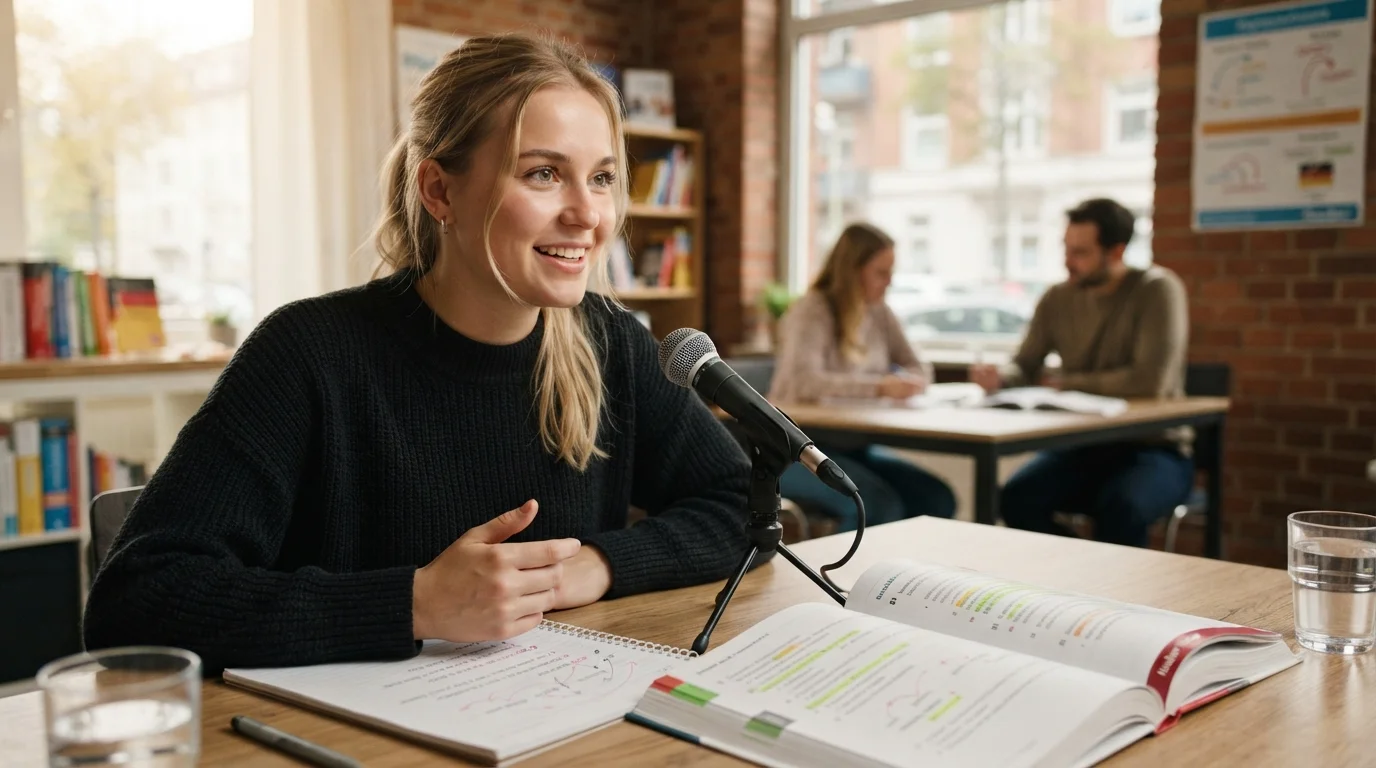
Mastering German Sentence Rhythm and Intonation for B1 Oral Exams
When preparing for the B1 German speaking exam—whether it is the Goethe-Zertifikat B1, telc Deutsch B1, or the Deutsch-Test für Zuwanderer...
Read more
If you have ever sat down with a German textbook, you probably felt an immediate wave of dread when you reached the chapter on plural nouns. In English, making a word plural is incredibly simple: you just add an -s or -es. Book becomes books, bus becomes buses. Easy, right?
In German, however, the rules seem to vanish into thin air. You have nouns that add an -e, some that add an -er, others that add an -n or -en, some that take an -s, and a frustrating group of nouns that do not change at all—except, perhaps, for a mysterious umlaut appearing over a vowel. To make matters worse, the plural form is closely tied to the noun's gender (der, die, or das).
It is easy to see why many expats, students, and integration exam candidates throw their hands up in defeat and resort to guessing. But here is the good news: German plurals are not completely random. Underneath the surface chaos lies a highly structured system of patterns, phonetic rules, and suffix shortcuts. By learning these simple, highly reliable patterns, you can accurately predict how to make almost any German noun plural.
In this comprehensive guide, we will break down the five golden rules of German plural endings, reveal the secret suffix shortcuts that work 100% of the time, and share actionable practice strategies to help you speak with confidence. Plus, we will show you how modern AI tools can make memorizing these patterns an absolute breeze.
Almost all German plural nouns fall into one of five main categories. Instead of memorizing thousands of individual words, you can categorize them by these five primary endings. Let's look at each one in detail.
This is by far the most common plural ending in the German language, covering about 35% of all nouns. The great news is that it is incredibly consistent: almost all feminine nouns (die) take "-n" or "-en" in the plural.
Let's look at some examples:
Note: If a feminine noun ends in -in (often denoting a female profession), you double the "n" and add "-en". For example: die Lehrerin (the female teacher) → die Lehrerinnen.
The -e ending is the default choice for many masculine (der) and neuter (das) nouns, especially those that are single-syllable words.
Examples:
If you see a plural ending in -er, there is a very high chance the noun is neuter (das). This ending is almost never used for feminine nouns. Crucially, every single noun that takes an "-er" plural must take an umlaut on the stem vowel if it is able to (a, o, u, au).
Examples:
This is the easiest rule for English speakers to remember because it matches our native tongue. German uses the -s ending primarily for words borrowed from other languages (like English and French), abbreviations, and words ending in full vowels other than "e" (such as a, i, o, u, y).
Examples:
What if the plural is identical to the singular? This is common for masculine and neuter nouns that already end in -el, -en, or -er. Because these words already end in unstressed syllables, adding another syllable would sound awkward.
Examples:
To understand how these morphological changes evolved historically, you can read more about the linguistic roots on the Wikipedia guide on German nouns.
While the five rules above cover general patterns, there are specific noun suffixes (endings of singular words) that act as absolute cheat codes. If you see a noun ending in any of the following suffixes, you do not even have to think about its plural. The suffix dictates both the gender and the plural ending with absolute certainty.
| Singular Suffix | Gender | Plural Ending | Example Singular | Example Plural |
|---|---|---|---|---|
| -ung | Feminine (die) | -en | die Wohnung (apartment) | die Wohnungen |
| -heit / -keit | Feminine (die) | -en | die Freiheit (freedom) | die Freiheiten |
| -schaft | Feminine (die) | -en | die Freundschaft (friendship) | die Freundschaften |
| -tät | Feminine (die) | -en | die Universität (university) | die Universitäten |
| -lein / -chen | Neuter (das) | No change | das Mädchen (girl) | die Mädchen |
| -ismus | Masculine (der) | -ismen | der Optimismus (optimism) | die Optimismen |
Memorizing these suffixes is one of the highest-yield activities you can do as a German learner. It instantly solves both the gender puzzle and the plural puzzle simultaneously.
Mastering plural endings is not just about vocabulary; it is a critical pillar of overall sentence construction. Once you master noun plurals, you will find it much easier to master German adjective declension without boring charts, as adjective endings depend heavily on whether a noun is singular or plural, and what case it is in.
For example, in the nominative plural, adjectives take a simple -en ending when preceded by a definite article (die alten Bücher - the old books). Without knowing the plural form of Buch, you would struggle to apply the correct adjective ending.
While structuring your thoughts might also require you to get comfortable with complex syntax like German word order rules like weil, denn, and da, building a robust vocabulary of plural nouns is the bedrock of expression. Without the correct plural nouns, even perfect word order won't save a sentence from sounding unnatural.
Now that you know the rules, how do you get them to stick in your brain so you can use them in real-time conversations? Here are three actionable strategies:
When you learn a new German word, never write down just the English translation. Always learn the word as a three-part package: [Gender Article] + [Singular Noun] + [Plural Ending].
Instead of writing: table = Tisch
Write: der Tisch, -e (or der Tisch, die Tische)
By treating the article and the plural ending as part of the word's spelling, your brain will naturally link them together as a single auditory unit.
Rote memorization from static lists is incredibly boring and highly inefficient. This is where technology can save you hours of frustration. Using the Bretzi app, you can access personalized learning plans powered by AI. Bretzi offers specialized article mastery games and vocabulary building features utilizing spaced repetition. This system tracks which plural endings you struggle with and surfaces them right before you are about to forget them, ensuring they lock into your long-term memory.
Instead of studying random words alphabetically, group your vocabulary by category and pattern. For example, create a study session focused entirely on kitchen items that take the feminine "-n" ending (die Gabeln, die Tassen, die Pfannen). This helps your brain build strong visual and contextual associations, making recall much faster when you are in the middle of a real-life conversation.
As you practice, keep an eye out for these unique quirks of the German language:
While German plural endings can seem overwhelming at first glance, they are governed by logical patterns that you can master with the right approach. By focusing on the five golden rules, utilizing suffix shortcuts, and learning nouns as complete packages, you will rapidly build your grammatical intuition.
Ready to take your German plural mastery to the next level? Download the Bretzi app today. With real-life German conversation practice with AI, instant pronunciation training, and interactive dialogue games, you can practice your plurals in natural, practical scenarios without any fear of making mistakes. Start your streak today and watch your confidence soar!
Share this article:
When preparing for the B1 German speaking exam—whether it is the Goethe-Zertifikat B1, telc Deutsch B1, or the Deutsch-Test für Zuwanderer...
Read moreYou sit down at a German bakery, smile warmly at the server, and confidently declare: "Ich bin voll!" Instead of a polite nod acknowledging your...
Read moreWhen you start learning German, you quickly realize that translating every word literally leads to utter confusion. A German colleague might suddenly...
Read more