
DTZ Exam Writing: How to Express Regret and Formal Apologies
When preparing for the Deutsch-Test für Zuwanderer (DTZ), the writing portion (Schreiben) is frequently where test-takers feel the most pressure. In...
Read more
This article was drafted by AI and edited by a person before it was published.
AI can get things wrong. For anything official, check the source it points to.
AI-generated image
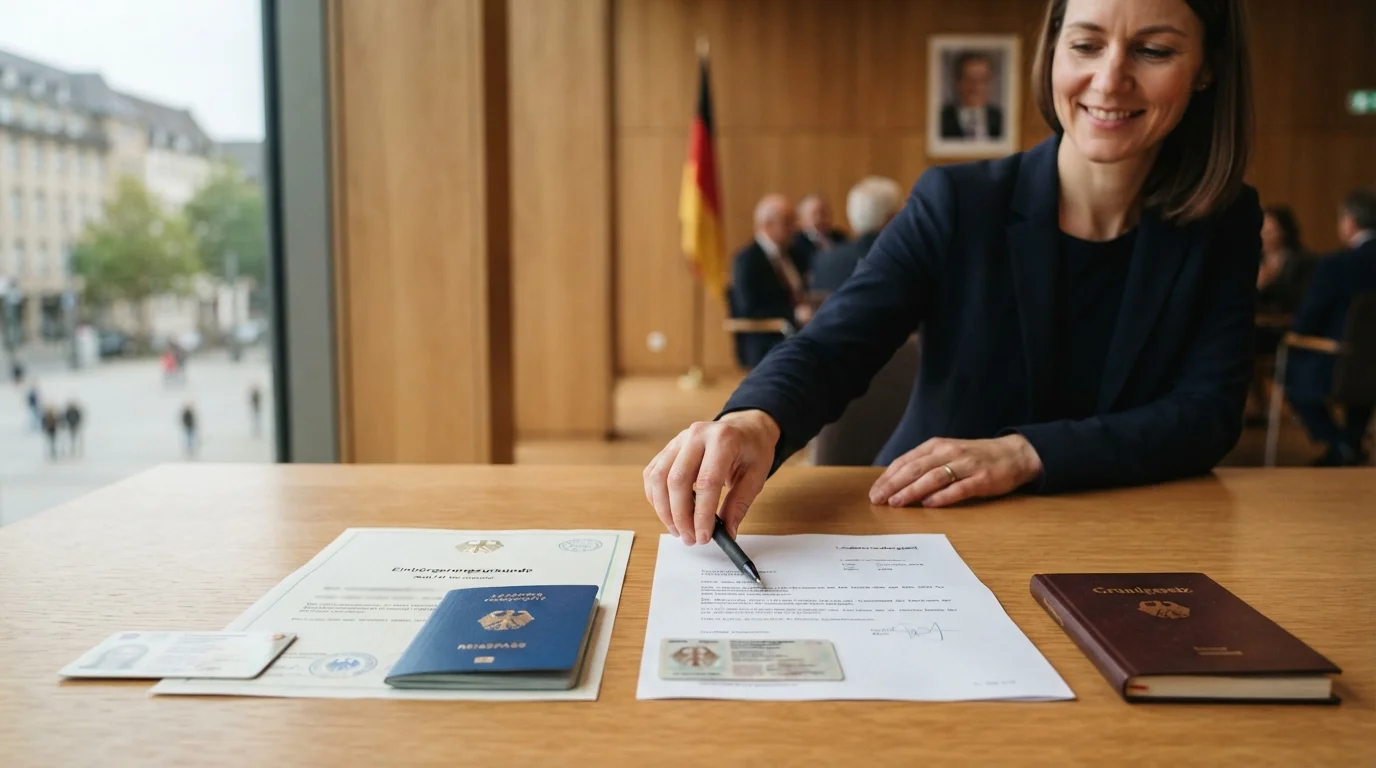
After months—or often years—of collecting payslips, translating birth certificates, taking language tests, and waiting patiently through bureaucratic processing times, your official invitation letter (*Einladung*) has finally arrived in the mailbox. You are invited to your naturalization appointment or ceremony (*Einbürgerungsfeier*). This is the moment where you receive your certificate of naturalization (*Einbürgerungsurkunde*) and officially become a German citizen.
While the ceremony is a festive and proud occasion, it remains an official legal appointment conducted by the naturalization authority (*Einbürgerungsbehörde*). Showing up unprepared without the right documents can cause unnecessary delays or even postpone the delivery of your certificate. To ensure everything goes smoothly on your special day in 2026, here is a detailed, comprehensive guide to what you need to bring, what to expect, and how to prepare.
Before packing your folder, it helps to understand what kind of appointment you will be attending. In Germany, the delivery of the certificate generally takes one of two formats, depending on your city (*Kommune* or *Landkreis*):
Regardless of whether you are attending a grand celebration in a town hall or an administrative meeting in an office, the mandatory legal documentation required from you remains strictly the same.
A German citizenship ceremony (*Einbürgerungsfeier*) is the official statutory event where an applicant recites the solemn declaration of loyalty to the Basic Law and receives their certificate of naturalization (*Einbürgerungsurkunde*), which is the exact legal moment German citizenship is granted under Section 16 of the German Nationality Act (StAG). Whether organized as a festive town hall reception or an administrative counter appointment, the event follows a set legal protocol to verify your identity, administer your commitment, and hand over your citizenship deed.
If your local authority hosts a group ceremony, the schedule generally proceeds through five distinct stages:
A communal German citizenship ceremony typically lasts between 60 and 90 minutes from opening remarks to the final handover of certificates. By contrast, an individual administrative counter appointment (*Einzelaushändigung*) takes approximately 10 to 20 minutes, focusing strictly on identity checks, verbal recitation, signing the declaration, and document exchange.
Since the naturalization law update that took effect on 27 June 2024, Germany allows multiple citizenship, meaning you are no longer required under federal law to give up your previous nationality unless your country of origin requires renunciation under its own domestic statutes. Naturalization requires at least five years of lawful residence, proven German language skills at B1 level, and a passed naturalization test (*Einbürgerungstest* or *Leben in Deutschland*), which requires 17 correct answers out of 33 questions from the official 310-question catalogue (costing €25). Understanding the essential legal terms to know for the German naturalization exam will ensure you are comfortable with the legal vocabulary used during the speeches and declarations on your ceremony day.
Do not wait until the morning of your ceremony to organize your documents. Gather the following items into a clean, sturdy document folder at least a few days in advance:
Your invitation contains critical information: your appointment time, room number, case file number (*Aktenzeichen*), and the name of your case worker. In larger public buildings, security staff or reception desks will ask to see this letter before directing you to the ceremonial hall.
You cannot receive your German citizenship certificate without definitive proof of identity. Bring your current foreign passport or valid national identity card. It must not be expired on the day of the ceremony. If your passport was recently renewed while your citizenship application was pending, bring both the new passport and the expired document referenced in your initial application file.
Bring your electronic residence card (*elektronischer Aufenthaltstitel* - eAT) or residence permit sticker in your passport. Under German administrative procedure, your existing residence permit becomes legally void the moment you become a German citizen. In many districts, the case worker will officially retain, invalidate, or puncture your eAT card right at the appointment.
The standard statutory administrative fee for naturalization is €255 per adult (and €51 for underage children naturalized alongside their parents). Some municipalities invoice you by mail before the ceremony and require you to bring the bank transfer receipt (*Überweisungsbeleg* or *Kontoauszug*). Other authorities require you to pay on the day using an EC/Girocard at an automated payment terminal (*Kassenautomat*). Read your appointment invitation carefully to check whether payment confirmation is required.
Authorities frequently ask applicants to present original civil documents that were previously only submitted as certified copies. These may include:
If your application relied on language or civic certificates, the clerk may review your original language or civic certificates one final time before completing your file.
Under Section 16 of the German Nationality Act (Staatsangehörigkeitsgesetz - StAG), naturalization becomes legally effective only after you have made the solemn declaration of loyalty to the free democratic basic order.
Every applicant aged 16 or older must make this oral declaration (or repeat it after the presiding official):
"Ich erkläre feierlich, dass ich das Grundgesetz und die Gesetze der Bundesrepublik Deutschland achten und alles unterlassen werde, was ihr schaden könnte."
("I solemnly declare that I will respect the Basic Law and the laws of the Federal Republic of Germany and refrain from anything that could harm it.")
In addition to reciting this statement aloud, you will be required to sign a written version of the loyalty declaration (*Loyalitätserklärung*) confirming your commitment to democratic values, the protection of human dignity, and the constitutional order.
Because the oath must be spoken aloud in German, many candidates feel a brief flutter of nervousness about their pronunciation. While you do not need perfect diction, officials must be confident that you understand the words you are speaking. If you want to build vocal confidence before the ceremony, the Bretzi app features an AI conversation partner called SprachBuddy, where you can speak German out loud in a low-pressure environment, alongside pronunciation practice that scores your speech and pinpoints words to improve.
Once your documents are in order, you can focus on the practical details of attending the event.
There is no strict legal dress code in the German civil code, but respect for the occasion is standard practice:
Check the fine print of your invitation letter. Festive municipal ceremonies usually allow you to bring one or two guests (such as a partner, parents, or children). Due to venue capacities, some cities require you to pre-register the names of your guests a week in advance. In smaller individual office appointments, space is limited, so officers often request that only the applicant (and direct family members being naturalized together) enter the room.
Group ceremonies usually provide dedicated photo backdrops or designate a moment at the end where your family can take photos of you holding the *Einbürgerungsurkunde*. However, recording or photographing staff during individual administrative processing is strictly prohibited in German public buildings due to data privacy laws (*Datenschutz*). Always ask the presiding officer before taking out your camera.
Once you sign the declaration and receive your Einbürgerungsurkunde, you are legally a citizen of Germany. However, the physical certificate itself is not a travel document or a daily ID. Here are the immediate administrative steps you must take right after leaving the building:
Book an appointment at your local residents' registration office (*Bürgeramt* or *Bürgerbüro*) as soon as you have your ceremony date. To apply for your German identity card and passport, bring:
Standard delivery of the passport and national ID takes roughly three to six weeks via the federal printing office (Bundesdruckerei). If you have urgent travel plans, you can order an express passport for an additional fee or request a temporary passport (*Vorläufiger Reisepass*).
Your legal nationality has changed, which affects social security records, employment master data, and bank compliance checks. Send a scanned copy of your certificate or your new ID card to:
Your Einbürgerungsurkunde is an irreplaceable vital document. The naturalization authority does not issue duplicate originals; if lost, you can only obtain certified extracts or administrative confirmation letters (*Bescheinigung über die Einbürgerung*). Store the original deed flat in an acid-free document protector inside a secure home safe or fireproof box.
Receiving your German citizenship is the culmination of dedication, learning, and integration. Whether you arrived in Germany years ago and took your first steps by passing the Orientierungskurs final exam, or you came by another route, this ceremony marks your permanent belonging in the democratic society of Germany.
Pack your folder thoughtfully, arrive 15 minutes before your scheduled appointment time, take a deep breath, and enjoy reciting your commitment to your new home country.
Rules, fees and dates change. Check the current version on the official pages before you act.
Share this article:
When preparing for the Deutsch-Test für Zuwanderer (DTZ), the writing portion (Schreiben) is frequently where test-takers feel the most pressure. In...
Read moreStanding outside the exam room, heart thumping, waiting for the oral portion of the Deutsch-Test für Zuwanderer (DTZ) is an experience thousands of...
Read moreSecuring a German B1 language certificate is one of the most critical milestones for anyone building a life in Germany. Whether you are aiming for a...
Read more