German Citizenship Reform 2026: Fast-Track Rules
Germany's modernized citizenship law has transformed how long-term foreign residents build their futures in the country. Following landmark updates...
Read more
This article was written by AI and published by Bretzi.
AI can get things wrong. For anything official, check the source it points to.
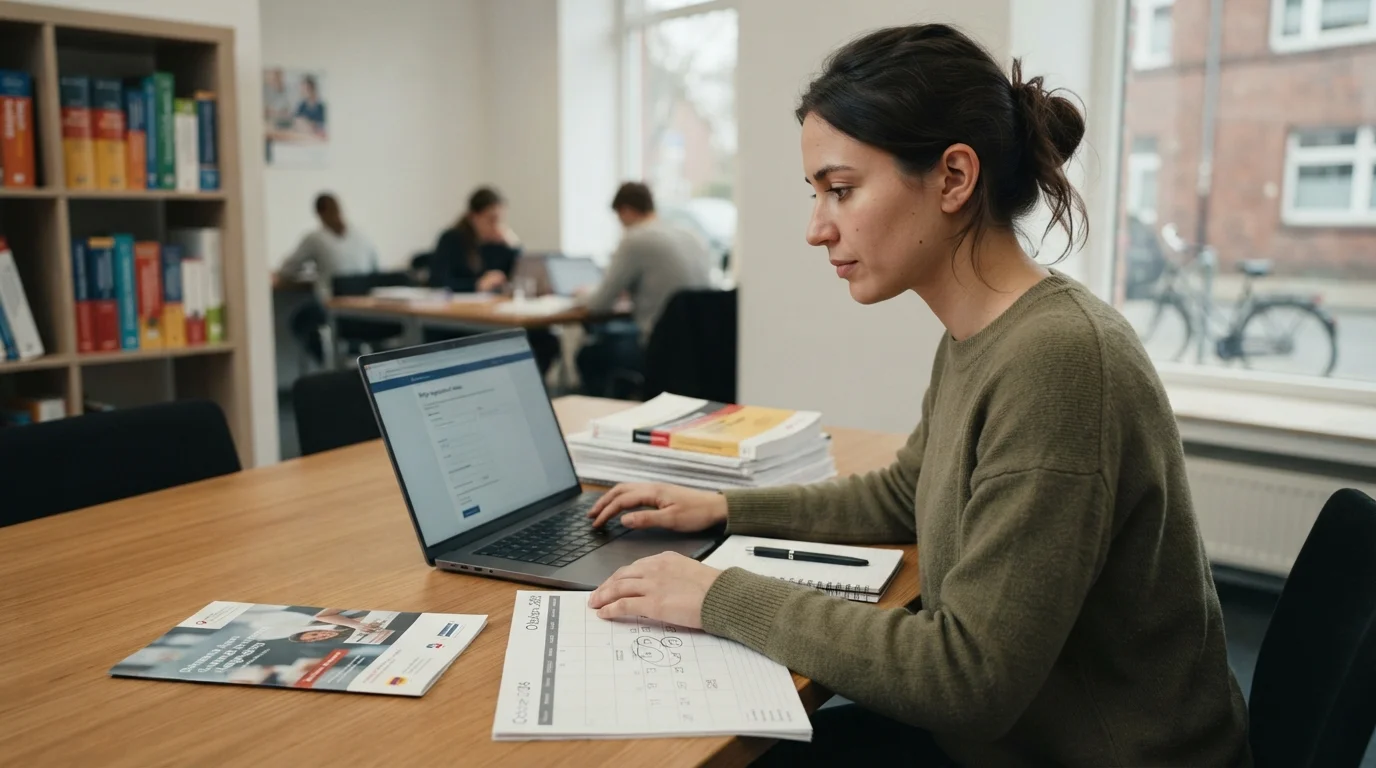
AI-generated image

Standing outside the exam room, heart thumping, waiting for the oral portion of the Deutsch-Test für Zuwanderer (DTZ) is an experience thousands of immigrants in Germany share every month. While introducing yourself in Teil 1 is fairly predictable, Teil 2: Über ein Bild sprechen (Picture Description) catches many candidates off guard. The examiner slides a photograph across the table, and you have roughly two to three minutes to deliver a coherent, structured description and personal reflection in German.
Achieving a solid B1 rating on this task does not require poetic fluency or an encyclopedic vocabulary. Instead, it demands a clear strategy, versatile transition phrases (Redemittel), and the ability to demonstrate key B1 grammatical structures under pressure. Whether you are mapping out your A1 to B1 German timeline or putting the final polish on your exam preparation, this comprehensive guide walks you through every step to master the DTZ picture description.
The DTZ oral exam is typically conducted in pairs (with two test candidates and two examiners) and consists of three distinct parts:
In Teil 2, you and your partner receive different pictures. Each candidate speaks individually about their own image for approximately 1.5 to 2 minutes, followed by 1 to 2 targeted follow-up questions from the examiners. The photographs reflect typical situations of daily life, work, bureaucracy, healthcare, shopping, housing, or family in Germany—themes defined by the Federal Office for Migration and Refugees (BAMF).
Examiners evaluate your performance according to strict CEFR (Common European Framework of Reference) rubrics. They do not expect you to name every tiny object in the frame. Instead, they assess:
When the examiner hands you the photo, do not immediately launch into disorganized commentary. Use this reliable 4-step framework to keep your response structured, logical, and thoroughly grounded in B1 German.
Start with a high-level summary of the scene. What is the central theme? Where is the action taking place?
Move your eyes systematically across the picture. A classic technique is moving from the foreground to the background, or from left to right. Describe the people, their clothing, expressions, and what they are actively doing.
Examiners love speculation because it forces you to use modal verbs, conditional forms, or subordinating conjunctions. If you aren't sure what is happening, do not freeze—interpret it!
This final step is essential for reaching the B1 benchmark. Connect the situation to your own life and compare how things work in Germany versus your home country.
Having a toolkit of dependable phrases allows your brain to focus on accuracy rather than searching for words. Review these standard building blocks regularly alongside your broader strategy for building active vocabulary for the DTZ.
| Function | German Phrase (Redemittel) |
|---|---|
| Spatial Orientation | Im Vordergrund / Im Hintergrund / In der Mitte / Oben / Unten / Auf der linken/rechten Seite |
| Describing Appearance | Die Person sieht glücklich/müde aus; Sie trägt legere Kleidung; Er scheint circa 40 Jahre alt zu sein. |
| Speculating | Es könnte sein, dass... / Wahrscheinlich / Vermutlich / Ich habe den Eindruck, dass... |
| Expressing Opinion | Meiner Ansicht nach... / Ich finde, dass... / Für mich persönlich bedeutet das... |
| Comparing Cultures | Im Vergleich zu meinem Heimatland... / Bei uns macht man das meistens so, dass... |
The boundary between A2 and B1 often comes down to syntactic variety. If every sentence begins with "Das Bild zeigt..." or "Der Mann ist...", your score will hover around A2. Sprinkle in these specific grammatical tools to signal B1 competence:
Use conjunctions that send the conjugated verb to the very end of the clause:
Relative clauses allow you to pack descriptive details smoothly into a single sentence:
Describing spatial layout requires precision with the dative case (location) versus the accusative case (direction):
While mastering grammar patterns is vital for oral communication, keep in mind that the DTZ also tests your writing skills; balancing your study time with mastering the written portion ensures balanced progress across all four exam components.
Even well-prepared learners encounter moments of hesitation. Knowing how to react when things do not go as planned makes all the difference.
If you see a stapler, a fire extinguisher, or a stethoscope and draw a blank on the German noun, never freeze or switch to English. Paraphrase using simpler words or relative clauses:
Examiners love circumlocution; it directly proves B1-level communication flexibility.
Silence hurts your fluency mark. Use filler phrases (Verzögerungsmarker) when your brain needs three seconds to assemble a sentence:
Nervous candidates often rush, which increases grammatical errors with verb endings and gender agreements. Speak at a measured, deliberate pace. Focus on placing the conjugated verb in position 2 for main clauses and at the end for subordinate clauses.
Passive reading won't make your tongue move faster. To build genuine oral fluency, you need interactive, voiced repetition that mimics the pressure and tempo of test day.
One practical tool built specifically for Germany's language ecosystem is Bretzi. The app offers a dedicated exam practice section for the B1 integration test, covering listening, reading, writing, and speaking with a built-in timer. For speaking practice, you can call Bretzi's AI conversation partner, SprachBuddy, and practice talking out loud about everyday situations—such as appointments, work scenes, or shopping scenarios—receiving pronunciation feedback and reviewing your full transcripts afterward. It is available on iOS (iPhone, iPad, Apple Watch) and Android devices with an internet connection, allowing you to turn daily spare moments into focused oral practice.
In addition to app-based practice, use this weekly routine leading up to your exam:
The DTZ B1 picture description is not an unpredictable riddle. It is an exercise in structural discipline. When you walk into the exam room armed with an orderly plan—starting with the big picture, detailing visual elements, offering plausible interpretations, and sharing personal comparisons—you relieve your anxiety and give the examiners precisely what the CEFR rubric rewards.
Stay calm, keep your sentences structured with clean connective words, and practice speaking aloud every day. With consistent, focused preparation, you will deliver a confident, polished presentation on exam day.
Share this article:
Germany's modernized citizenship law has transformed how long-term foreign residents build their futures in the country. Following landmark updates...
Read moreSecuring a German B1 language certificate is one of the most critical milestones for anyone building a life in Germany. Whether you are aiming for a...
Read moreOpening an envelope from the Federal Office for Migration and Refugees (BAMF) and seeing that you didn't reach the required B1 level or pass the...
Read more