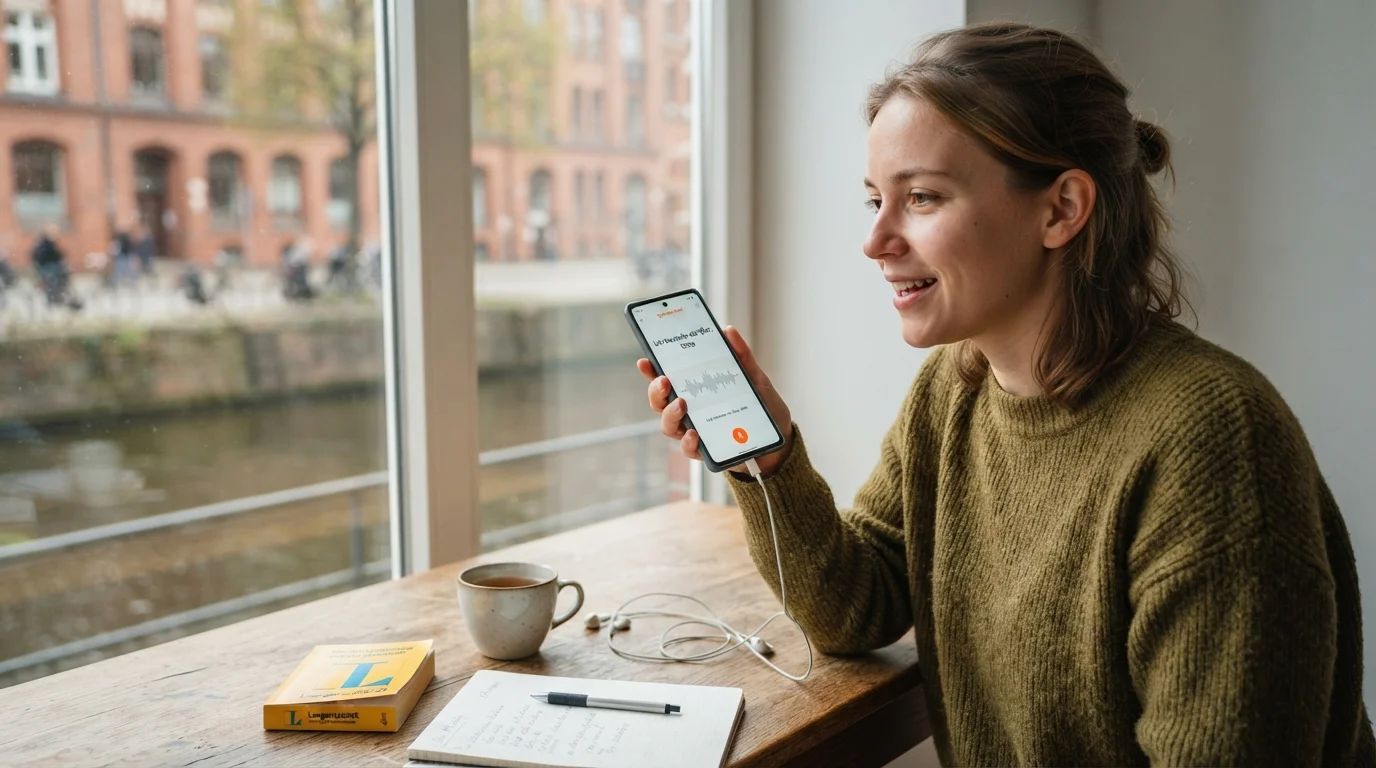
How to Practice German Pronunciation: Best App Features and Voice Recognition Tools
When you start learning German, the grammar often gets the lion's share of the attention. You wrestle with cases, memorize noun genders, and...
Read more
Learning German has long carried a reputation as one of the most challenging linguistic endeavors for English speakers. Between complex cases, three grammatical genders, and compound words that stretch across entire sentences, achieving genuine fluency requires dedication, strategy, and the right toolkit. As artificial intelligence transforms language acquisition in 2026, language learners, expats, and exam candidates are increasingly turning to dedicated platforms rather than traditional, slow-paced classroom methods.
Among the rising stars in AI-powered learning is Bretzi, an app designed specifically to bridge the gap between textbook grammar and natural spoken German. But can an intelligent language learning platform really take you all the way to fluency? In this comprehensive, realistic 2026 review, we take an objective look at what it takes to become fluent in German, where Bretzi excels, where its boundaries lie, and how you can leverage its features to reach your language goals faster.
Before evaluating whether Bretzi—or any tool—can lead you to fluency, it is essential to establish what fluency actually means. Many learners confuse fluency with perfection, assuming they must speak without an accent or know every word in the dictionary. In reality, language proficiency is structured around functional capabilities.
The Common European Framework of Reference for Languages (CEFR) divides language proficiency into six levels: A1, A2, B1, B2, C1, and C2. When language experts and expats talk about practical fluency, they usually refer to Level B2 or C1:
For most expats moving to Germany, Switzerland, or Austria, reaching B2 functional fluency is the golden milestone. It allows you to work in a German-speaking environment, socialise comfortably, and navigate daily administrative hurdles without panic.
Traditional language apps often fall into one of two traps: either they rely on mindless vocabulary matching games that fail to build practical speaking skills, or they present dry, overwhelming grammar rules detached from actual conversation. Bretzi addresses these flaws by integrating conversational AI directly into a structured curriculum ranging from beginner (A0) to advanced (C1) levels.
Here is an overview of how the platform structures the learning path:
To determine if Bretzi can bring you to fluency, let us examine the core pillars required to master the German language: speaking confidence, active vocabulary acquisition, structural understanding, and listening comprehension.
The biggest hurdle for non-native speakers living in German-speaking countries is the reluctance to speak. Many learners spend months studying grammar tables, only to freeze up when speaking to a cashier or colleague. The fear of making mistakes in front of native speakers often slows down progress dramatically.
This is where interactive AI conversations shine. By offering a patient, judgment-free conversational partner, learners can speak aloud from day one. You can practice phrasing sentences, experimenting with word order, and taking risks without feeling self-conscious. To take full advantage of voice technology, explore our complete guide on mastering German pronunciation at home.
German vocabulary is vast, and retaining thousands of nouns along with their corresponding genders requires strategic review. Storing words in short-term memory is easy, but transferring them to long-term recall requires spaced intervals.
Bretzi incorporates spaced repetition algorithms (SRS) directly into vocabulary building and article games. Instead of memorising static lists, you encounter target vocabulary right when your brain is about to forget it. If you want to dive deeper into cognitive memory techniques, check out our guide on how to learn German vocabulary fast with spaced repetition.
Textbooks frequently teach formal, archaic phrases that sound unnatural on the streets of Berlin, Munich, or Vienna. True fluency means understanding colloquial phrasing, situational etiquette, and practical vocabulary.
Whether you are registering your address, opening a bank account, or discussing work projects, simulation exercises prepare you for authentic conversations. Read more on how Bretzi helps expats learn real-life German to see how practical scenarios translate to daily life abroad.
Let us answer the central question candidly: Can you reach full German fluency using Bretzi as your sole tool?
The short answer is that Bretzi provides structured lessons from A0 to C1, interactive practice, and speaking repetition, but how far you get depends on your practice, and real fluency also requires combining digital tools with real-world exposure.
To work towards B2 fluency, you need a balanced, action-oriented routine. Here is a proven daily framework to maximize your progress:
Consistency beats intensity every time. Spending 20 minutes every single day on Bretzi yields far better memory retention than a single 3-hour marathon session on Sundays. Use this time to finish a grammar lesson, review spaced-repetition vocabulary, and complete an interactive dialogue game.
Do not skip the vocal exercises! Treat your AI conversation partner like a private tutor. Challenge yourself to answer using full sentences rather than one-word replies. Speak loudly, pay attention to pronunciation feedback, and try rephrasing ideas when you make a mistake.
Surround yourself with the sounds of the language throughout your day:
If you live in a German-speaking region, commit to using German in low-stakes interactions. Resist the temptation to switch to English at cafes or supermarkets. If you live abroad, join local German language meetups or online language exchange partnerships to apply what you have practiced in the app.
In 2026, language learning has evolved beyond passive flashcards and static grammar books. Bretzi stands out as a practical option for anyone serious about learning German. By combining personalized learning paths, instant pronunciation feedback, interactive scenario games, and real-time AI conversation, it addresses the exact areas where conventional methods fall short—speaking confidence and practical application.
If your goal is to build strong conversational fluency, understand complex grammar rules intuitively, and feel confident speaking German in everyday life, Bretzi offers an efficient, highly practical path forward. When combined with regular exposure to authentic German media and active real-world conversations, reaching fluent B2 proficiency is not just possible—it is a completely realistic, achievable goal.
Ready to transform your German learning journey? Download Bretzi today, create your personalized AI learning plan, and start speaking real German with confidence from your very first lesson!
Share this article:
When you start learning German, the grammar often gets the lion's share of the attention. You wrestle with cases, memorize noun genders, and...
Read moreAnyone who has attempted to learn German knows the infamous 'motivation cliff.' You start with immense enthusiasm, eager to master words like...
Read moreMoving to Germany, Austria, or Switzerland is an exciting milestone, but for many expats, the initial excitement quickly collides with linguistic...
Read more