
How to Ace the Oral Picture Description in the DTZ B1 German Exam
Standing outside the exam room, heart thumping, waiting for the oral portion of the Deutsch-Test für Zuwanderer (DTZ) is an experience thousands of...
Read more
This article was written by AI and published by Bretzi.
AI can get things wrong. For anything official, check the source it points to.
AI-generated image
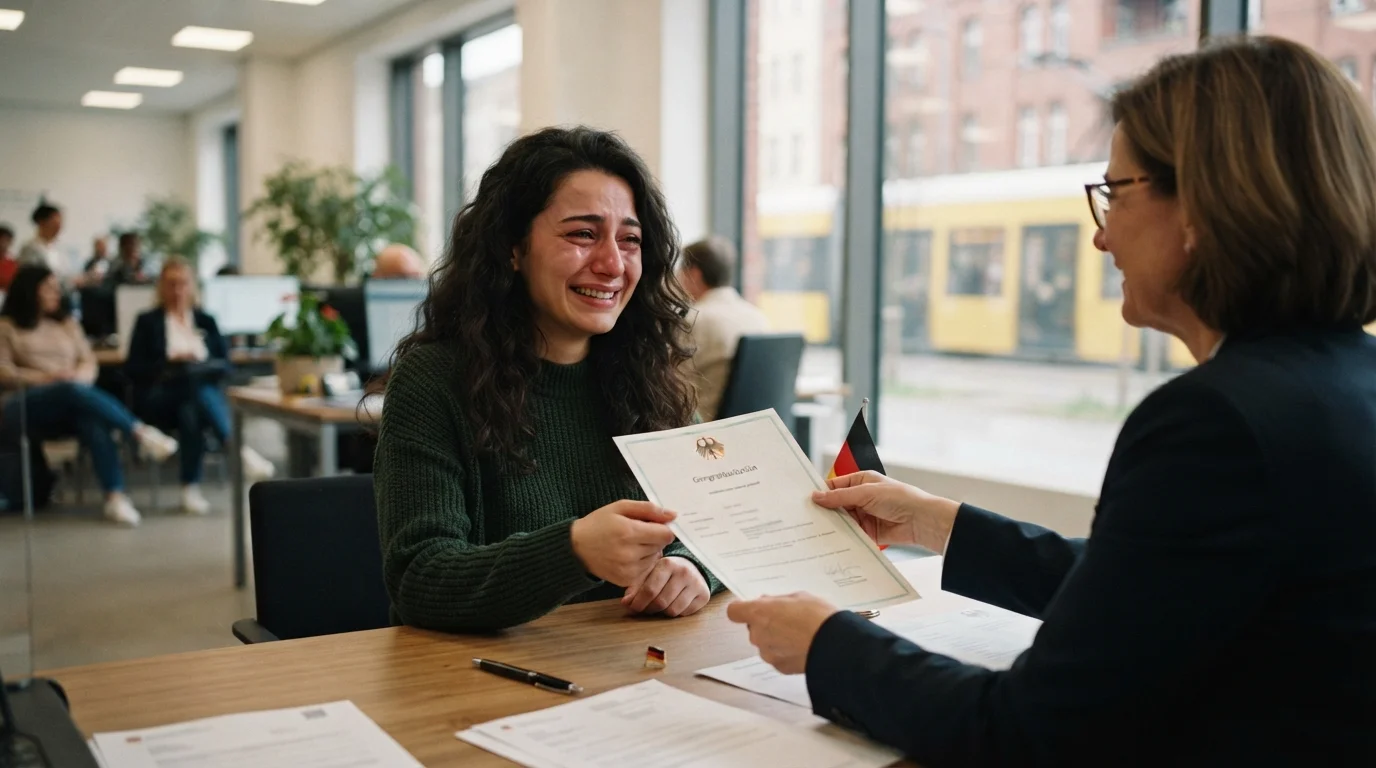
Germany's modernized citizenship law has transformed how long-term foreign residents build their futures in the country. Following landmark updates to the Nationality Act (Staatsangehörigkeitsgesetz, or StAG), the standard residency requirement for naturalization stands at five years, down from the previous eight. Even more striking is the fast-track naturalization pathway, which permits motivated residents to claim German citizenship in as little as three years.
While the prospect of obtaining an EU passport in three years sounds appealing, the bar for the turbo track is intentionally high. Authorities do not hand out accelerated citizenship purely for passive residence; candidates must demonstrate remarkable personal effort, financial independence, and advanced language skills. If you are an expat, an international professional, or an EU immigrant living in Germany, this comprehensive guide explains everything you need to know about navigating the fast-track naturalization requirements in 2026.
Before diving into the detailed criteria, it helps to understand the two main routes available under the reformed citizenship framework:
If you are planning your legal journey, reading our breakdown of understanding the 3-year citizenship criteria will provide additional legal background on how these changes evolved.
To successfully apply under Section 10, Paragraph 3, Sentence 2 of the StAG, applicants must meet five strict pillars of eligibility. Missing even one will typically push your application back into the standard five-year category.
While standard naturalization requires B1 German according to the Common European Framework of Reference for Languages (CEFR), fast-track naturalization demands C1 proficiency. This is a dramatic jump in complexity.
At the B1 level, you can handle familiar situations, describe experiences, and write straightforward personal letters. At the C1 level, however, you must be capable of understanding demanding, longer texts, recognizing implicit meaning, and expressing yourself fluently and spontaneously without searching for words. C1 German proves that you can participate actively in professional, academic, and social environments across Germany without linguistic friction.
To satisfy this requirement for the citizenship office (Einbürgerungsbehörde), you must present an officially recognized language certificate, such as the Goethe-Zertifikat C1, telc Deutsch C1, or a TestDaF certificate demonstrating equivalent competence.
Beyond language proficiency, the law requires tangible evidence that you have integrated into German society far beyond what is typical. Case workers have discretionary room when evaluating integration, but official administrative guidelines focus on three primary avenues:
Caseworkers evaluate the overall picture: a candidate who combines solid professional success with two years of regular community volunteer work presents a compelling case for accelerated naturalization.
The 2026 naturalization rules emphasize fiscal independence. Applicants for fast-track citizenship must be able to support themselves and their dependent family members entirely without recourse to public funds under the Social Code Books II or XII (such as Bürgergeld or basic social welfare). Housing benefits (Wohngeld) or family allowances are scrutinized rigorously.
You will need to submit recent salary statements, employment contracts, pension insurance records (Rentenversicherungsverlauf), and, if self-employed, tax assessments and verified audit statements from a certified tax advisor (Steuerberater).
Every candidate must demonstrate knowledge of Germany’s legal order, society, and living conditions. This requirement is met by passing either the official Einbürgerungstest or the identical final test of the orientation course, the Leben in Deutschland (LiD) test.
The test consists of 33 multiple-choice questions drawn from a published catalog of 310 questions. You must answer at least 17 correctly to pass for citizenship purposes. If you are starting your test preparation, review our actionable strategies for studying for the Leben in Deutschland test to ensure you clear this hurdle on your first attempt.
Candidates must sign a declaration of loyalty pledging allegiance to Germany’s constitutional principles (Freiheitliche demokratische Grundordnung). In addition, applicants must explicitly affirm Germany’s historical responsibilities and reject antisemitic, racist, or xenophobic acts. Background checks conducted with security agencies ensure the candidate poses no threat to constitutional order.
For most applicants, the hardest condition to satisfy in just three years is securing an official C1 language certificate. Moving from basic daily comprehension to sophisticated academic or professional German requires focused consistency.
If you have already navigated the early stages of integration, you may recall how long it takes to progress through the levels. Advancing from B1 to C1 demands roughly as much study time as reaching B1 from zero. At higher levels, textbook grammar exercises alone are not enough; you must train yourself to discuss abstract concepts, parse complex syntax like passive constructions and subjunctive moods (Konjunktiv II), and communicate naturally in professional contexts.
Structured daily preparation is critical when working toward rigorous standards. The German learning app Bretzi is built specifically around the German spoken in Germany, guiding learners across a continuous path from beginner (A0) all the way to advanced C1.
Bretzi helps learners bridge the gap between intermediate theory and practical execution through real-life scenarios, grammar explanations with conjugation tables, and sentence-building exercises. For applicants preparing to clear administrative tests, Bretzi Premium includes timed exam practice modules for the Einbürgerungstest at B1 (incorporating reading, writing, listening, speaking, and Leben in Deutschland questions) as well as academic practice for the TestDaF at B2 and C1. Each section is practiced individually with a timer, and the app uses AI to grade your writing and speaking while displaying a dedicated readiness score.
To overcome hesitation when speaking out loud, Bretzi features SprachBuddy, an AI conversation partner that lets you carry out realistic voice conversations covering workplace scenarios, civic discussions, or doctor visits, complete with immediate pronunciation scores.
Preparing a well-organized application file is essential to avoid months of bureaucratic delays. When filing your application at your local Einbürgerungsbehörde or municipal office, ensure you have the following records ready:
Because the three-year window moves quickly, following a structured timeline will help keep your citizenship goals on track:
Register your residence promptly upon arrival and secure a suitable residence permit. Focus on daily language acquisition to move through A1 and A2. Begin looking for a registered association (Verein) or local initiative where you can contribute your skills as a volunteer. Starting your civic commitment early creates a documented history of long-term engagement.
Aim to solidify B1 and transition into B2 German. Focus on excelling in your workplace or degree program. If you plan to use civic engagement as your primary special achievement, ensure you are taking on active responsibilities in your volunteer role. Register for and take the Einbürgerungstest during this year; test results do not expire, and completing the exam early eliminates last-minute stress.
Intensify your study routine to reach C1 proficiency. Book your official C1 exam several months in advance, as testing centers frequently fill up months ahead. Gather your income statements, pension documentation, and volunteer reference letters. Submit your completed application packet as soon as you hit your 36-month legal residency mark.
While the legal timeline allows for submission after three years, processing times at local immigration offices remain a practical hurdle. Major metropolitan areas like Berlin, Munich, Frankfurt, and Hamburg handle tens of thousands of active files. To prevent unnecessary delays:
Germany’s three-year fast-track naturalization pathway offers dedicated international residents a clear, rewarding route to full citizenship. By combining advanced C1 German skills, active civic contributions, and sustained financial independence, you can secure dual citizenship and make Germany your permanent legal home in record time.
Start laying the groundwork today. Build your volunteer connections, keep your financial documents organized, and make daily German study an unbreakable habit. With structured effort and steady language practice, you can turn the ambitious three-year milestone into reality.
Share this article:
Standing outside the exam room, heart thumping, waiting for the oral portion of the Deutsch-Test für Zuwanderer (DTZ) is an experience thousands of...
Read moreSecuring a German B1 language certificate is one of the most critical milestones for anyone building a life in Germany. Whether you are aiming for a...
Read moreOpening an envelope from the Federal Office for Migration and Refugees (BAMF) and seeing that you didn't reach the required B1 level or pass the...
Read more