How Audio Exercises on Bretzi Improve Conversational Fluency
The Acoustic Hurdle: Why Reading German Is Not Enough Many German learners experience an unsettling shock when stepping out of their study room and...
Read more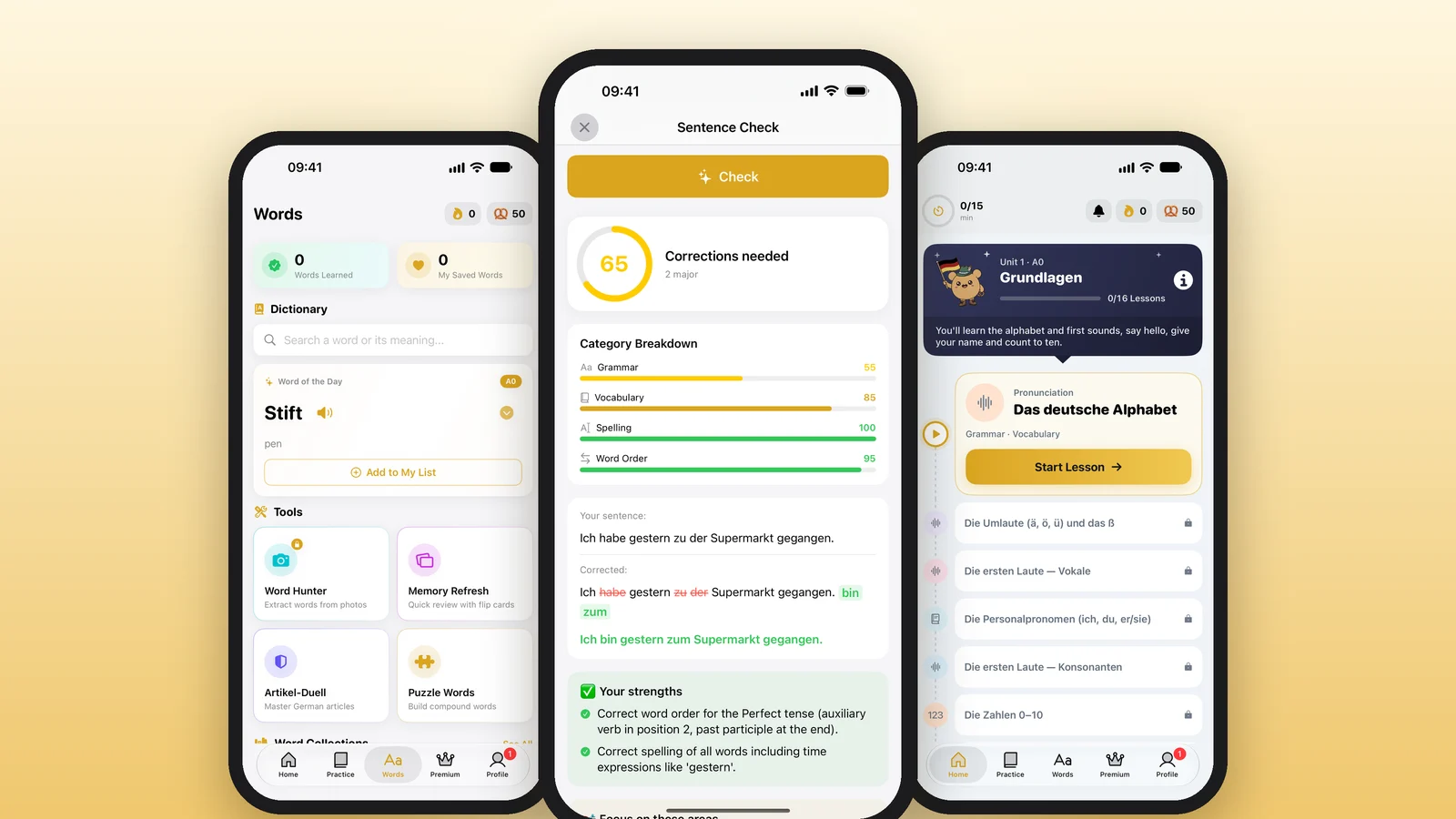
When you start learning German, two distinct grammatical hurdles quickly dominate your study sessions: remembering whether a noun is der, die, or das, and correctly conjugating verbs across different tenses and moods. To tackle these hurdles, the mobile app stores are crowded with hyper-focused micro-tools—specifically, dedicated verb conjugation reference apps and single-purpose "Der Die Das" flashcard trainers.
While isolating a single grammar topic might seem like an efficient way to plug knowledge gaps, language rarely exists in isolation. In the real world, choosing the right article determines the case ending of the adjective, which must balance with the verb and its required preposition. This guide compares single-purpose German conjugation and article trainers against an integrated learning approach like Bretzi, helping you decide which tool best fits your study routine in 2026.
Many adult learners, especially expats navigating integration requirements or university entrance exams, download several single-task apps. You might have one app containing conjugation charts for irregular verbs, another app for swiping through noun genders, and a notebook full of vocabulary lists. However, practicing grammar forms in a vacuum often creates a distinct disconnect: you might score 100% on a multiple-choice gender quiz, yet freeze up when trying to use that same noun in an accusative sentence at the Bürgeramt.
To master German conjugation and gender agreement, your brain needs to connect the forms to real sentence structures. Let us examine what standalone trainers do well, where they fall short, and how a comprehensive app bridges the gap.
Dedicated article trainers generally do one thing: they present a German noun on screen, and you tap der, die, or das. Some use gamified mechanics, like Tinder-style swiping, color-coded flashcards, or countdown timers.
The primary drawback of micro-trainers is the absence of case context. In spoken and written German, nouns rarely appear in the nominative singular. As soon as you enter a store or write an email, that noun takes an accusative, dative, or genitive form. Drilling der Tisch repeatedly doesn't automatically train your muscle memory to say an dem Tisch or ich sehe den Tisch. For a deeper look at retaining article genders long term, see our guide on how to master German noun genders.
On the other side of the app spectrum are verb conjugation tools. These apps act as digital versions of reference charts, listing forms from the present tense (Präsens) to the past perfect (Plusquamperfekt) and subjunctive (Konjunktiv I and II).
Memorizing a static chart is very different from deploying a verb under pressure. Standalone conjugators rarely test word order—such as kicking the conjugated verb to the end of a subordinate clause introduced by weil or dass. Furthermore, they don't drill the prepositional cases that verbs govern (e.g., warten auf + accusative vs. gehören zu + dative). Without syntax and case context, verb memorization remains abstract.
Bretzi approaches German grammar from a holistic standpoint. Rather than splitting verbs and nouns into separate silos, Bretzi teaches the everyday German used in Germany—spanning from complete beginner (A0) all the way to advanced proficiency (C1). The lessons follow a sequential path where vocabulary, grammar mechanics, and sentence construction are woven together.
In Bretzi, grammar is not an abstract theory studied separately from conversation. Within each short lesson, you encounter grammar tips, contextual examples, and full conjugation tables right when the verb forms are introduced. Instead of merely memorizing a table, you interact with it immediately:
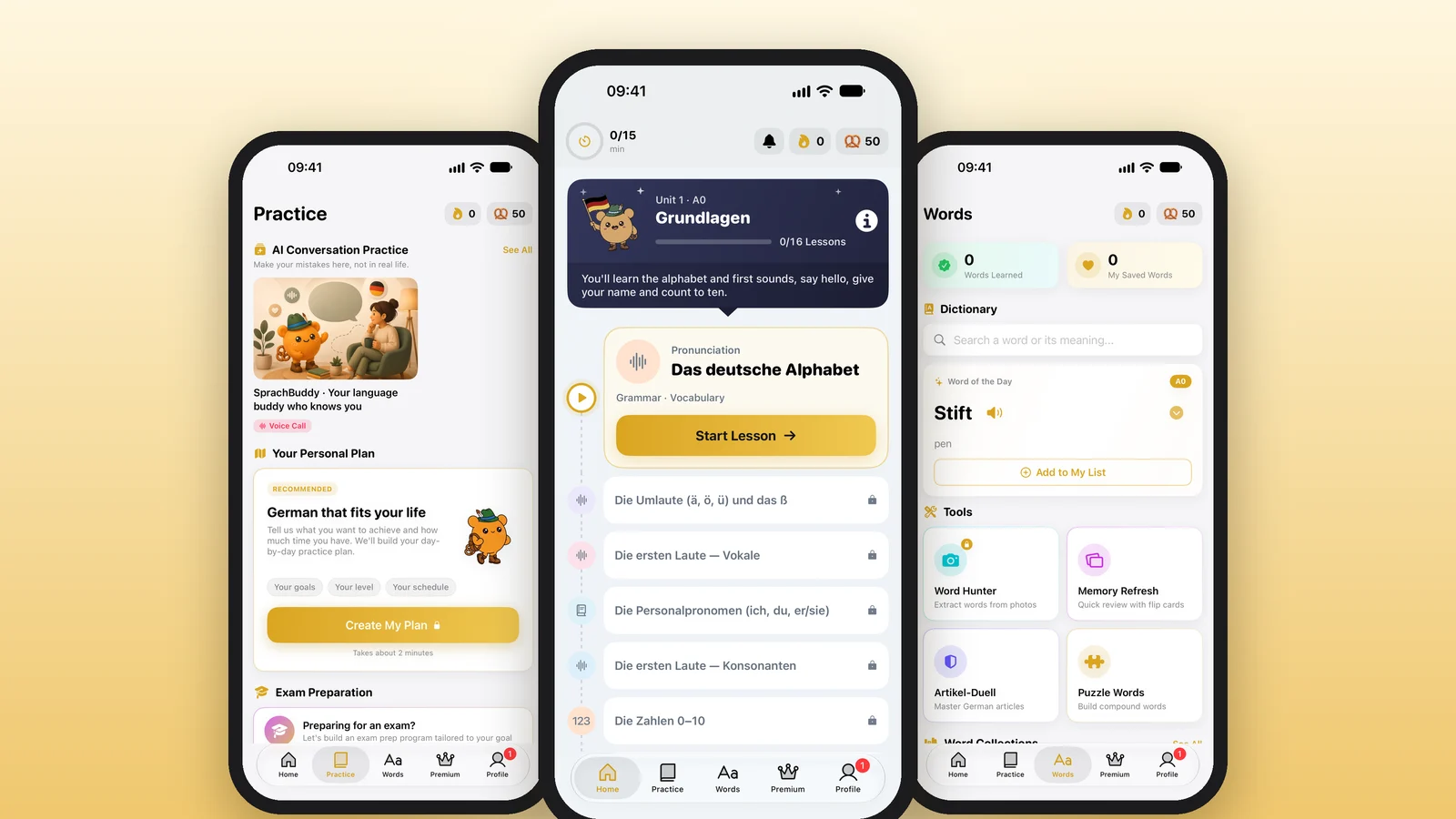
If you enjoy the fast-paced drill style of standalone gender apps, Bretzi includes a dedicated game for learning which article goes with a noun right inside its Words tab. Alongside this game, the Words tab features:
For more details on how automated intervals assist noun retention, explore our deep dive into AI spaced repetition for German noun articles.
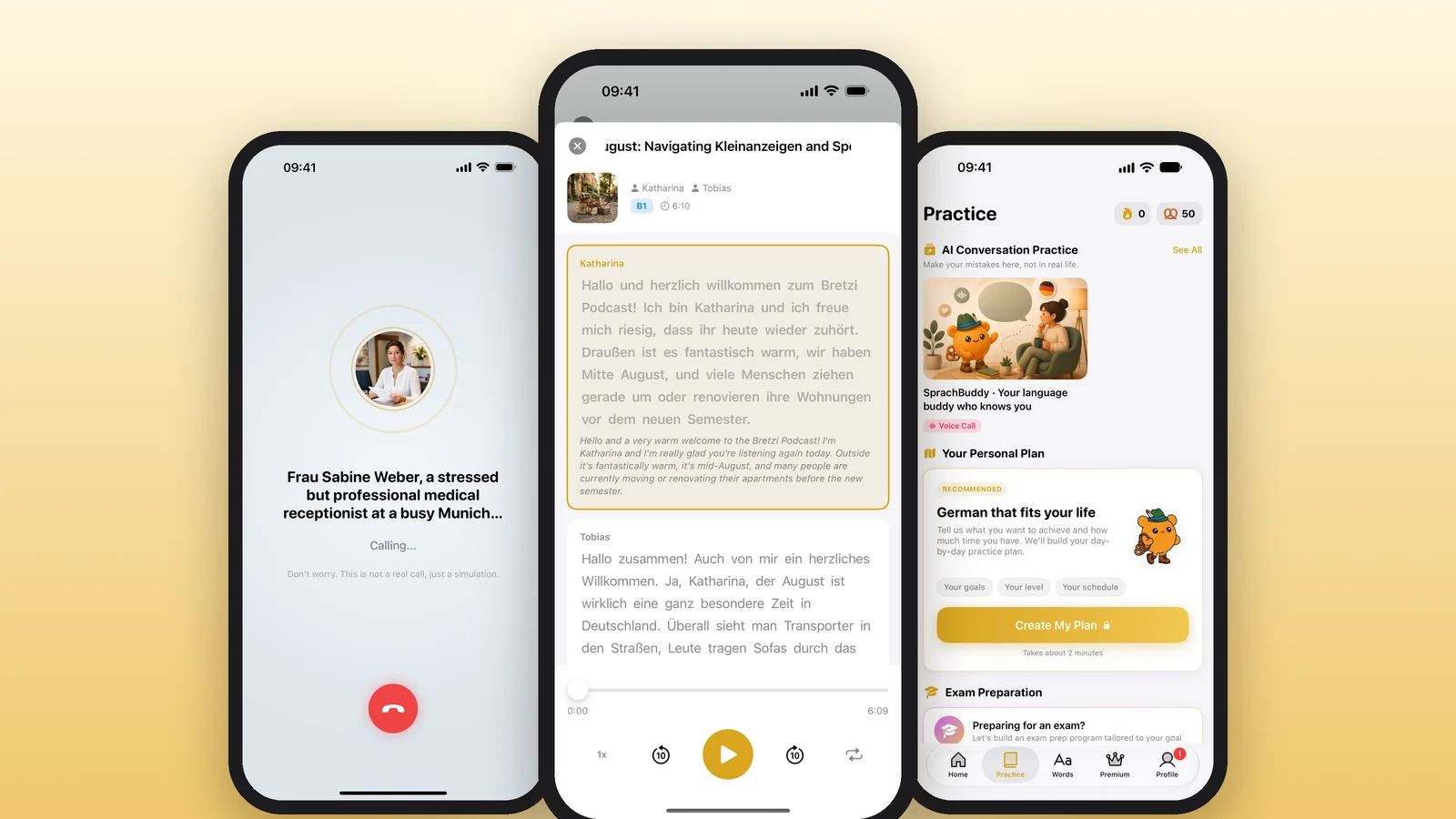
Knowing an article or a conjugation table is step one; speaking it aloud is step two. Bretzi allows learners to bridge the gap between static flashcards and real output:
To see how single-feature tools compare to a comprehensive platform, consider this breakdown of daily learning tasks:
| Feature / Task | Standalone Noun Trainers | Conjugation Apps | Bretzi |
|---|---|---|---|
| Primary Focus | Noun genders (der, die, das) | Verb tables & tenses | Full CEFR curriculum (A0–C1) |
| Case Context | Nominative only | None (isolated tables) | Embedded in real sentences & dialogues |
| Review System | Basic flashcards or random shuffle | Lookup / manual reference | Spaced repetition for words & past mistakes |
| Output Practice | Tapping buttons | Typing stems or reading | Typing, dictation, AI speech with SprachBuddy |
| Exam Preparation | None | None | B1 Einbürgerungstest & B2/C1 TestDaF timed practice |
For learners trying to decide between different grammar systems at the intermediate stage, you can also read our evaluation of B1 German grammar tools.
Regardless of the digital tools you choose, relying solely on passive memorization will slow down your progress. Here are four practical techniques to combine verb conjugation and noun training in your daily study routine:
Instead of learning der Kaffee in isolation, learn it attached to an active verb and a specific case: Einen Kaffee trinken (accusative) or mit dem Kaffee warten (dative). When you link the noun to a verb action, the correct gender and case markers form a natural cognitive rhythm.
Do not try to memorize 150 strong German verbs at random. Group them according to their stem changes:
Consistency trumps marathon weekend study sessions. Spending 10 to 15 minutes each day reviewing spaced repetitions and completing one structured lesson builds retention far more effectively than an occasional two-hour grammar binge. Setting a fixed daily reminder helps establish that routine.
Whenever an app shows you a conjugation chart or tests an article, say the complete sentence out loud. Auditory feedback trains your articulatory muscles to pronounce German vowels and consonant clusters correctly, reducing hesitation when speaking in live settings.
Modern language study happens across diverse moments in your day—at home, on a train, or during a lunch break. If you use Bretzi, you can access your learning path on an iPhone or iPad running iOS 18 or later, or on an Android smartphone or tablet running Android 8.0 or later. Both platforms support home-screen widgets to keep your streak visible, and there is an Apple Watch companion app specifically designed for quick word practice on the go. Your progress synchronizes seamlessly across these mobile devices via an internet connection using your Apple, Google, or email login (note that there is no desktop or web version).
Single-purpose conjugation tools and "Der Die Das" flashcard apps serve a valid, targeted purpose: they are convenient digital cheat sheets for quick lookups and fast drills. However, if your goal is to hold conversations, handle bureaucratic paperwork in Germany, or prepare for formal examinations, isolated drills quickly reach their limit.
By using an integrated platform like Bretzi, you can practice your noun genders via the article game in the Words tab while simultaneously encountering those words in structured A0–C1 lessons, complete with full conjugation tables, instant answer explanations, and practical conversation modules. Start with consistent daily practice, connect your verbs directly to real-life nouns, and build the grammatical confidence you need for daily life in Germany.
Rules, fees and dates change. Check the current version on the official pages before you act.
Share this article:
The Acoustic Hurdle: Why Reading German Is Not Enough Many German learners experience an unsettling shock when stepping out of their study room and...
Read moreRelocating to Germany is an exciting milestone, but it quickly introduces newcomers to a distinctive set of linguistic challenges. From navigating...
Read moreReaching the B1 threshold in German is often described as the great plateau. At A1 and A2, you can get by with basic vocabulary, simple...
Read more