Top 3 German App Features to Retain Complex Prepositions
Few grammar hurdles cause as much frustration for German learners as prepositions. At first glance, a word like an, auf, or in seems deceptively...
Read more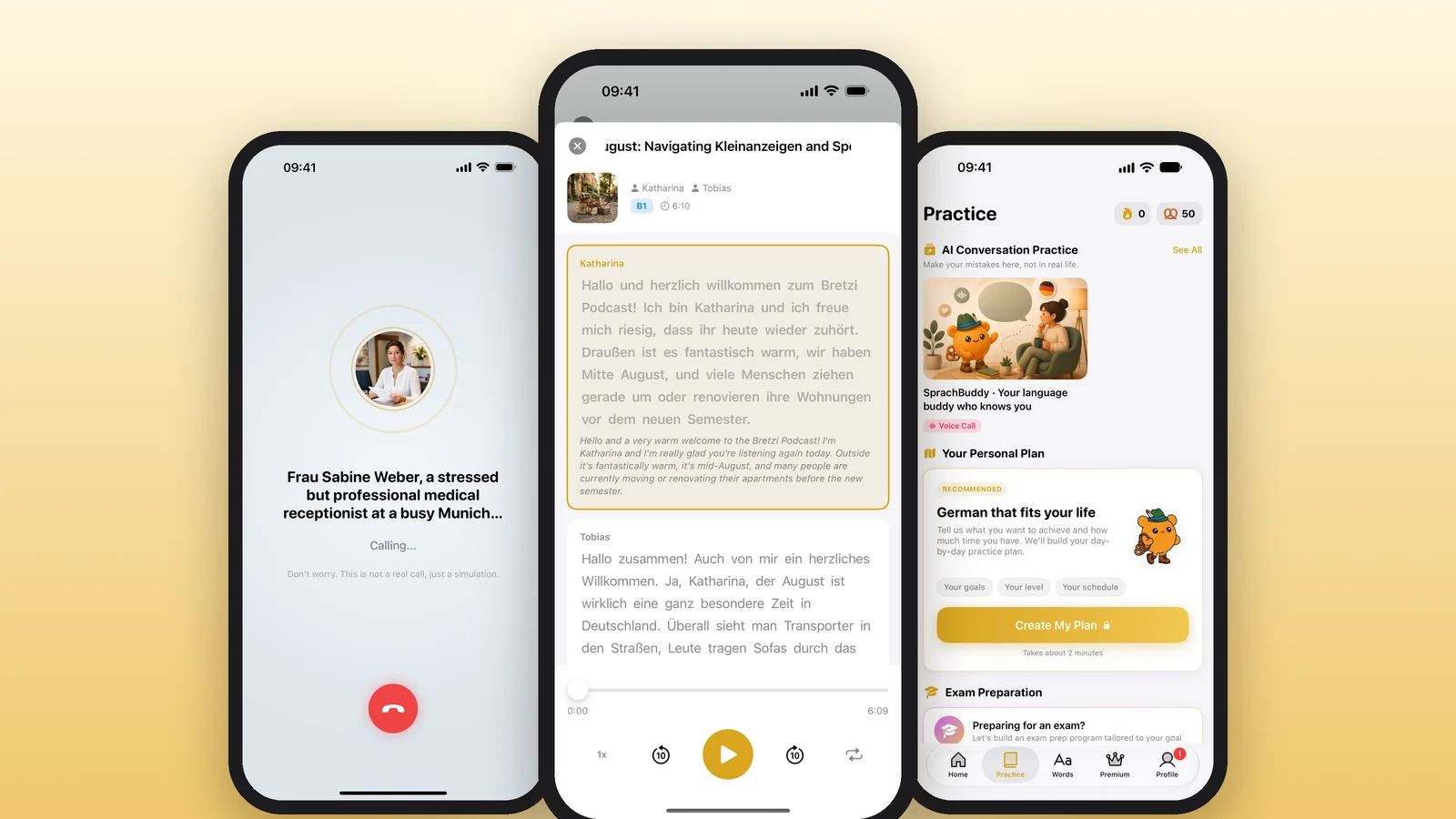
Many German learners experience an unsettling shock when stepping out of their study room and into the streets of Berlin, Munich, or Frankfurt. You might understand relative clauses on paper, identify adjective endings correctly in multiple-choice quizzes, and read official documents without sweating. Yet, when a bakery clerk asks 'Darf's sonst noch was sein?' at natural speaking tempo, your mind freezes.
This gap between textual competence and real-world comprehension is common in second language acquisition. Written language is visual, discrete, and offers generous processing time. Speech, by contrast, is a continuous acoustic stream filled with contractions, swallowed syllables, shifting pitch contours, and ambient noise. If your ear has not been systematically trained to parse natural German speech patterns, conversational fluency remains elusive.
Developing conversational confidence demands deliberate auditory training. To speak naturally in spontaneous dialogues—a core element of mastering conversational German for daily expat life—learners need audio exercises that bridge the gap between passive listening and active oral production.
Conversational fluency relies on automated speech processing. According to classic cognitive research on language acquisition, speech comprehension operates in milliseconds. In conversation, there is no time to mentally look up case tables or conjugate strong verbs. The brain must decode incoming phonetic cues, group them into meaningful lexical units ('chunks'), and interpret grammatical relationships instantaneously.
When you practice with targeted audio exercises, several critical cognitive shifts occur:
A widespread misconception among language learners is that having German radio or television babbling in the background will generate fluency through osmosis. While passive exposure offers general phonetic familiarity, it rarely builds active conversational reflexes. To turn acoustic input into usable language, listening must be accompanied by conscious cognitive effort.
When selecting routines for studying on the move—such as those explored in our guide on using audio practice on daily commutes—active engagement makes the difference. Active audio exercises challenge the brain in three specific ways:
Dictation forces you to transcribe exactly what you hear. It strips away guesswork. If an audio clip says 'Er hat dem Nachbarn geholfen' and you write 'den Nachbarn', you immediately notice a gap in your perception of the dative case. Dictation requires high-precision listening, converting indistinct acoustic impressions into explicit grammatical structures.
When you follow an interactive transcript while listening, your brain maps auditory signals directly onto orthographic representations. This double-channel processing strengthens memory retention. If a word sounds unfamiliar due to speed, the synchronized text clarifies the boundary between words, resolving acoustic confusion in real time.
Listening to an audio prompt and immediately repeating it aloud forces your articulatory muscles to mimic authentic rhythm, accentuation, and pacing. This process bypasses native-language translation and connects the ear directly to the vocal tract.
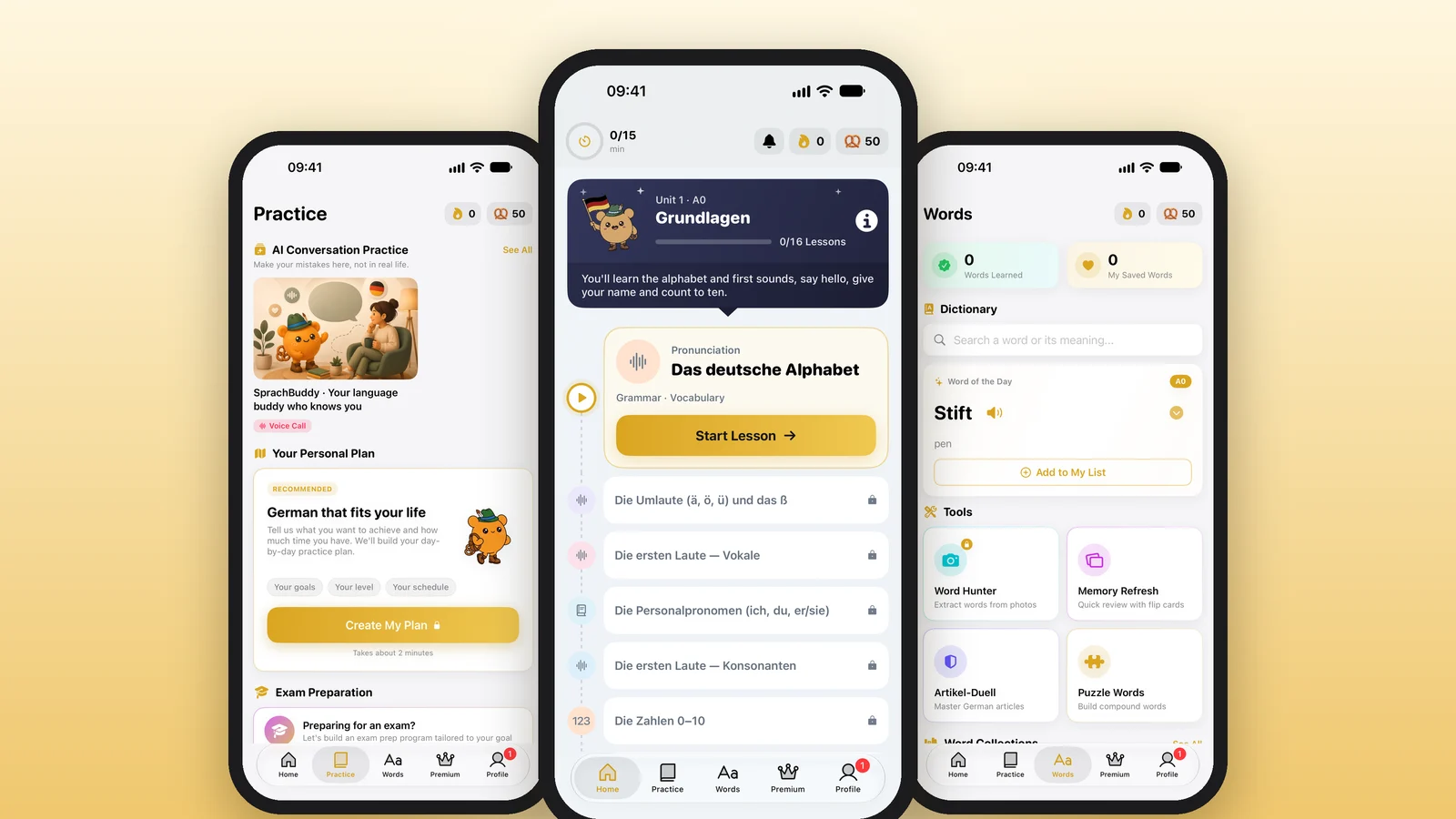
Bretzi approaches German learning through the lens of real-world communication in Germany, structuring lessons from beginner A0 up to advanced C1. Rather than treating listening as an isolated postscript, the app embeds auditory exercises into the daily learning path.
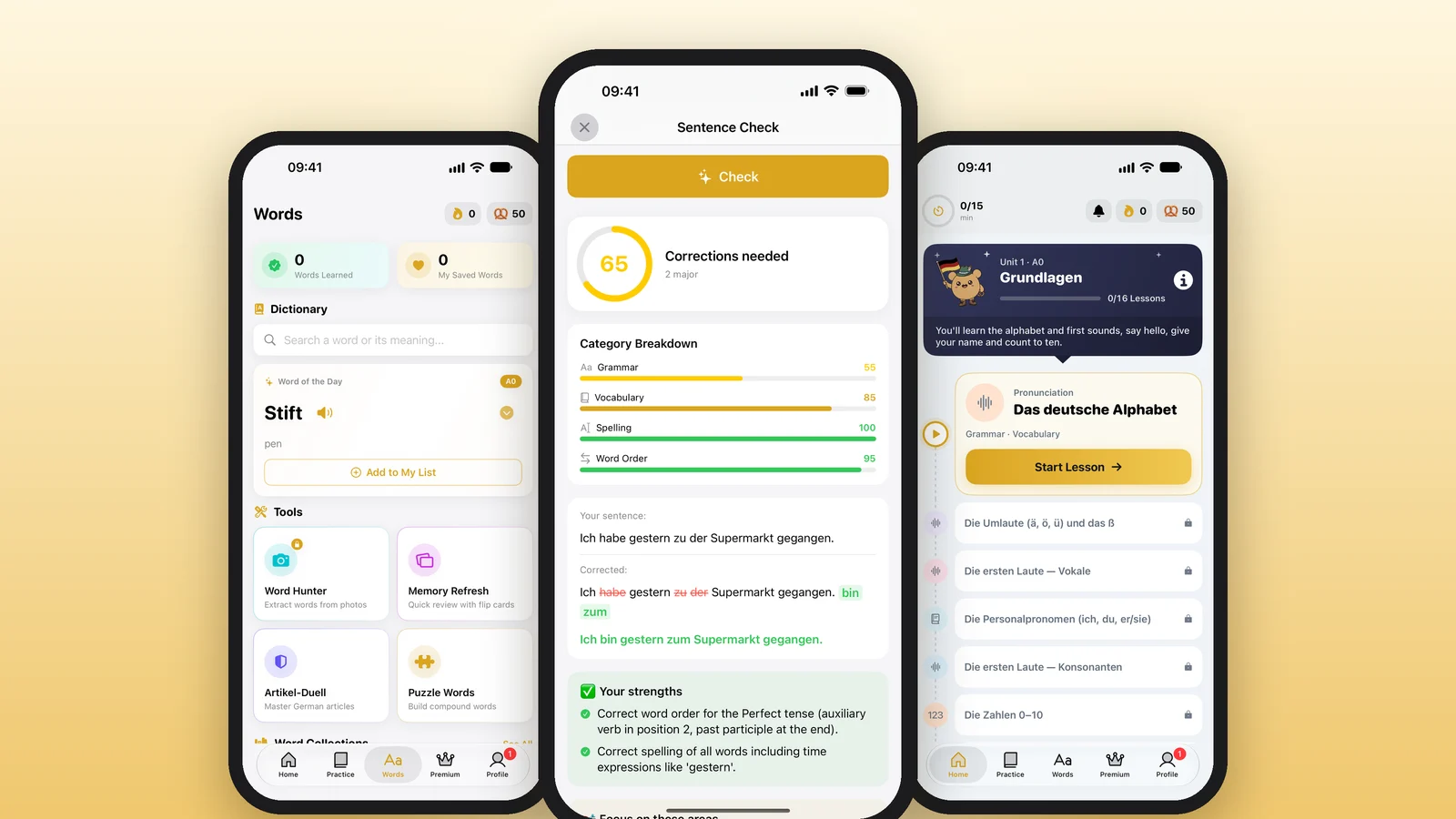
Throughout the sequenced curriculum, Bretzi challenges learners to listen, type what they hear, and spot audio mistakes. After every interaction, the app reveals whether your answer was correct and explains why. Because every unit concludes with a dialogue reflecting authentic everyday situations in Germany—such as registering at the Bürgeramt or running errands at a local market—learners train their ears on contextualized, pragmatic phrasing rather than detached vocabulary lists.
Bretzi features an integrated podcast section designed to ease learners into extended spoken German. Each podcast episode includes a scrolling transcript that tracks the voice recording word for word. While listening, you can adjust the playback speed—slowing down intricate phrasing or accelerating to challenge your comprehension. If an unfamiliar term appears, you simply tap the word to reveal its definition and save it immediately to your vocabulary list for spaced-repetition review.
Understanding a spoken sentence is only half the battle; responding aloud without hesitation is the other. Bretzi connects auditory input directly to spoken output through SprachBuddy, an AI conversation partner built into the app. SprachBuddy operates as dedicated software (stating its AI identity upfront) that you call on your phone to converse in German out loud.
Learners can discuss daily topics or rehearse scenarios like job interviews and doctor visits. After speaking, you can review the full dialogue transcript in text format. Complementing this conversational roleplay, Bretzi provides pronunciation scoring, which evaluates your spoken words or sentences against native acoustic baselines and highlights specific areas for phonetic improvement. For learners refining their accent, using modern acoustic assessment tools is essential; read more in our review of how to practice German pronunciation with voice recognition tools.
To maximize the benefits of structured audio exercises, incorporate this 20-minute daily acoustic training framework into your study schedule:
Begin with structured lesson exercises that feature dictation and gap-filling. Focus entirely on acoustic cues: notice whether the speaker uses an informal contraction or an official phrasing. Do not rush through the audio prompts; play them twice to confirm vowel length and verb endings.
Open a level-appropriate podcast episode. During the first play-through, focus exclusively on the audio stream without reading ahead. On the second run, activate the interactive transcript. Tap any unknown expressions, examine their translations, and save them to your personal review list for long-term retention.
Select two or three sentences from the podcast dialogue. Pause the track after each sentence and repeat it aloud, attempting to match the exact tempo, pitch rise, and cadence of the native speaker. Pay close attention to word stress (BETONUNG), ensuring you do not stress prefixes that should remain unstressed.
Put the auditory input into immediate production. Open a voice call with SprachBuddy to discuss a topic related to your morning study or simulate a practical exchange. Focus on speaking spontaneously without drafting written notes beforehand. By concluding your audio routine with spoken output, your brain hardwires passive recognition into active speech production.
Grammar charts provide structure, but audio exercises provide life. Conversational fluency in Germany requires training your auditory cortex to register rapid phonetic signals, decode context instinctively, and formulate prompt oral responses without translating in your head.
By engaging with progressive audio lessons, following synchronized transcripts, and practicing verbal exchanges with an AI conversation partner like SprachBuddy on Bretzi, you develop the real-world acoustic reflexes required for daily life in Germany. Set a manageable daily goal, pick up your headphones, and start training your ear today.
Rules, fees and dates change. Check the current version on the official pages before you act.
Share this article:
Few grammar hurdles cause as much frustration for German learners as prepositions. At first glance, a word like an, auf, or in seems deceptively...
Read moreWhen you start learning German, two distinct grammatical hurdles quickly dominate your study sessions: remembering whether a noun is der, die, or...
Read moreRelocating to Germany is an exciting milestone, but it quickly introduces newcomers to a distinctive set of linguistic challenges. From navigating...
Read more