How to Practice German Pronunciation: Best App Features and Voice Recognition Tools
When you start learning German, the grammar often gets the lion's share of the attention. You wrestle with cases, memorize noun genders, and...
Read more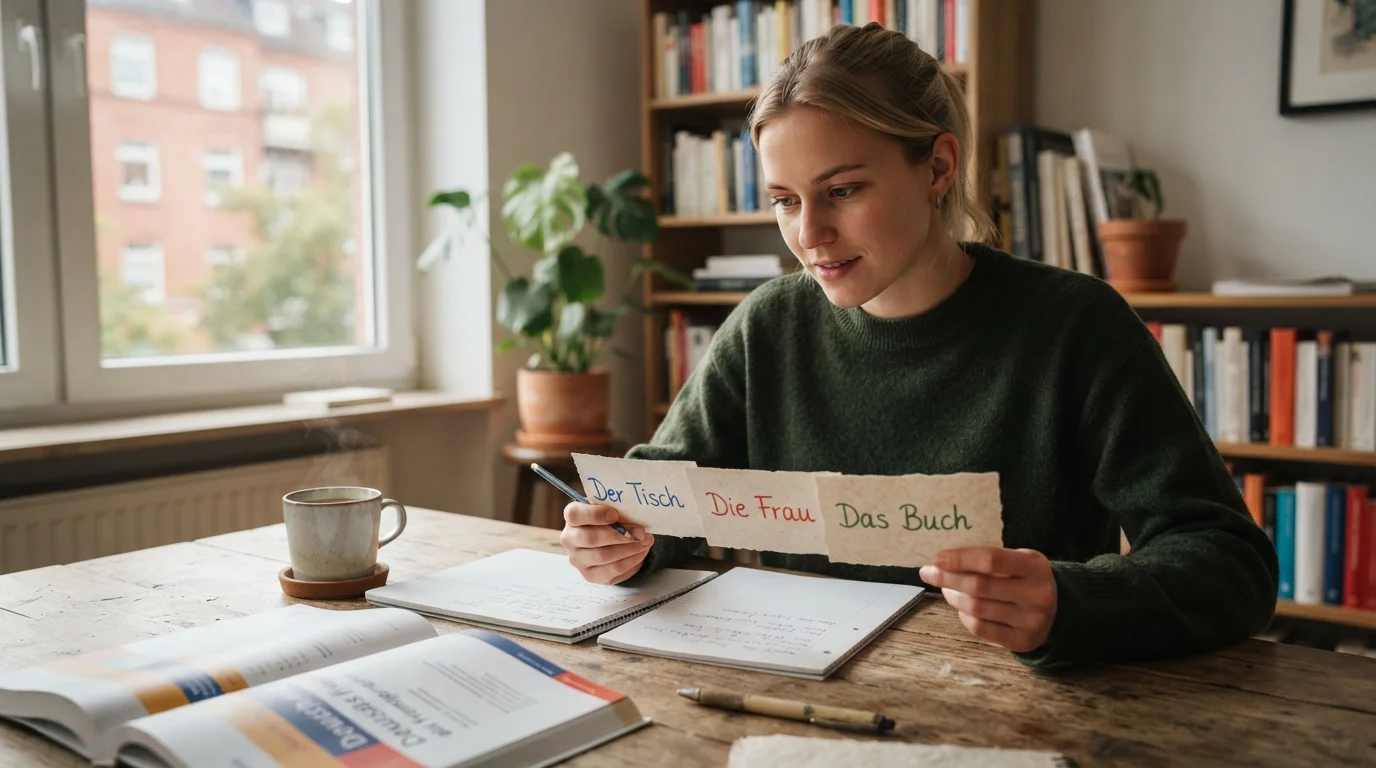
If you have ever spent an evening staring blankly at a list of German vocabulary, wondering why a sofa is neuter (das Sofa), a chair is masculine (der Stuhl), and a couch is feminine (die Couch), you are not alone. As Mark Twain famously lamented in his satirical essay The Awful German Language, "In German, a young lady has no sex, while a turnip has."
For expats, international professionals, and students preparing for integration or language exams like the DTZ or Goethe-Zertifikat, German noun genders represent one of the most stubborn hurdles to achieving true fluency. Guessing articles might get you through casual street banter, but when you enter real-world situations—such as workplace communications, official paperwork, or structured exams—a shaky grasp of der, die, and das creates a domino effect of grammatical errors across cases, adjective endings, and relative pronouns.
Fortunately, mastering German noun genders does not require miraculous linguistic talent or brute-force memorization. By understanding the underlying patterns and leveraging modern cognitive science through spaced repetition algorithms, you can internalize German articles until they become second nature. In this guide, we will explore why German genders behave the way they do, why conventional study techniques fail, and how an intelligent spaced repetition approach—like the one powering the personalized German vocabulary routine in Bretzi—is the most effective way to achieve article mastery.
English speakers are accustomed to natural gender: people and animals with biological sexes are he or she, while inanimate objects are "it." German, however, employs grammatical gender. A noun's gender is an inherent linguistic property rather than a reflection of physical biology.
This reality leads to three primary grammatical categories:
Why does this matter so much? In German, gender is the anchor of the entire sentence structure. The gender of a noun dictates:
When you learn a German noun without its gender, you are only learning half the word. If you don't know the gender, you cannot reliably decline the noun in a sentence, which causes your German to sound broken even if your pronunciation and vocabulary breadth are impressive.
While grammatical gender can feel entirely arbitrary, German is surprisingly consistent once you learn to look at noun endings (suffixes). Approximately 80% of German nouns provide clues to their gender through their morphological endings or semantic categories.
Nouns ending in the following suffixes are almost universally masculine (der):
Semantic categories: Days of the week, months, seasons, compass directions, and most alcoholic beverages (with the notable exception of das Bier) are masculine.
Feminine endings are among the most reliable in the German language. If a noun ends in one of these suffixes, it is almost certainly feminine (die):
Neuter nouns (das) frequently feature diminutive endings or specific technical suffixes:
While these rules provide an excellent foundation, they leave thousands of high-frequency, everyday root words unaccounted for: der Tisch, die Wand, das Fenster. This is where rote memorization begins to break down, and where cognitive science steps in.
The standard advice for language learners has long been: "Make flashcards!" Write the German word on one side, and the English translation on the other. But as many learners discover, traditional flashcards often create an illusion of competence.
When using physical index cards or basic digital decks, learners frequently experience the following pitfalls:
To understand why traditional tools fall short compared to modern technology, check out our deep dive on why Bretzi beats flashcards for long-term retention.
In the late 19th century, German psychologist Hermann Ebbinghaus pioneered experimental research on memory, identifying the infamous Forgetting Curve. His findings showed that newly acquired information decays exponentially from our memory within days unless actively reinforced.
Spaced Repetition Systems (SRS) solve this problem mathematically. An SRS algorithm schedules reviews at the precise moment a memory trace begins to fade. Each time you successfully recall an item just before forgetting it, the memory trace becomes stronger, and the interval before the next review lengthens exponentially (e.g., 1 day → 3 days → 10 days → 30 days → 90 days).
When applied specifically to German noun genders, SRS acts as an automated triage nurse for your vocabulary:
Understanding the theoretical benefits of spaced repetition is one thing; executing it daily in an intuitive, engaging environment is another. The Bretzi app was built from the ground up to solve the exact pain points German learners face when tackling grammar and vocabulary.
Here is how Bretzi approaches noun gender mastery differently:
In Bretzi, a noun is never presented as an isolated translation. Every noun is treated as a unified lexical unit consisting of [Article + Noun + Plural]. Through dedicated Article Mastery mini-games, learners engage in rapid-fire categorization drills that test their instinctive reflex for der, die, and das. These exercises transform slow, analytical deliberation into fast, automatic recall.
Bretzi's reviews don't just bring back words; they also bring back your past mistakes, including a wrong article. If you know that Fahrrad means "bicycle" but keep guessing der instead of das, Bretzi brings that mistake back in your daily reviews.
Memorizing an article in a flashcard drill is step one; using it under conversational pressure is step two. Bretzi bridges this gap by embedding newly learned nouns directly into AI-powered conversation practice. As you speak with AI characters in simulated real-life German scenarios—such as ordering at a bakery, registering at the Bürgeramt, or discussing work projects—the app provides immediate feedback on case and gender agreements in your spoken sentences.
Alongside an AI-driven spaced repetition app like Bretzi, adopting smart cognitive techniques will dramatically accelerate your path to fluency. Here are five practical strategies you can apply starting today:
The human brain is predominantly visual. Associate each gender with a vivid color and maintain this color code across all your notes, digital highlights, and flashcards:
When you visualize der Apfel, picture a bright blue apple. When you study die Tomate, picture a glowing red tomato. When recalling the word later, your visual memory will often retrieve the associated color before your analytical brain recalls the article.
Never write down or memorize a noun by itself. Treat the article as the first syllable of the word:
Not: "Hund = dog" → Instead: "der Hund, die Hunde = the dog, the dogs"
By saying "der Hund" out loud as a single rhythmic phrase, your auditory memory helps reinforce the connection. If you hear someone say "das Hund" in the future, it will sound acoustically wrong to your ears, much like "an university" sounds wrong to a native English speaker.
Group new words into thematic clusters that share the same gender rather than studying mixed alphabetical lists:
For advanced memory retention, use the Method of Loci (Memory Palace technique). Divide a familiar mental landscape—like your hometown or neighborhood—into three distinct zones:
When you need to remember the gender of a word, take a mental walk through your town and check where the object is located.
Consistency trumps cramming every single time. Studying German for 15 minutes every day using spaced repetition creates vastly stronger neural pathways than studying for two hours once a week on Sunday afternoon. Bretzi's gamified streak mechanics are designed precisely around this principle, ensuring you touch your active vocabulary pool daily without burning out.
| Gender | Key Suffixes | Semantic Categories | Example |
|---|---|---|---|
| Der (Masculine) | -ling, -or, -ismus, -ist, -er (agent) | Days, seasons, weather, cars, compass points | der Frühling, der Motor, der Montag |
| Die (Feminine) | -ung, -heit, -keit, -schaft, -tät, -ion, -ik, -e | Trees, flowers, ships, aircraft, cardinal numbers | die Freiheit, die Wohnung, die Musik |
| Das (Neuter) | -chen, -lein, -ment, -um, -ma, -tum | Nominalized verbs, metals, colors, languages | das Mädchen, das Zentrum, das Deutsch |
Mastering German noun genders doesn't have to be an endless source of anxiety. While the system appears chaotic at first glance, combining reliable morphological patterns with the proven power of spaced repetition turns article acquisition into a structured, highly manageable process.
By pairing high-frequency active recall drills with immersive AI conversational practice, you can transform der, die, and das from intimidating obstacles into automatic, effortless reflexes. Whether you are aiming to pass your B1 integration exam, communicate confidently with German colleagues, or simply feel at home in your daily life abroad, mastering your articles is the single best investment you can make in your German language journey.
Ready to put spaced repetition to work and master German noun genders once and for all? Download Bretzi today and experience how AI-powered personalized learning plans and targeted article games can take your German to the next level.
Share this article:
When you start learning German, the grammar often gets the lion's share of the attention. You wrestle with cases, memorize noun genders, and...
Read moreAnyone who has attempted to learn German knows the infamous 'motivation cliff.' You start with immense enthusiasm, eager to master words like...
Read moreMoving to Germany, Austria, or Switzerland is an exciting milestone, but for many expats, the initial excitement quickly collides with linguistic...
Read more