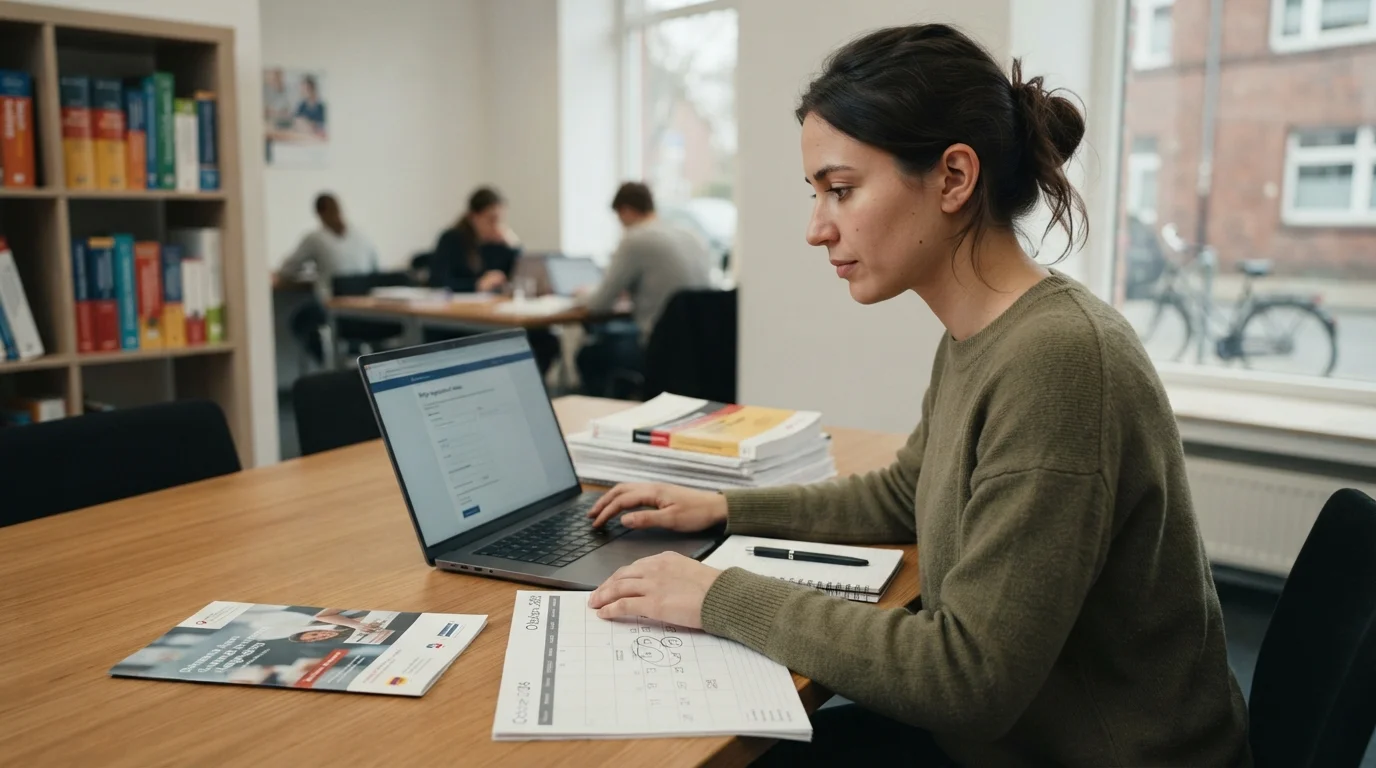
How to Ace the Oral Picture Description in the DTZ B1 German Exam
Standing outside the exam room, heart thumping, waiting for the oral portion of the Deutsch-Test für Zuwanderer (DTZ) is an experience thousands of...
Read more
This article was written by AI and published by Bretzi.
AI can get things wrong. For anything official, check the source it points to.
Preparing for the DTZ B1 exam can feel overwhelming, especially when you need to remember practical German vocabulary and speak confidently under time pressure. The good news is that you do not need perfect German to succeed. You need focused vocabulary, clear communication strategies, and regular practice with everyday situations.
The Deutsch-Test für Zuwanderer (DTZ) assesses the German you need for daily life, work, appointments, family, housing, and public services. Its speaking tasks reward understandable communication and appropriate language more than complicated sentences. With the right routine, you can turn passive vocabulary into active speaking skills and approach the exam with much greater confidence.
This guide explains how to use the Bretzi app to prepare for DTZ B1 vocabulary and speaking tasks. You will learn what to study, how to practise exam-style situations, how to improve pronunciation, and how to build a realistic weekly plan.
The DTZ is connected to the German integration course system and tests language used in realistic situations. For official information about integration courses and German language examinations, consult the Federal Office for Migration and Refugees. Always check the latest instructions from your course provider or examination centre because formats and administrative details can change.
In the speaking part, you may need to introduce yourself, describe a picture, make or respond to a suggestion, plan something with another person, or discuss an everyday problem. Typical topics include:
Knowing isolated nouns is not enough. You must also know useful combinations and sentence patterns. For example, learning Termin is helpful, but learning einen Termin vereinbaren, einen Termin verschieben, and einen Termin absagen is much more useful for the speaking exam.
Functional language helps you complete a communicative task even when your vocabulary is limited. Memorise flexible phrases such as:
These expressions give your answer structure and allow you to keep speaking while you search for a word. They are particularly valuable if German is not your first language or if exam stress makes spontaneous speaking difficult.
A long vocabulary list can create the illusion of progress without improving your speaking. Instead, organise words by situation and practise them in context. Create vocabulary groups for a doctor visit, a job interview, a landlord conversation, a school meeting, and a telephone call. For every new word, learn its article, plural form, common verb combinations, and one complete example sentence.
For the topic of housing, for example, do not study only Wohnung, Nachbar, and Reparatur. Build a practical group:
This method makes it easier to retrieve language during the DTZ B1 speaking tasks. You are not searching for one word; you are remembering a complete communication package.
Review new vocabulary shortly after learning it, then again after a longer interval. This spaced-repetition method helps move words from short-term memory into long-term memory. On each review, test yourself before looking at the answer. Recognition is easier than production, so ask yourself to say the word aloud or use it in a sentence.
Bretzi can support this process with vocabulary building and spaced repetition. You can use short daily sessions to revisit weak words, practise topic-based vocabulary, and strengthen the expressions that you repeatedly forget. Keep the sessions manageable: fifteen focused minutes every day is usually more effective than one long session at the weekend.
You do not need to master every advanced grammar rule for a B1 speaking task. Concentrate on structures that make your meaning clear:
For example, the sentence Ich kann am Montag nicht kommen, weil ich arbeiten muss is more useful in an exam conversation than an impressive but unfamiliar grammatical construction. Prioritise accuracy, clarity, and flexibility.
The biggest mistake many learners make is studying vocabulary silently. The speaking exam requires active production, so your preparation must include speaking every day. Read a phrase, cover it, and reproduce it. Then adapt it to your own life. If you learn Ich möchte einen Termin vereinbaren, practise changing the day, time, and reason for the appointment.
When describing a picture, follow a reliable structure. Start with the general setting, describe people and actions, add details, and finish with a likely interpretation or personal comment. Useful starters include Auf dem Bild sehe ich ..., Im Vordergrund ..., Im Hintergrund ..., and Ich vermute, dass ...
Many DTZ B1 speaking situations require cooperation. You may need to plan a birthday party, organise a trip, choose a gift, or solve a practical problem. Train yourself to follow this pattern:
A short model could be: Ich schlage vor, dass wir am Samstag fahren, weil dann alle Zeit haben. Was meinst du? If your partner suggests another option, respond naturally: Das wäre auch möglich. Allerdings ist der Sonntag für mich besser, weil ich am Samstag arbeiten muss.
Bretzi's AI-powered conversation practice is useful for this kind of preparation because it lets you rehearse realistic exchanges rather than only completing isolated exercises. You can practise everyday scenarios, receive feedback, and repeat a conversation until your responses feel more automatic. Interactive dialogue games also make it easier to practise situations such as making an appointment, reporting a problem, or discussing plans.
Pronunciation does not need to sound perfect, but it must be understandable. Examiners need to follow your meaning without excessive effort. Focus first on sounds and word endings that affect comprehension, including long and short vowels, the German ch sound, final consonants, and verb endings.
Shadowing means listening to a short sentence and repeating it immediately, copying the rhythm and intonation. Start with five to ten seconds of audio. Repeat the sentence several times, then try to say it without listening. This improves pronunciation, speed, and natural sentence melody.
Record a one-minute answer on your phone or in a learning app. Listen for three specific features:
Do not try to correct everything at once. Choose one improvement goal per recording. For example, speak more slowly, pronounce the -en endings, or use more connecting words. Bretzi's pronunciation training can provide instant feedback, giving you an additional way to notice sounds that are difficult to hear yourself.
A clear schedule prevents last-minute cramming. Adjust the plan to your level, available time, and exam date.
Take a practice speaking task and record your answer. Identify missing vocabulary, grammar problems, and pronunciation difficulties. Create topic lists for health, work, housing, shopping, appointments, and free time. Review high-frequency verbs and question words.
Study one or two topics each day. Learn words in phrases, not as isolated translations. Practise articles and plurals aloud. Finish each session with a one-minute monologue using at least eight new words.
Complete dialogue tasks with a partner, teacher, or AI conversation tool. Train suggestions, polite disagreement, clarification, and decision-making. Add a time limit so you become comfortable speaking without translating every sentence in your head.
Complete full speaking practice sessions several times. Use random topics and avoid preparing every sentence in advance. After each simulation, write down only your three most important improvements. On the final days, review familiar phrases and sleep well rather than trying to learn hundreds of new words.
If you are also preparing for the written part, combine this plan with a focused guide to passing the B1 German letter-writing exam. Learners taking an integration course may also benefit from understanding how to find a BAMF-approved integration course provider, especially when planning their course and exam timeline.
On exam day, listen carefully to the task and identify the goal. Are you describing, requesting, planning, or solving a problem? Use the information provided rather than giving a memorised speech that does not answer the question.
Speak clearly and at a moderate speed. Short, correct sentences are better than long sentences that break down halfway through. If you forget a word, explain it in another way. For instance, if you cannot remember Staubsauger, you might say eine Maschine zum Saubermachen. Communication strategies can protect your performance when vocabulary is incomplete.
If you make a mistake, continue unless it changes your meaning. You can correct yourself naturally: Am Dienstag ... nein, am Mittwoch kann ich kommen. Ask for repetition when necessary, and show that you are listening by responding to your partner's ideas.
Before the exam, prepare a small phrase bank organised by purpose rather than topic. Include phrases for opening a conversation, asking questions, giving reasons, comparing choices, disagreeing politely, and ending with a decision. This bank becomes a reliable framework that you can adapt to almost any DTZ speaking task.
Aceing the DTZ B1 vocabulary and speaking tasks is not about knowing every German word. It is about using common language effectively in familiar situations. Build vocabulary by topic, learn phrases in context, practise speaking aloud, improve pronunciation gradually, and simulate realistic conversations under time pressure.
Use a consistent daily routine and track the areas that need attention. Bretzi can help by combining personalised learning plans, spaced-repetition vocabulary practice, grammar support from A0 to C1, pronunciation feedback, and realistic AI conversations in one study routine. Start with one practical topic today, record a short answer, and repeat it tomorrow with clearer language and greater confidence.
Your next step: choose one DTZ topic, learn ten useful words and five functional phrases, then complete a two-minute speaking task without stopping. Small, repeated practice is what turns exam preparation into real-world German.
Share this article:
Standing outside the exam room, heart thumping, waiting for the oral portion of the Deutsch-Test für Zuwanderer (DTZ) is an experience thousands of...
Read moreGermany's modernized citizenship law has transformed how long-term foreign residents build their futures in the country. Following landmark updates...
Read moreSecuring a German B1 language certificate is one of the most critical milestones for anyone building a life in Germany. Whether you are aiming for a...
Read more