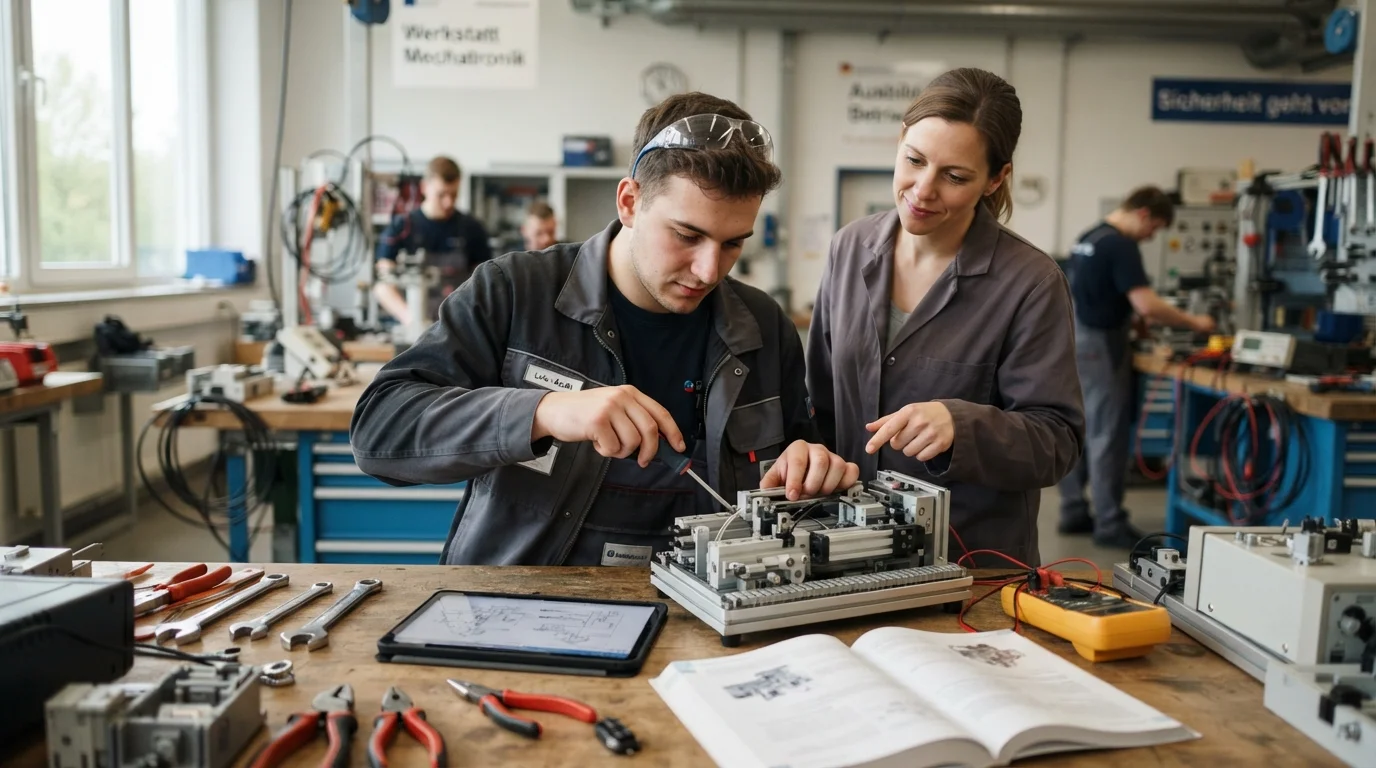
German Ausbildung Guide: Vocational Training for Expats
When planning a career move to Germany, most international professionals immediately think of university degrees or direct corporate hiring. However,...
Read more
This article was written by AI and published by Bretzi.
AI can get things wrong. For anything official, check the source it points to.
AI-generated image

Picture this: It is your first week at a German company. You walk into the kitchen to grab coffee, and a colleague greets you warmly. Later that afternoon, you step into a boardroom with your department head and an external client. Suddenly, the conversational waters turn murky. Do you address your team lead by their first name? Should you say "Hallo Peter" or "Guten Tag, Herr Schmidt"? When does a colleague transition from the formal Sie to the informal du?
For international professionals and expats entering the German labor market, few linguistic hurdles cause as much anxiety as the choice between du and Sie. This social phenomenon—known linguistically as the T-V distinction in German (Duzen vs. Siezen)—is not just about grammar; it is the cornerstone of professional respect, organizational hierarchy, and interpersonal distance in German business culture.
In this comprehensive guide, we will demystify German business etiquette, explain the unwritten rules of addressing colleagues and superiors, explore modern shifts in corporate culture, and provide actionable tips so you never suffer an awkward workplace slip-up again.
Before diving into modern workplace subtleties, let us establish the fundamental grammatical and social differences between the two forms of address in the German language:
While standard etiquette cleanly divides between full formal (Sie + Surname) and full informal (Du + First Name), German corporate life has developed intriguing intermediate compromises:
In German business culture, switching from Sie to du is a deliberate milestone. You cannot simply decide to start duzen your boss on a whim. The transition requires an explicit offer known as the Du-Angebot. To navigate this smoothly, remember these hierarchical rules:
The highest-ranking person always has the prerogative to offer the du. A manager offers the du to a direct report, a senior director offers it to a team lead, and the CEO offers it to vice presidents. Never offer the du upward to a superior, even if you share a friendly rapport or have worked together for months.
If you are preparing to enter a German firm, understanding these subtle hierarchies begins long before your first day. When reviewing how to prepare for a German job interview with cultural dos and don'ts, you will notice that maintaining a polite, consistent Sie throughout the recruitment stage signals professionalism and cultural awareness.
If two colleagues are on the exact same organizational hierarchy level, the privilege to offer the du falls to the colleague who has been with the company longer. If both started at the same time, the older colleague traditionally offers it to the younger colleague.
When dealing with clients, suppliers, or external auditors, the client always dictates the level of formality. Even if your internal company culture is 100% informal, you should default to Sie when communicating with external partners unless they explicitly invite you to do otherwise.
When a senior colleague or client offers you the du, the standard response is simple, appreciative, and straightforward:
"Sehr gerne, ich bin [Your First Name]." (With pleasure, I am [Name].)
Can you decline a Du-Angebot? Technically, yes, but in practical corporate life, declining an offer from a superior or a close peer is perceived as a cold rejection and can create permanent distance. If you genuinely prefer maintaining Sie (for example, with a direct subordinate you must manage objectively), you can politely say:
"Vielen Dank für das Angebot. Ich würde im beruflichen Kontext gerne beim 'Sie' bleiben, um eine professionelle Distanz zu wahren. Ich hoffe, das ist für Sie in Ordnung."
Corporate culture in Germany is not monolithic. Depending on the size, industry, and age of your company, the standard default will differ significantly.
In modern German tech hubs like Berlin, Munich, and Hamburg, the general rule is "Firmenweites Du" (company-wide informal address). From the intern to the founder, everyone goes by their first name and uses du. In many job advertisements, companies explicitly write "Bei uns duzen sich alle" (We all use 'du' here) to attract younger talent.
The backbone of the German economy—the small-to-medium manufacturing, engineering, and automotive firms known as the Mittelstand—often leans conservative. Here, Siezen is the standard baseline.
In these companies, you will likely address your department head and colleagues from other divisions with Sie. Your immediate peers within your direct team might offer the du after your probationary period (Probezeit), but inter-departmental emails and board presentations remain strictly formal. If you run collaborative workshops or project kick-offs in such settings, mastering essential business German phrases for leading professional meetings will ensure you command respect while using the correct register.
Government offices (Ämter), legal practices (Kanzleien), and financial institutions maintain rigid boundaries. Even colleagues who have worked across the hall from one another for a decade may continue to use Sie, which in this context denotes high mutual esteem rather than unfriendliness.
Determining how to address someone in written form requires attention to both the greeting (Anrede) and the sign-off (Grussformel). Here is how to structure your business communications:
Maintaining clear written standards is vital throughout your entire career in Germany—from onboarding right through to the day you move on. For example, maintaining formal distance and impeccable phrasing is standard practice even when learning how to write a German resignation letter (Kündigungsschreiben).
When in doubt, use this quick reference table to determine the safest course of action:
| Scenario / Colleague | Default Address | Key Rule to Remember |
|---|---|---|
| Day 1 at a Startup / Tech Firm | Du | Follow the onboarding team's lead; first names are standard. |
| Day 1 at a Traditional Konzern / Bank | Sie | Wait for senior team members to offer the du. |
| Direct Manager / Department Head | Sie | Never initiate the du upward; only the boss may offer it. |
| External Clients & Vendors | Sie | Always default to formal respect; let the client set the tone. |
| Interns & Direct Peers in Same Team | Du / Contextual | Peers often transition to du during introductory coffee chats. |
Accidentally calling your managing director du or saying "Hallo Thomas" instead of "Herr Dr. Weber" can make your heart skip a beat. However, German professionals understand that non-native speakers are juggling vocabulary, complex cases, and social rules simultaneously.
If you accidentally slip up, handle it calmly and swiftly without over-apologizing:
Gaining an instinctive feel for German business hierarchy takes real-world practice. While textbooks give you grammar rules, they rarely prepare you for the split-second decisions required in high-stakes meetings or spontaneous hallway chats.
This is where Bretzi makes all the difference. With Bretzi's interactive dialogue games and real-life conversation practice with AI, you can simulate German office interactions, practice switching registers between du and Sie, and receive instant pronunciation feedback. Whether you are building industry-specific vocabulary through spaced repetition or working through structured grammar lessons from A0 to C1, Bretzi gives you the confidence to communicate seamlessly in any German workplace setting.
Mastering German business etiquette is less about memorizing rigid formulas and more about demonstrating respect and intentionality. The default rule of thumb is remarkably simple: When in doubt, use "Sie" until invited to use "du."
By observing your company's internal culture, respecting hierarchical boundaries, and practicing professional expressions, you will not only avoid awkward faux pas—you will also build strong, trusted working relationships with colleagues at every level of your organization.
Share this article:
When planning a career move to Germany, most international professionals immediately think of university degrees or direct corporate hiring. However,...
Read moreGermany is currently experiencing one of the most substantial tech talent shortages in Europe. From booming AI startups in Berlin to cloud...
Read moreMastering the German Lebenslauf: Your Gateway to Working in Germany Securing a job in Germany is an exciting milestone, whether you are relocating...
Read more