German Ausbildung Guide: Vocational Training for Expats
When planning a career move to Germany, most international professionals immediately think of university degrees or direct corporate hiring. However,...
Read more
This article was written by AI and published by Bretzi.
AI can get things wrong. For anything official, check the source it points to.
AI-generated image

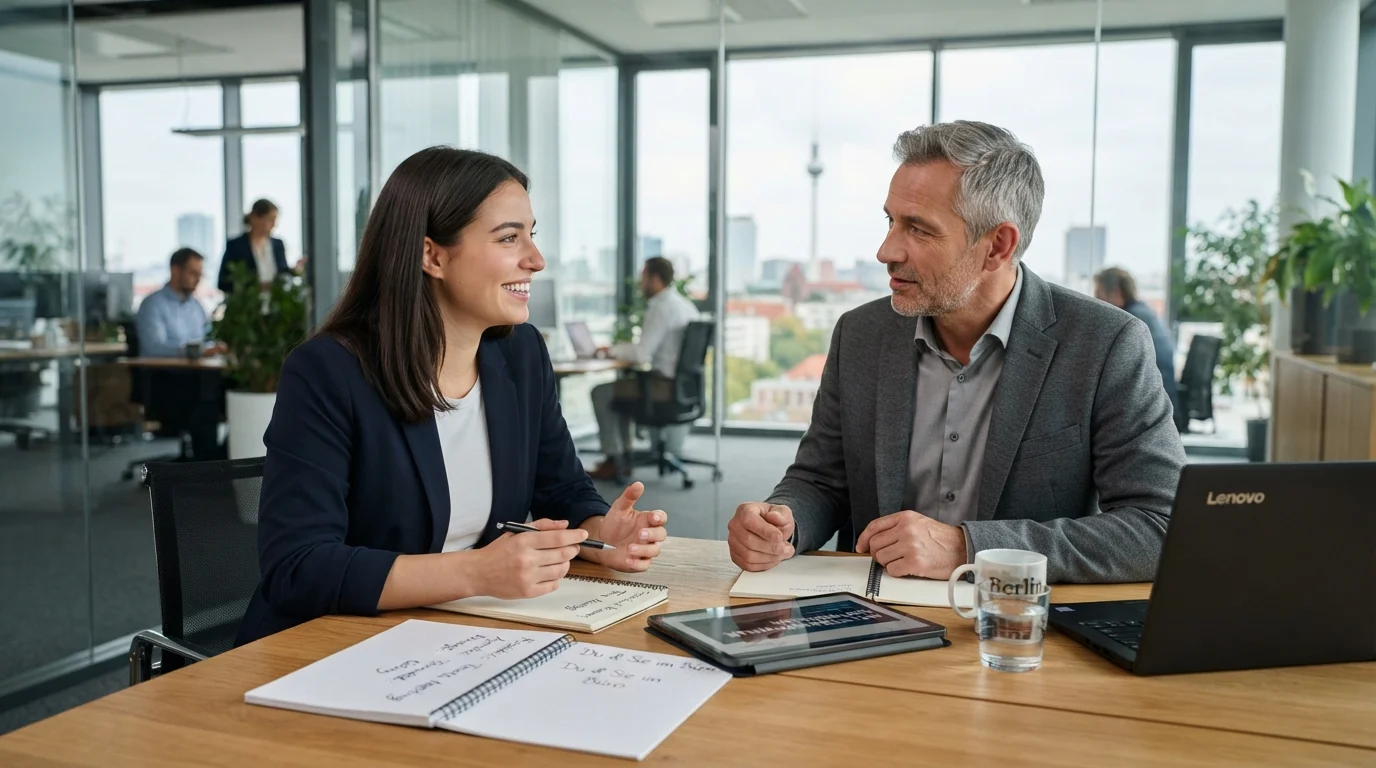
Stepping into a leadership role in a German-speaking workplace can feel like a major milestone in your career. However, when it comes time to run a project sync, pitch a new strategy, or chair a department meeting, many non-native speakers feel a surge of anxiety. Standard conversational German is one thing, but navigating the structured, formal environment of German business culture requires a specific set of linguistic tools.
German professional culture places high value on structure, efficiency, clarity, and punctuality. Leading a meeting in German is not just about translating English phrases literally into German; it is about using the correct formal register, setting clear boundaries, and moderating discussions with confidence. Just like when you are preparing for a German job interview, knowing the exact key phrases gives you authority and puts your team at ease.
In this comprehensive guide, we will break down essential Business German phrases for every phase of a professional meeting—from opening greetings to delegating action items and handling difficult discussions. You will also learn crucial workplace etiquette tips that will help you gain respect from your colleagues and stakeholders.
First impressions matter significantly in German professional environments. When opening a meeting, you want to project confidence, warmth, and structure right from the start. Depending on the size of the meeting and your relationship with the team, you will choose between formal and semi-formal language.
In large corporate settings, cross-department meetings, or when external clients are present, always stick to the formal Sie address.
If you are leading a daily standup or a meeting with close colleagues who already use the informal Du, you can keep the intro slightly more relaxed while remaining professional.
German meetings strictly follow an agenda (die Tagesordnung). Announcing the goals clearly at the outset demonstrates competence and focus.
As the meeting leader, your primary job is to moderate (moderieren), keeping participants on topic while encouraging valuable input. Effective transitions ensure that the meeting runs smoothly without wasting time.
Moving efficiently from one point to the next helps maintain momentum.
Great leaders ensure everyone has a voice. In German corporate culture, direct questions are welcomed, provided they maintain a respectful tone.
Whether you are managing internal staff or asking for a promotion in German yourself, clear and precise articulation during these moderation moments showcases your strong communication skills.
Meetings rarely go entirely without hitches. People may talk out of turn, discussions might derail, or opinions might clash. According to core German business culture principles, addressing issues directly yet politely is the best approach.
Time management is sacred in German business settings. If a discussion runs over, you must intervene firmly.
When someone interrupts or the group strays off-topic, use these professional interventions:
German workplaces encourage constructive feedback (Sachkritik). Disagreements are viewed as problem-solving discussions rather than personal attacks.
A meeting is only as good as its outcomes. Concluding clearly with agreed-upon next steps, responsible individuals, and deadlines ensures accountability.
Always conclude by highlighting decisions made during the session.
Be explicit about who does what and by when.
Close the session on a positive, respectful note.
Mastering vocabulary is only half the battle; knowing cultural expectations ensures your leadership is received positively.
Arriving 2 to 3 minutes early is considered "on time." Starting at 10:00 AM means opening your laptop and launching the slide deck at 09:58 AM. If you run the meeting, start on the dot even if a participant is missing.
Never default to Du unless it has been explicitly offered by a senior colleague or is standard company policy (common in tech startups). Stick to Sie paired with last names (Herr Müller, Frau Schmidt) in corporate environments.
Every official German meeting usually has a designated minute-taker (Protokollführer). At the start of the meeting, assign someone to record decisions: "Herr Weber, könnten Sie heute das Protokoll führen?"
German professional discourse relies heavily on facts, data, and logical arguments rather than emotional sales pitches or excessive small talk. Keep small talk brief before the meeting starts, then transition quickly to the agenda.
If you are an expat working in Germany, understanding your company culture and workplace rights—much like understanding your German Tarifvertrag—will build your confidence to speak up and lead meetings effectively.
Learning business phrases from a list is a great start, but real confidence comes from speaking practice. Pronouncing complex compound words like Tagesordnungs-punkt or Entscheidungsprozess smoothly under pressure takes practice.
This is where the Bretzi app comes in. Designed to help language learners excel in practical scenarios, Bretzi offers real-life German conversation practice with AI tailored specifically for professional workplace settings. You can simulate leading meetings, test your responses, and get instant feedback on your pronunciation and grammar.
Through interactive dialogue games and personalized AI learning plans, Bretzi uses spaced repetition vocabulary building to ensure you remember formal corporate terms when you need them most in front of your colleagues.
Leading professional meetings in German might feel intimidating at first, but with clear structure and the right set of phrases, you will command authority and gain the respect of your team. Practice opening meetings, setting agendas, steering discussions, and summarizing key outcomes out loud before your next work presentation.
Ready to level up your professional Business German? Download Bretzi today to practice interactive workplace dialogues, refine your pronunciation, and step into your next business meeting with ultimate confidence!
Share this article:
When planning a career move to Germany, most international professionals immediately think of university degrees or direct corporate hiring. However,...
Read moreGermany is currently experiencing one of the most substantial tech talent shortages in Europe. From booming AI startups in Berlin to cloud...
Read moreThe Expat Dilemma: Navigating the German Workplace Picture this: It is your first week at a German company. You walk into the kitchen to grab coffee,...
Read more