German Ausbildung Guide: Vocational Training for Expats
When planning a career move to Germany, most international professionals immediately think of university degrees or direct corporate hiring. However,...
Read more
This article was written by AI and published by Bretzi.
AI can get things wrong. For anything official, check the source it points to.
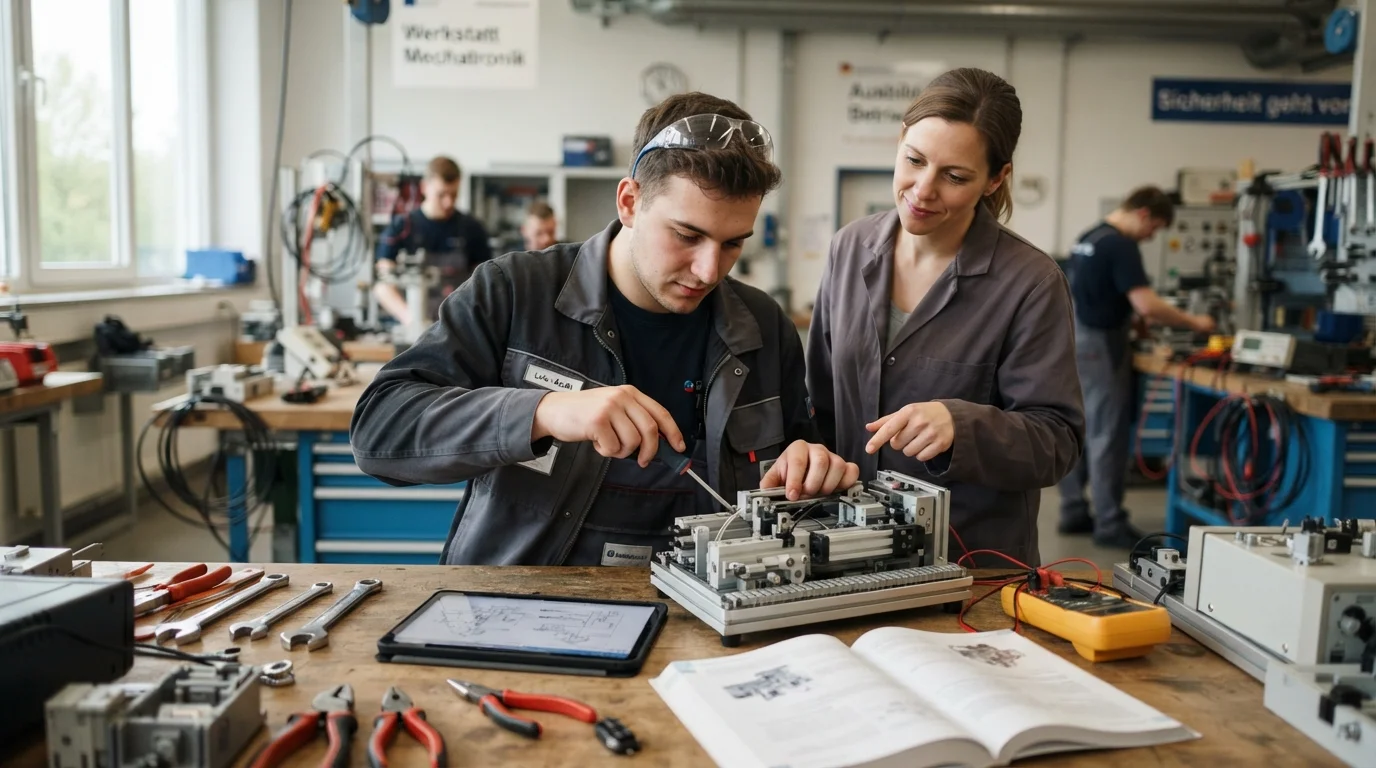
AI-generated image

Germany continues to face significant skilled labor shortages across engineering, healthcare, IT, trades, and business operations. To attract global talent, the German government introduced the Chancenkarte (Opportunity Card)—a points-based visa designed to let qualified non-EU citizens come to Germany for up to one year to search for employment. As we navigate 2026, the application procedures, financial thresholds, and points requirements have become standardized, making it one of the most attractive pathways for foreign professionals to move to Europe.
In this comprehensive guide, we will break down exactly how the Chancenkarte works in 2026, who qualifies, how the points system is calculated, and the step-by-step application process to help you launch your career in Germany.
The Chancenkarte is a residence permit issued under Section 20a of the German Residence Act (Aufenthaltsgesetz). Unlike traditional work visas, the Opportunity Card does not require a binding job offer prior to arrival. Instead, it allows eligible individuals to move to Germany for up to 12 months with the sole purpose of looking for a full-time position that matches their qualifications.
While searching for a career-track job, cardholders are permitted to:
If you take up secondary employment while job hunting, it is important to understand local employment contracts and wage structures, such as German Minijobs and part-time tax rules, to ensure you remain compliant with local regulations.
There are two distinct legal routes to qualify for an Opportunity Card. Understanding which bucket you fall into will dictate the document collection process.
If your professional qualification or university degree is fully recognized as equivalent to a German qualification (Vollgleichwertigkeit), you automatically qualify for the Chancenkarte without needing to accumulate points.
To qualify via this direct route, you must demonstrate:
If your qualification is only partially recognized, or if you hold a state-recognized vocational qualification (requiring at least two years of training) or university degree from your home country, you can qualify by scoring at least 6 points under the German legal framework.
You can verify official guidelines and country-specific recognition portals directly on the Make it in Germany official portal maintained by the Federal Government.
To reach the required 6-point threshold under Pathway 2, criteria are evaluated across five key categories: qualifications, work experience, language skills, age, and ties to Germany.
Language capability plays a pivotal role in points allocation. Boosting your German proficiency directly increases your chances of securing approval:
Note: You must possess at least A1 German OR B2 English to submit a points-based application. However, higher German proficiency awards significantly higher points.
Receiving the Opportunity Card does not entitle you to social welfare assistance in Germany. Therefore, applicants must prove financial stability prior to visa issuance.
For 2026, applicants must demonstrate a minimum monthly balance to cover living costs. The primary method is opening a Blocked Account (Sperrkonto) deposited with approximately €1,027 to €1,090 per month (totaling roughly €12,324 to €13,080 for the full 12-month duration).
Alternatively, you can provide an official Declaration of Commitment (Verpflichtungserklärung) signed by a resident sponsor in Germany, or an employment contract for a part-time job in Germany working up to 20 hours per week.
You must present proof of travel health insurance or private incoming health insurance that covers emergency medical treatment, hospitalization, and repatriation for the full term of your visa. Standard international travel policies are often rejected if they do not explicitly cover long-term residence job-seeking visas.
Preparing a clean, organized application package will prevent administrative delays at the German embassy or foreign authority (Ausländerbehörde).
Review your academic credentials and work history. Verify whether your university and degree are listed as "H+" on the Anabin database. If relying on the points system, ensure you have documented evidence for at least 6 points before booking appointments.
Gather the following documents translated into German or English by a certified translator:
Book a visa appointment through the official online booking system of the German Embassy or Consulate in your country of origin or legal residence. Details can be cross-referenced at the German Federal Foreign Office portal.
Present your original documents and copies at the consular interview. Standard processing fees for national visas are approximately €75. Processing time typically ranges from 4 to 12 weeks depending on consular workload.
Once your visa sticker is stamped, travel to Germany. Within your first two weeks, complete your local address registration (Anmeldung) at the local town hall or Bürgeramt. If your visa was issued for less than 12 months, book an appointment at the local Ausländerbehörde to extend your Opportunity Card to the full term.
Arriving in Germany with an Opportunity Card gives you a competitive advantage over candidates applying from abroad, as employers appreciate that you are already locally available and legally authorized to start immediately.
To convert your Opportunity Card into a long-term career, focus on building professional application materials catered to German industry standards. When applying for tech roles, engineering positions, or corporate jobs, ensure you are writing an effective German cover letter (Anschreiben) that highlights both your technical background and your current residence status in Germany.
Furthermore, prepare thoroughly for local corporate culture. Practicing interviewing technique is essential—focus on direct communication, structured responses, and preparing for a German job interview by mastering cultural expectations in corporate environments.
While English is widely spoken in large tech hubs like Berlin or Munich, speaking professional German is the single most important factor for securing high-paying roles across the federal republic. Furthermore, moving from A2 to B1 or B2 level German adds vital points directly to your Chancenkarte calculation.
To build practical language skills rapidly, modern interactive apps provide real-world advantages over traditional textbooks. For example, using Bretzi—an AI-powered German language learning app—allows you to practice real-life German conversation scenarios tailored to job interviews, administrative visits, and everyday workplace interactions. With personalized learning plans, pronunciation feedback, and grammar modules spanning A0 to C1 levels, continuous daily practice on Bretzi can accelerate your path toward reaching B1 or B2 certificates required for visa points and career success.
The German Chancenkarte offers foreign professionals an unprecedented opportunity to land a career in Europe's largest economy without first waiting months for remote employment approval. By preparing your documentation, managing financial requirements, and actively sharpening your German language skills, you set yourself up for a seamless transition into the German job market.
Start building your language proficiency today, gather your credentials, and take the first concrete step toward securing your Opportunity Card for 2026!
Share this article:
When planning a career move to Germany, most international professionals immediately think of university degrees or direct corporate hiring. However,...
Read moreGermany is currently experiencing one of the most substantial tech talent shortages in Europe. From booming AI startups in Berlin to cloud...
Read moreThe Expat Dilemma: Navigating the German Workplace Picture this: It is your first week at a German company. You walk into the kitchen to grab coffee,...
Read more