
How to Book a Bürgeramt Appointment in Autumn 2026
Securing an appointment at the local Bürgeramt (also called Bürgerbüro or Kundenzentrum depending on your federal state) has long been considered...
Read more
This article was written by AI and published by Bretzi.
AI can get things wrong. For anything official, check the source it points to.
AI-generated image
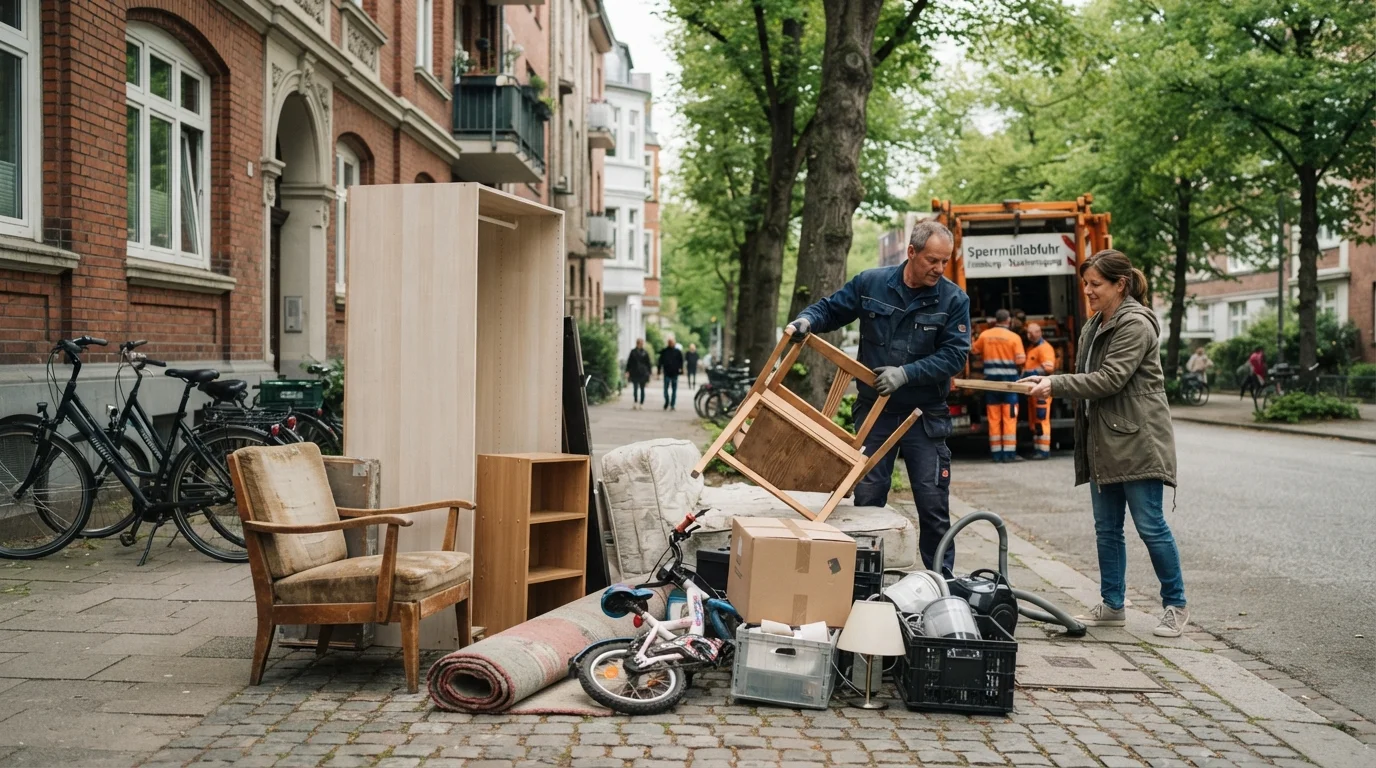
If you have recently moved to Germany or walked through a German residential neighborhood, you have likely encountered a curious sight: stacks of old wooden wardrobes, rolled-up mattresses, desk chairs, and mirrors lined up neatly on the pavement. You might have even seen people stopping by to inspect a vintage lamp or hauling away a bedside table.
This widespread ritual revolves around Sperrmüll (bulky household waste). For newcomers, the system can seem bewildering. Is it free trash pickup? Can you simply dump an old sofa by the curb whenever you buy a new one? And can you legally take home that retro armchair you spotted outside your neighbor's building?
Germany takes its waste management seriously. Leaving oversized items on the street without following the local municipal procedure is considered illegal dumping (illegale Müllablagerung) and can trigger steep fines. In this comprehensive guide, you will learn everything you need to know about Sperrmüll: what counts, how to arrange a pickup, how to visit a local recycling depot, and the vital German vocabulary you need to handle the process with confidence.
In simple terms, Sperrmüll refers to bulky household items that are too large, too heavy, or too unwieldy to fit into your building's regular grey residual waste bin (Restmülltonne), even after being dismantled or broken down.
A classic rule of thumb used by German municipal waste services (Abfallwirtschaftsbetriebe) is the "moving house rule": If you turned your apartment upside down, whatever falls out that you would normally pack into a removal van counts as Sperrmüll—provided it does not fit into an ordinary trash bag.
One of the most frequent mistakes expats make is assuming that anything large can go onto the curb. Putting non-permitted waste out for collection often means the waste disposal team will leave it behind, and you could be held liable for cleanup costs.
Waste management in Germany is organized at the local municipal level (Kommunalebene). Because each city and administrative district (Landkreis) sets its own municipal statutes, Sperrmüll operates primarily under one of two systems: on-demand appointment or fixed collection dates.
This is the standard model in most major cities and suburban districts today. Rather than waiting for a set street date, individual households register their bulky waste whenever they need a disposal run. Depending on where you live:
In some smaller towns and rural communities, the local council designates fixed days throughout the year for specific neighborhoods (often once in spring and once in autumn). You will find these dates listed in your annual waste calendar (Abfallkalender), which every household receives in the mail or can download as a PDF.
On these designated collection days, residents are permitted to place their bulky items on the street during a specified time window without having to pre-register.
Booking and staging your bulky waste requires attention to detail. Follow this step-by-step checklist to ensure a smooth pickup without annoying your neighbors or the local sanitation department.
When booking online, municipal portals will prompt you to specify every item you intend to discard. They will ask how many chairs, tables, mattresses, or cupboards you have. Do not skip this step: collection crews plan truck capacity based on reported items, and they may refuse to take unaccounted furniture.
After submitting your request, the waste management agency will email you an official appointment date (usually within 2 to 4 weeks, though express services are often available for an extra charge). Keep this confirmation handy. If you live in a rented apartment, it is good etiquette to give your caretaker (Hausmeister) or neighbors a quick heads-up if you plan to clear out substantial amounts of furniture.
When doing major clearances, such as when you declutter to prepare your German apartment for winter heating, reserving your slot a few weeks ahead prevents clutter from piling up in communal hallways or courtyards.
Timing is critical. In nearly all German municipalities, you are legally only allowed to place Sperrmüll on the public sidewalk from late afternoon or evening (usually after 18:00 or 19:00) the night before collection, or early in the morning before 06:30 on the day itself.
Putting items out days in advance is considered an illegal use of public space (unerlaubte Sondernutzung) and attracts unauthorized trash dumping from passersby. Furthermore, be conscious of noise levels: hauling heavy wooden panels across stairwells and stone sidewalks late at night can breach statutory quiet hours. Familiarize yourself with Ruhezeit quiet hours and house rules to avoid complaints from neighbors.
When stacking items along the curb:
If you don't want to wait several weeks for an on-demand truck appointment, or if you only have one or two items, you have several practical alternatives.
Every German city operates several municipal recycling centers, known variably as a Wertstoffhof, Recyclinghof, or Bauhof. If you have access to a car, a van, or a car-sharing vehicle with cargo space, you can load your items and drive there directly.
Important: Bring proof of local residency (your Personalausweis or your passport along with your Meldebescheinigung). Most municipal depots accept typical bulky waste from local residents free of charge (up to an annual volume limit, often 1–2 m³ per visit), but they turn away non-residents or commercial contractors.
If your items are still functional and in decent shape, consider setting them outside temporarily with a visible handwritten sign reading "Zu verschenken" (free to take). In urban hubs like Berlin, Hamburg, Leipzig, and Munich, useful household goods frequently disappear into appreciative hands within hours.
However, be responsible: if nobody takes your items by evening, you are still legally obligated to bring them back indoors or dispose of them properly. Abandoning unwanted possessions permanently under the guise of "gifting" remains an administrative offense.
Before throwing functional goods away, try listing them on platforms like Kleinanzeigen under the category Zu verschenken. Many people are eager to collect usable furniture for student apartments or guest rooms. Additionally, charitable organizations and social department stores (Sozialkaufhäuser) run by Caritas, the Red Cross (DRK), or Diakonie often collect intact furniture directly from your flat for a nominal fee or for free, refurbishing it for low-income families.
Seeing a charming wooden desk sitting on the pavement can tempt anyone to carry it home. But what is the legal situation in Germany?
Strictly speaking, under German property law (§ 959 BGB), when a resident sets an item out for municipal Sperrmüll pickup, they do not necessarily abandon it as masterless property (herrenlos) for anyone to claim. Instead, they transfer custody of the item specifically to the municipal waste disposal company. Removing items from a registered Sperrmüll pile can technically be treated as theft (Diebstahl) or an unauthorized appropriation of recyclable resources belonging to the city.
In practice, everyday scavengers taking a single chair or picture frame are rarely prosecuted unless the owner explicitly complains or the person causes a massive mess by tearing apart mattresses and scattering debris. However, commercial "waste scavenging" (Sperrmülltourismus), where vans comb neighborhoods to strip out valuable scrap metal and leave the rest scattered across sidewalks, is strictly prohibited and actively monitored by the local public order office (Ordnungsamt).
To register your disposal, read notices from your building management, or speak with municipal sanitation workers, it helps to master the core terminology:
| German Term | Gender / Plural | English Meaning |
|---|---|---|
| der Sperrmüll | der (no pl.) | Bulky household waste |
| der Wertstoffhof / Recyclinghof | der (pl. -höfe) | Municipal recycling depot |
| die Abfallwirtschaft | die (no pl.) | Waste management authority |
| das Elektroaltgerät / der Elektroschrott | das (pl. -e) / der | Electronic waste / obsolete appliances |
| der Bauschutt | der (no pl.) | Construction and renovation rubble |
| der Sondermüll / Schadstoff | der (pl. -stoffe) | Hazardous / toxic waste |
| entsorgen | Verb (regular) | To dispose of / to discard |
| die Abholung beantragen | Phrase | To apply for / request a pickup |
| die Mülltrennung | die (no pl.) | Waste separation / sorting |
When living in Germany, everyday domestic tasks—from interpreting waste schedules to contacting municipal authorities—require practical, authentic German. In the Bretzi app, lessons follow real situations from life in Germany across levels A0 to C1. You can save and review vocabulary with spaced repetition, practise noun genders with article mini-games, and use the Premium photo scanning feature to snap a picture of local municipal recycling flyers to add unknown terms directly to your personal study deck.
Germany has established strict fines (Bußgelder) for environmental infractions. Dumping mattresses, furniture, or construction rubble in public parks, on street corners, or next to communal bin areas without an appointment is treated as an administrative violation under the Federal Immission Control and Closed Substance Cycle Waste Management Acts.
If you live in a rented apartment complex, your landlord or property management company (Hausverwaltung) will charge the cost of removing illegally dumped furniture from communal basements or courtyards directly to all tenants via the annual operating costs (Betriebskostenabrechnung), unless the culprit is identified. Being a considerate neighbor means arranging your own disposal properly.
Whether you need to ask your building's caretaker where the designated Sperrmüll staging point is located, or call the local Stadtreinigung because an scheduled truck missed an item, having the confidence to speak German out loud makes all the difference.
With Bretzi Premium, you can practise such real-life encounters using SprachBuddy, the app's AI conversation partner. You can hold out-loud German phone roleplays simulating interactions with landlords or municipal offices, receive immediate feedback on your pronunciation and grammar, and read through full conversation transcripts afterward to consolidate your everyday German skills.
Mastering the rules of Sperrmüll is one of those understated milestones of settling into German life. Once you understand the system, getting rid of old furniture or clearing out your basement becomes an organized, stress-free process that keeps your neighborhood clean and your neighbors happy.
Rules, fees and dates change. Check the current version on the official pages before you act.
Share this article:
Securing an appointment at the local Bürgeramt (also called Bürgerbüro or Kundenzentrum depending on your federal state) has long been considered...
Read morePicture this scenario: You arrive at Frankfurt Airport (FRA), Munich (MUC), or Berlin Brandenburg (BER) ready to board your flight. You reach into...
Read moreChoosing between public and private health insurance in Germany can feel like a test of both bureaucracy and vocabulary. You may encounter terms such...
Read more