
Guide to Sperrmüll in Germany: How to Dispose of Bulky Waste (2026)
If you have recently moved to Germany or walked through a German residential neighborhood, you have likely encountered a curious sight: stacks of old...
Read more
This article was written by AI and published by Bretzi.
AI can get things wrong. For anything official, check the source it points to.
AI-generated image
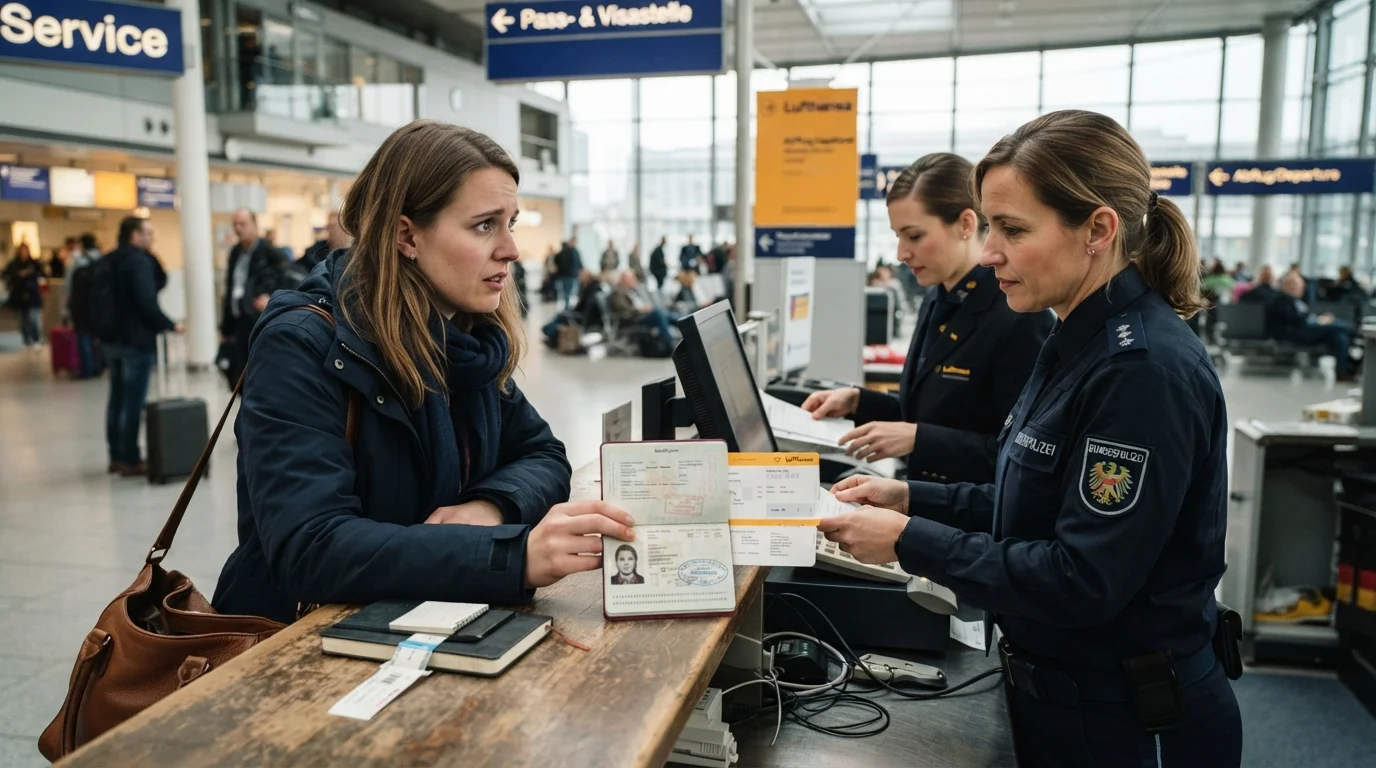
Picture this scenario: You arrive at Frankfurt Airport (FRA), Munich (MUC), or Berlin Brandenburg (BER) ready to board your flight. You reach into your travel wallet, only to realize your passport expired three days ago, or worse, vanished entirely between the train station and Terminal 1. Your stomach drops, your flight boards in two hours, and panic begins to set in.
Airport emergencies happen to thousands of international travelers and expats every year. Whether you have lost your identification or urgently need to buy a last-minute flight ticket due to a family crisis or a missed connection, German airports are equipped with specialized administrative infrastructure to handle these crises. However, German airport authorities follow strict bureaucratic protocols. Knowing exactly which office to approach, what documents qualify, and how to communicate your situation in German can be the difference between boarding your flight and being stranded in the departure hall.
In this comprehensive guide, we will walk you through the exact steps to procure emergency travel documents from the German Federal Police (Bundespolizei), how to buy walk-up tickets at airport service counters, the rules governing non-German citizens, and the key German vocabulary you need to navigate these high-stress situations smoothly.
If your passport is expired, lost, or stolen, you cannot pass through outbound border control (Grenzkontrolle). However, under German law, the Federal Police (Bundespolizei) have the authority to issue an emergency travel permit known as a Reiseausweis als Passersatz (Travel Document as a Passport Replacement) directly at the airport.
According to official regulations by the Bundespolizei, this document is an exceptional measure, not an everyday alternative to renewing your regular passport. It is issued under stringent conditions.
Even if the German Federal Police grant you a Reiseausweis als Passersatz, your destination country must formally recognize it. While most Schengen member states accept the document for entry, many non-EU destinations—including the United States, the United Kingdom, and Canada—do not accept it for inbound border control. If you attempt to board a flight to London or New York with only a German emergency travel document, the airline will deny boarding at the gate.
If you find yourself at a major German airport without a valid passport, follow these practical steps immediately:
Do not wait in the standard check-in line. Ask airport information for the Bundespolizeirevier or Servicepoint der Bundespolizei. At Frankfurt Airport, for instance, you will find stations in both Terminal 1 and Terminal 2. At Berlin Brandenburg (BER), the Bundespolizei service counter is situated on the departures level of Terminal 1.
You must prove who you are. The police officers will run background checks against the national registry (Melderegister) and international databases (such as the Schengen Information System). Bring whatever you have available:
A Reiseausweis als Passersatz requires a standard biometric passport photo. Most major German airports feature photo booths (Fotoautomaten) located adjacent to the police station or airline service desks. The machine will cost around €8 to €10, payable in cash or card.
The fee for issuing an emergency travel document typically ranges from €18 to €52, depending on the specific document type and administrative overhead. Payment can usually be made with an EC-Karte (Girocard), major credit card, or cash.
The document is strictly limited in duration—often valid only for the specific single journey or a maximum of one to three months. It is not an ongoing replacement for your official passport.
If you are an expat living in Germany without EU citizenship and your foreign passport is lost, the German Federal Police generally cannot issue you a replacement travel document to enter another nation. In this situation, your recourse involves your home country's diplomatic mission:
Keep in mind that when scheduling an emergency consulate visit, planning around local transit and timing is critical. If your flight is scheduled around autumn transit disruptions or daylight schedule updates, you may want to consult our guide on Germany's 2026 Time Change: An Expat Guide to prevent missing crucial appointment windows.
Aside from missing identity papers, you might need to buy an emergency flight ticket directly at the airport due to sudden personal emergencies, medical crises, or cancellations of connecting flights on separate itineraries.
Every major German airport features airline ticket desks (often operated by Lufthansa, Austrian, Swiss, or independent handling agents like Swissport or Aviapartner). Here is what you need to know about purchasing tickets at the counter:
If the last-minute flight is sold out or prohibitive in cost, remember that German airports are thoroughly integrated into the national rail network. Stations such as Frankfurt am Main Flughafen Fernbahnhof or Düsseldorf Flughafen connect directly to high-speed ICE trains traveling across Europe.
For cross-country domestic transit, local regional alternatives are also an option. If you are exploring regional and local transit options to connect to an alternative hub, read The Expat Guide to Germany's Deutschlandticket: Price, Validity, and Rules for 2026 to understand what trains you can take on short notice.
Under pressure, trying to explain an administrative crisis in a foreign language can feel overwhelming. Airport police officers and airline staff frequently speak English, but legal matters and official police forms are processed in German. Knowing precise terminology ensures your request is handled quickly and accurately.
Administrative dialogues in Germany can be intimidating if you have only studied generic phrasebooks. If you want to prepare for everyday and administrative interactions in Germany, the language learning app Bretzi offers comprehensive lessons from A0 to C1 that follow real life in Germany. Each unit wraps up with practical everyday dialogues, and with Bretzi Premium, you can use SprachBuddy—an AI conversation partner—to call and rehearse real-life scenarios out loud, such as speaking with airport authorities, asking for official forms, or handling customer service inquiries, complete with instant pronunciation feedback.
Preventing an emergency before you leave home is always less stressful than negotiating with border police at 6:00 AM. Run through this pre-flight checklist 48 hours prior to every departure from Germany:
Experiencing a travel documentation or ticketing emergency at a German airport is undeniably stressful, but it does not have to ruin your travel plans permanently. The German Federal Police and airport service desks have well-defined processes to resolve genuine emergencies for eligible travelers. By staying calm, heading directly to the Bundespolizeirevier, presenting clear alternative identification, and using clear German terminology, you can navigate official procedures effectively and get your journey back on course.
Rules, fees and dates change. Check the current version on the official pages before you act.
Share this article:
If you have recently moved to Germany or walked through a German residential neighborhood, you have likely encountered a curious sight: stacks of old...
Read moreChoosing between public and private health insurance in Germany can feel like a test of both bureaucracy and vocabulary. You may encounter terms such...
Read moreAutumn in Germany is more than cooler mornings, colourful forests and the return of indoor activities. It is also an excellent time to join a local...
Read more