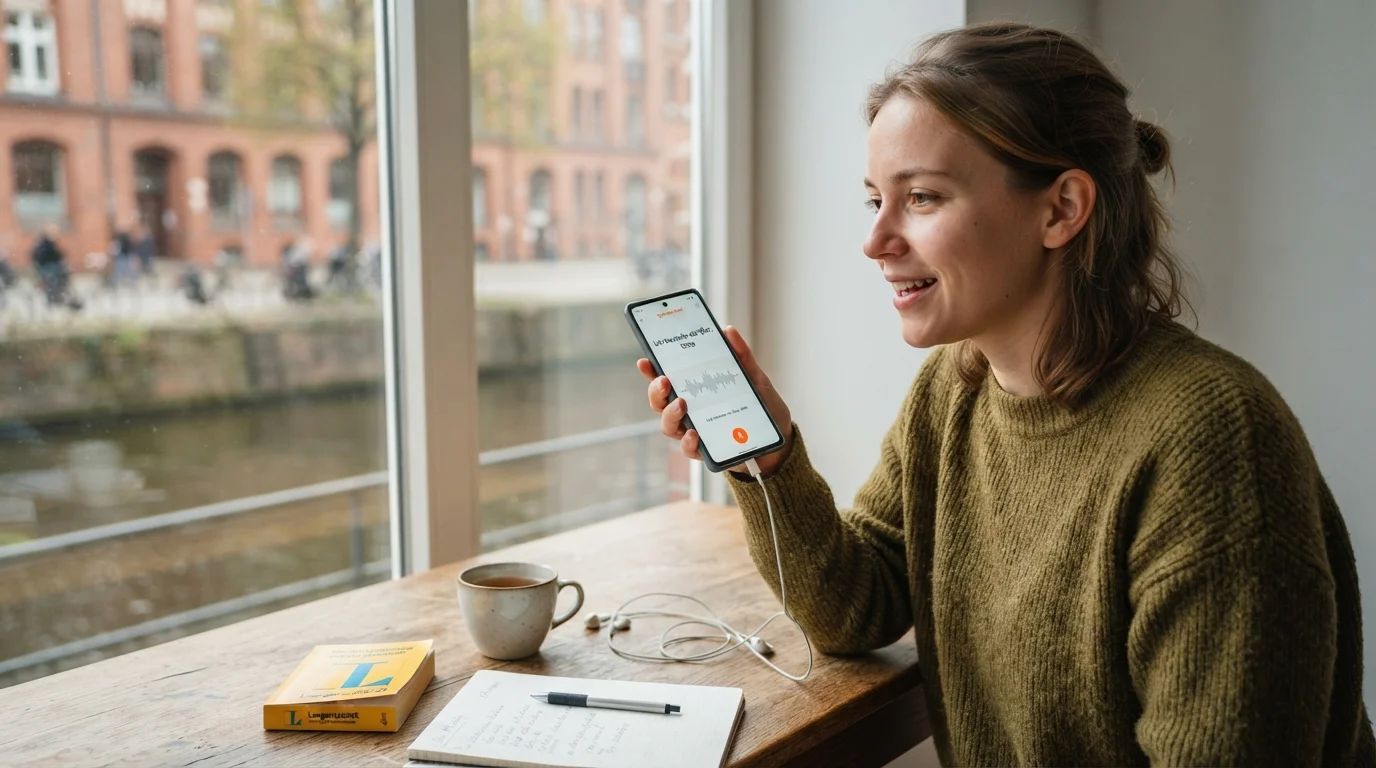
How to Practice German Pronunciation: Best App Features and Voice Recognition Tools
When you start learning German, the grammar often gets the lion's share of the attention. You wrestle with cases, memorize noun genders, and...
Read more
As the leaves turn amber across Berlin, Munich, Vienna, and Zurich, autumn signals a natural return to routines. For expats settling into life in the DACH region, this season often coincides with signing apartment leases, registering at the local Bürgeramt, starting new jobs, or enrolling in integration courses (Integrationskurse). In every one of these scenarios, one obstacle quickly becomes apparent: your German vocabulary determines your independence.
Grammar provides the skeleton of the German language, but vocabulary represents the muscle and vitality. Without words like die Kaution (security deposit), die Kündigungsfrist (notice period), or die Überweisung (bank transfer), even an understanding of basic sentence structure will leave you stranded in daily bureaucratic tasks. Fortunately, language learning technology in 2026 has evolved beyond static flashcards.
Whether you are looking for free tools or premium AI-assisted platforms, this guide breaks down the top 5 free and paid German vocabulary apps for expats in autumn 2026, helping you select the perfect digital companion to accelerate your path to fluency.
Unlike casual hobbyists, expats require vocabulary tools tailored to immediate survival and long-term career integration. When evaluating vocabulary apps, consider these critical criteria:
Pricing: Freemium (Generous free tier with premium AI features available)
Best For: Expats who want conversational confidence, article mastery, and personalized vocabulary.
Emerging as a standout app in 2026, Bretzi bridges the gap between raw vocabulary memorization and practical conversational application. Rather than treating vocabulary as disconnected flashcards, Bretzi integrates words into personalized learning plans designed around your actual daily life in Germany.
Bretzi features an intelligent vocabulary builder powered by spaced repetition, alongside dedicated Article Mastery Games that train your reflexes on der, die, and das. What sets Bretzi apart for expats is its ability to immediately deploy newly learned words into real-life AI conversation practice. If you learn medical or bureaucratic terms in the morning, you can roleplay a doctor's appointment or a visa office conversation with the AI tutor that very evening.
Key Features:
Pricing: 100% Free on Web and Android; Paid one-time fee on iOS
Best For: Self-directed learners who want full control over custom flashcard decks.
Anki remains a classic cornerstone of vocabulary acquisition. Built purely on open-source spaced repetition algorithms, Anki allows you to download massive shared decks (such as the Goethe B1 word lists) or construct your own custom decks tailored to your work environment.
While Anki lacks an intuitive modern interface and offers no conversational feedback or native grammar instruction, its raw efficiency for brute-force memorization is undeniable. If you enjoy building your own sentence-mining systems from German news or podcasts, Anki is an unbeatable free tool.
Pros & Cons:
Pricing: Paid subscription (Monthly/Yearly plans)
Best For: Learners seeking traditional, professionally curated curriculum pathways.
Babbel has long been a staple for adult language learners in Europe. When comparing top German learning apps, Babbel stands out for its methodical lesson design created by linguistic experts. Its vocabulary review manager automatically schedules learned terms into short daily drills.
Babbel's vocabulary selections emphasize practical dialogue, realistic audio recordings by native speakers, and cultural notes that assist newcomers with local etiquette. However, it offers less dynamic adaptability than cutting-edge AI tutors when you want to learn niche, career-specific terminology.
Pricing: Free (5 minutes per day) / Paid Unlimited Subscription
Best For: Visual learners and busy professionals who want quick, 5-minute daily study bursts.
If your schedule is packed and you only have five minutes on the U-Bahn, Drops offers a sleek, visually engaging interface. Every German vocabulary word is paired with a minimalist graphic illustration, making it especially effective for visual learners who struggle with standard text-based flashcards.
Drops breaks vocabulary into intuitive categories like food, transportation, housing, and emergency terms. While it does not teach complex grammar or conversational sentence generation, it is an excellent supplementary tool for expanding noun and verb recognition in short daily sprints.
Pricing: Freemium (Free basic version / Paid Quizlet Plus)
Best For: Students in integration courses (Integrationskurs) studying shared textbook modules.
Quizlet is widely used by language schools and community colleges across Germany. If you are enrolled in an in-person intensive German course using textbooks like Menschen, Schritte Plus, or Aspekte Neu, chances are fellow students have already built exact chapter-by-chapter vocabulary decks on Quizlet.
With diverse study modes such as "Match", "Learn", and "Test", Quizlet turns rote memorization into quick interactive quizzes. While the automated text-to-speech pronunciation can occasionally sound robotic, its collaborative features make it a reliable companion for formal exam prep.
To help you decide which tool fits your autumn study schedule, here is a quick breakdown of how these top contenders compare:
Downloading an app is only the first step. To make vocabulary stick permanently, incorporate these three habits into your autumn routine:
Mastering German vocabulary is your passport to feeling truly at home in your new city. From conversing effortlessly with local craftsmen to negotiating work contracts and passing official CEFR language exams, a robust vocabulary turns anxiety into autonomy.
If you want a modern solution that pairs intelligent spaced repetition with real-time AI conversation and article mastery, try incorporating Bretzi into your daily study routine this season. Set your daily streak, learn the words that matter for your daily life, and make autumn 2026 the turning point in your German language fluency.
Share this article:
When you start learning German, the grammar often gets the lion's share of the attention. You wrestle with cases, memorize noun genders, and...
Read moreAnyone who has attempted to learn German knows the infamous 'motivation cliff.' You start with immense enthusiasm, eager to master words like...
Read moreMoving to Germany, Austria, or Switzerland is an exciting milestone, but for many expats, the initial excitement quickly collides with linguistic...
Read more