Bretzi vs Anki: Which Spaced Repetition App is Best for German B1?
Reaching the B1 threshold is widely considered the most decisive milestone in your German learning journey. At this intermediate stage, you...
Read more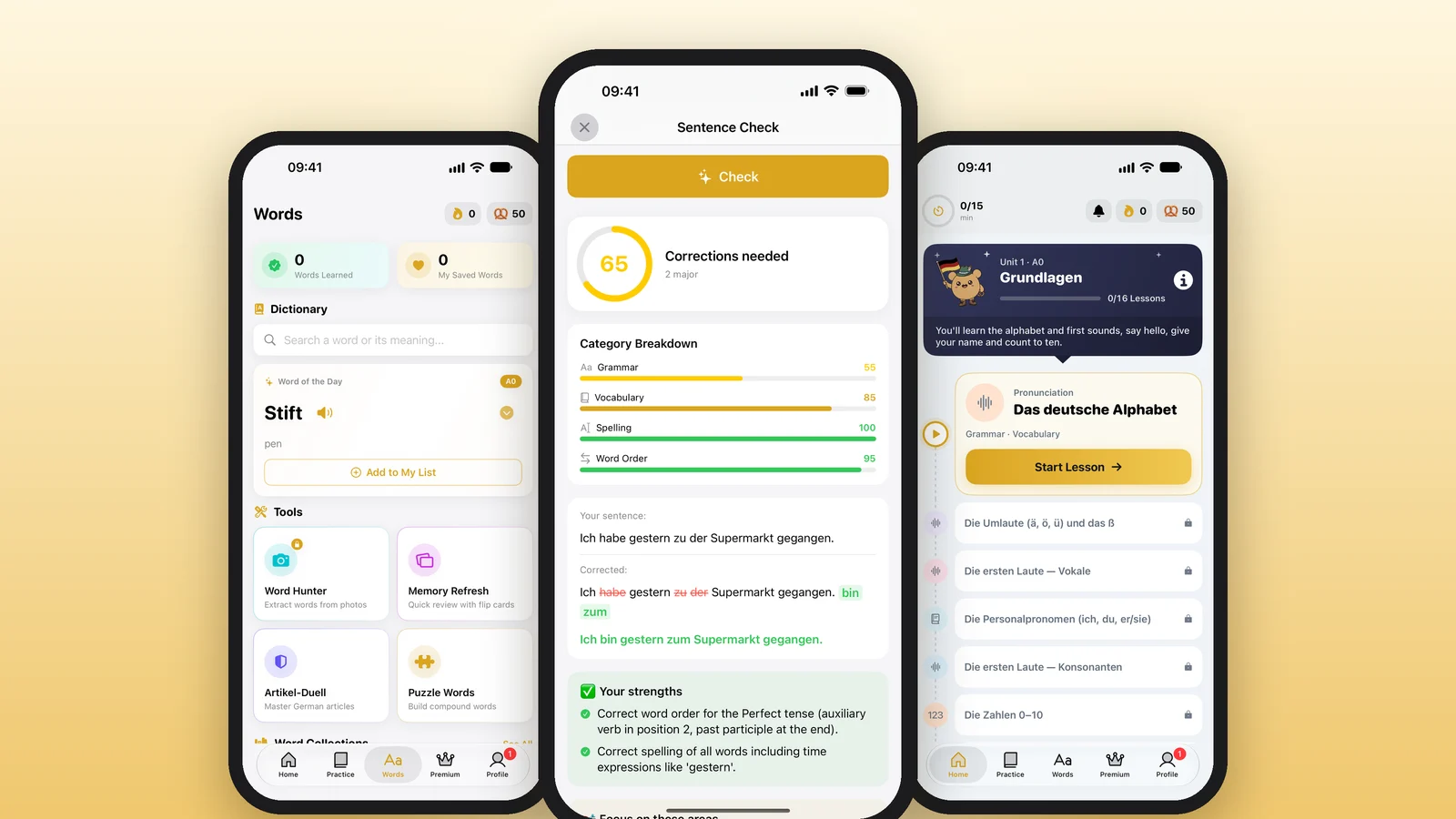
Few grammar hurdles cause as much frustration for German learners as prepositions. At first glance, a word like an, auf, or in seems deceptively simple—it is just two or three letters long. Yet, the moment you attempt to construct a sentence, an entire cascade of grammatical rules triggers: Does this preposition demand the accusative or the dative? Is it a two-way preposition (Wechselpräposition) governed by movement versus location? Or does it dictate a genitive construction that only shows up in formal writing?
For expats, professionals working in Germany, and anyone aiming for exams like the Einbürgerungstest or Goethe-Zertifikat, guessing cases is not a sustainable strategy. Rote memorization of lists like "aus, bei, mit, nach, seit, von, zu" might get you through a written quiz, but in spontaneous speech, conscious recall often collapses. Fortunately, modern mobile language learning tools have evolved beyond static vocabulary drills. In this guide, we break down why prepositions are notoriously tough and explore the top 3 German app features that actually help you retain complex German prepositions.
To understand what makes an app feature effective, one must first understand why German prepositions trip up learners. Unlike English, where prepositions simply indicate spatial or temporal relations without altering surrounding words, German prepositions strictly govern grammatical cases:
According to linguistic classifications on German grammar on Wikipedia, mastering these case governance mechanics is essential for achieving intermediate (B1) and advanced (B2/C1) fluency. Static textbooks show you the rule once, but training your brain to apply it instantaneously requires dynamic digital mechanics.
The single greatest weakness of paper flashcards is timing. You either review words you already know too frequently, or you let complex constructions slip away until you forget them entirely. Dynamic Spaced Repetition Systems (SRS) solve this by scheduling reviews at scientifically calibrated intervals right as memory begins to decay.
Preposition mastery is not about remembering the preposition in isolation; it is about cementing the association between the preposition and its required case. An intelligent review algorithm recognizes when you mistakenly pair mit with an accusative noun and re-queues that specific error for rapid follow-up.
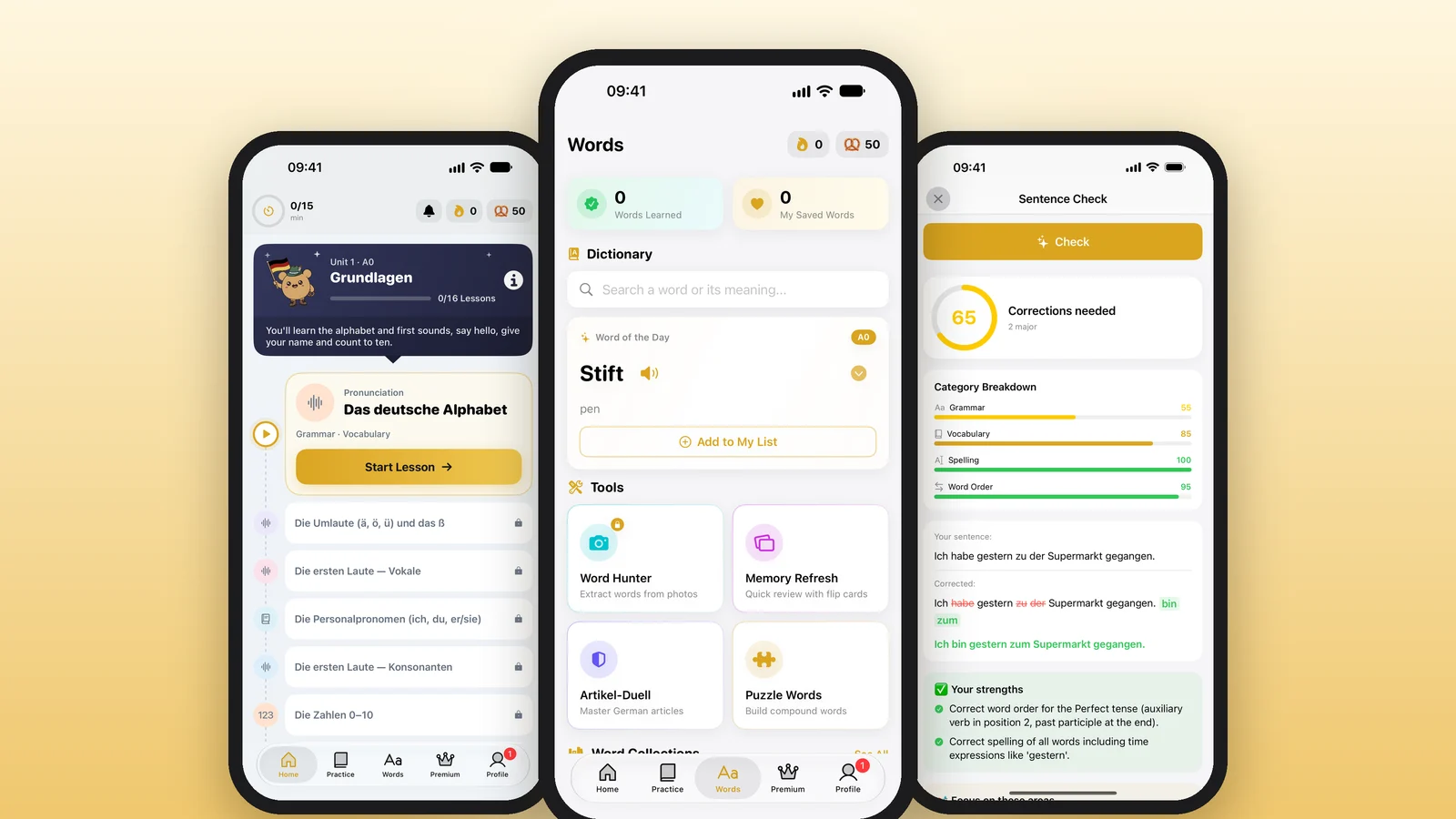
Apps like Bretzi use spaced repetition to target weak spots, ensuring that past mistakes return in short, targeted reviews. When you confuse whether an everyday item belongs in a dative or accusative structure, the mistake resurfaces just before it fades from memory. Instead of forcing you through hundreds of unrelated flashcards, smart SRS isolates troublesome prepositional phrases—such as am Bahnhof (dative) versus an den Bahnhof (accusative)—until your brain automatically selects the correct ending.
A classic multiple-choice prompt gives you a 25% chance of guessing the right case ending purely by luck. When learners guess correctly by accident, apps with shallow mechanics register the concept as "mastered." This creates a false sense of security that shatters the moment you need to compose an email or complete an official form.
To retain complex German prepositions, your brain must actively assemble sentences. The most effective apps incorporate diverse interactive modalities:
When choosing a study tool, compare how different programs handle grammatical depth. As explored in our comparison of apps for B1 German grammar, platforms that break down sentence mechanics systematically help learners progress far more reliably than those relying on abstract intuition alone.
Grammar rules learned in isolation often vanish during spontaneous conversation. You might ace a fill-in-the-blank test on two-way prepositions, yet find yourself saying "Ich gehe in der Supermarkt" instead of "in den Supermarkt" when speaking to a shopkeeper. The bridge between passive knowledge and active reflex is verbal output.
One of the modern breakthroughs in language software is the integration of AI-driven conversational partners. Practicing spoken German in a low-stakes environment allows you to apply prepositional phrases in genuine conversational scenarios, such as explaining an itinerary, describing where items belong in an apartment, or navigating a doctor's appointment.
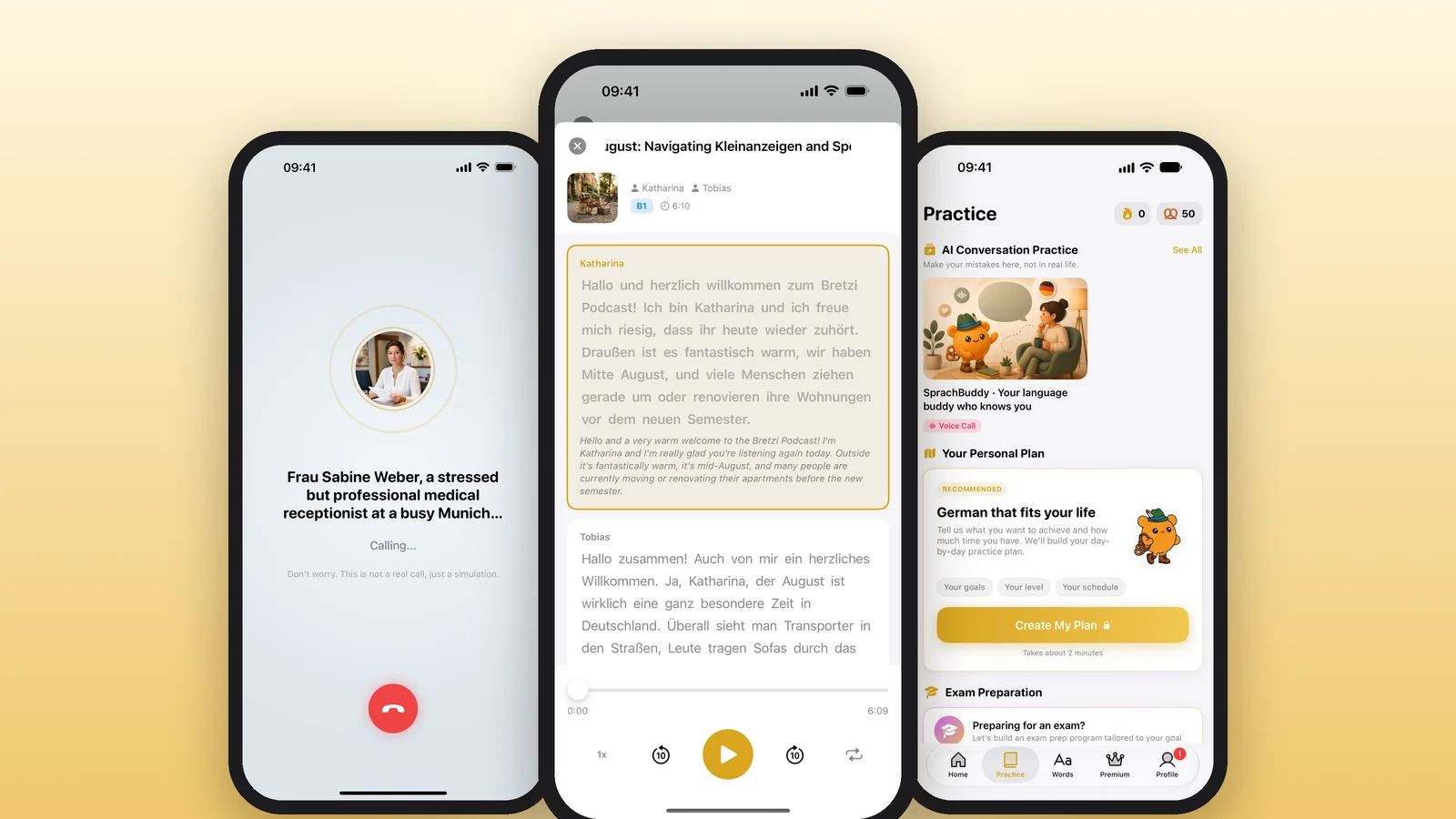
In Bretzi, for instance, learners can call SprachBuddy—an AI conversation partner that clearly states it is software, not a human—to practice speaking German out loud. You can engage in realistic roleplay situations (like visiting the doctor or discussing everyday life), inspect the conversation transcript afterward, and receive pronunciation scores on specific sentences you speak. By repeatedly verbalizing phrases like "Ich warte auf den Bus" or "Ich spreche mit meinem Chef" in context, prepositions transition from abstract grammatical rules into automatic speech patterns. This active practice is vital for mastering conversational German for daily expat life.
To visualize how these features change your daily learning routine, consider how a typical B1 learner approaches the tricky two-way preposition unter (under):
| Learning Approach | The Exercise Experience | Retention Outcome |
|---|---|---|
| Traditional Textbook / Simple Quiz | Memorize a list: unter + Akk (motion), unter + Dat (position). Pick A or B on a static sheet. | High cognitive strain; frequent hesitation in conversation. |
| Contextual App with SRS & Dialogue | Type sentences, correct mistakes with instant feedback, repeat in spaced intervals, and speak phrases in simulated daily scenarios. | Intuitive recall; case agreement feels natural rather than calculated. |
Even with the best app features, your personal study strategy determines how quickly these patterns lock into your long-term memory. Use these actionable techniques during your daily practice:
Never learn a preposition by itself. Instead of memorizing warten and auf separately, memorize the complete chunk: warten auf + Akkusativ. When creating or reviewing flashcards, always include an example noun with its case: "warten auf den Zug" (waiting for the train). This reinforces the grammatical connection as a single unit in your memory.
When an app informs you that an answer is wrong, do not immediately rush to the next question. Take ten seconds to review the detailed feedback. Did you miss the case because of an irregular noun gender, or did you confuse a static location with directional movement? Understanding the exact root of your error trains your analytical reasoning.
Whenever you complete a gap-fill or word-reordering exercise on your phone or tablet, say the full sentence out loud before tapping continue. Engaging your vocal cords and auditory memory reinforces the rhythm of the language, accelerating the transition from silent comprehension to spoken fluency.
German prepositions do not have to be an insurmountable obstacle. By moving away from static memorization and leveraging mobile tools equipped with dynamic spaced repetition, active contextual drills, and interactive conversational roleplay, you can turn complex case systems into automatic communication habits. Focus on daily, consistent immersion, pay close attention to immediate feedback, and practice speaking your phrases out loud whenever possible.
Rules, fees and dates change. Check the current version on the official pages before you act.
Share this article:
Reaching the B1 threshold is widely considered the most decisive milestone in your German learning journey. At this intermediate stage, you...
Read moreThe Acoustic Hurdle: Why Reading German Is Not Enough Many German learners experience an unsettling shock when stepping out of their study room and...
Read moreWhen you start learning German, two distinct grammatical hurdles quickly dominate your study sessions: remembering whether a noun is der, die, or...
Read more