Best Mobile Apps to Master German Verbs and Cases: Bretzi Review 2026
Ask any German learner what keeps them awake at night, and chances are you will hear two words: verbs and cases. Between memorizing whether a verb...
Read more
Learning German often feels like navigating a maze of intricate grammatical machinery. One day you feel confident ordering a bread roll at the local bakery, and the next day you find yourself paralyzed trying to decide whether a two-way preposition requires the dative or accusative case. For expats, professionals, and students living in Germany, these persistent blind spots can become significant obstacles when navigating daily bureaucracy, speaking at work, or preparing for formal language examinations.
Traditional language courses and static textbooks present a linear progression: everyone reads the same chapter, completes the same exercises, and moves forward at an arbitrary pace. However, real language acquisition is rarely linear. You might grasp complex German relative clauses effortlessly while continually stumbling over adjective endings or the specific gender of everyday nouns. Without targeted diagnosis, these subtle mistakes fossilize into permanent habits.
To break through these plateaus, modern language training relies on adaptive technology. In this article, we explore how intelligent analysis, automated error diagnosis, and targeted spaced practice pinpoint your individual German language weaknesses and guide your daily study routine.
German is a structurally rigorous language. Unlike languages where word endings have eroded over time, German requires precision across several intertwined systems:
When you practice passively—such as reading a text or listening to a dialogue—your brain uses context clues to bridge comprehension gaps. You understand the message even if you fail to recognize the dative plural suffix -n. But as soon as you have to write a formal email or speak under time pressure, those hidden gaps emerge. Finding and resolving these friction points requires active production paired with immediate, explanatory correction.
The best app to learn German in Germany must do more than simply mark an answer wrong with a red cross; it needs to explain the underlying logic and bring that concept back before you forget it. Bretzi approaches language acquisition by systematically identifying where your knowledge breaks down across reading, writing, listening, and speaking.
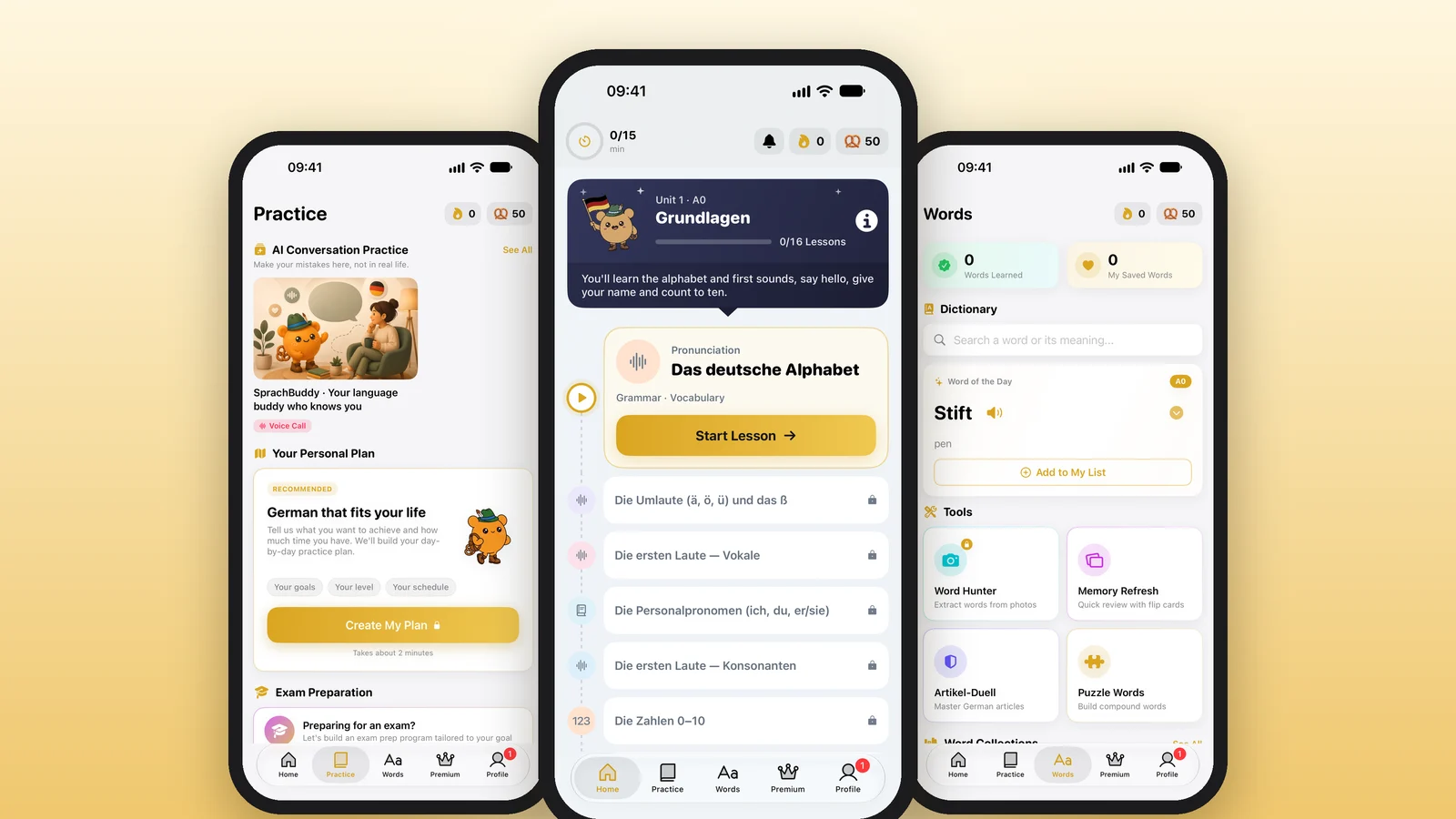
Bretzi structures its curriculum across clear CEFR levels, from total beginner (A0) up to advanced professional proficiency (C1). Rather than presenting unstructured content, the app organizes each level into a step-by-step path of short interactive lessons. During each lesson, you interact with German through varied modalities:
Crucially, whenever you submit an answer, the app does not merely display a pass/fail indicator. Bretzi explains immediately why an answer is correct or incorrect. Integrated grammar tips, concise examples, and clear conjugation tables clarify the structural rule right at the moment of error, preventing misconceptions from taking root.
Identifying an error once is rarely enough to fix it permanently. Human memory naturally follows an exponential forgetting curve. Bretzi addresses this through its dedicated Words and Reviews system. Whenever you make a mistake in a lesson or save a new term from the built-in dictionary, the item enters an intelligent review queue.
Past mistakes and vocabulary return in short, spaced review sessions timed specifically to reappear just as they begin to fade from active memory. Through features like the dedicated article game (training der, die, and das), flashcards, and word puzzles, the system continuously monitors your recall speed and accuracy. You can explore this mechanism further in our guide on how Bretzi personalizes your German vocabulary routine.
Passive recognition exercises can only diagnose half of your linguistic competence. True fluency requires active production. In many traditional environments, getting granular feedback on writing and pronunciation requires private tutoring. Bretzi leverages adaptive AI tools within its Premium tier to pinpoint output weaknesses directly on your mobile device.
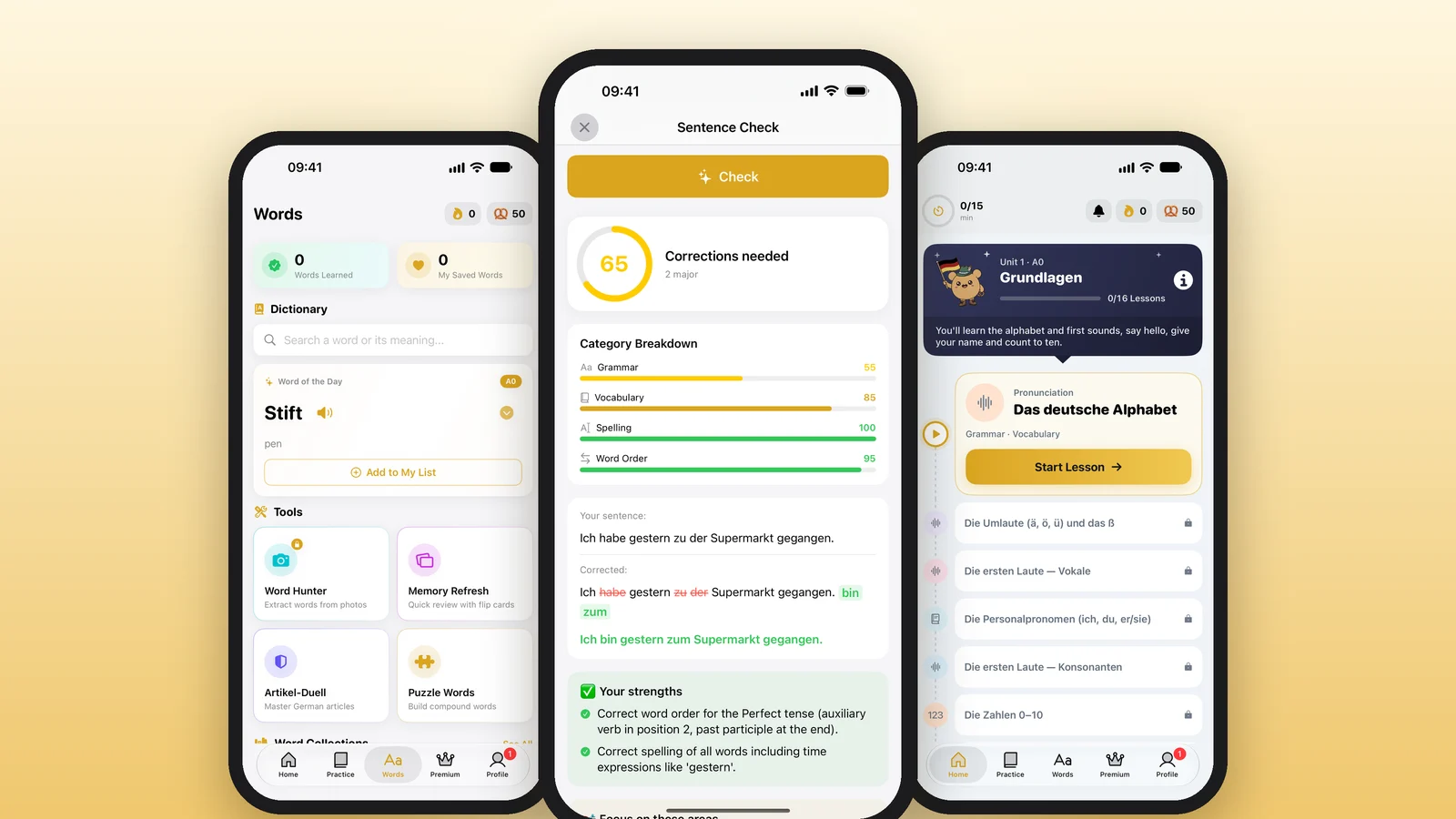
When writing German sentences, learners frequently produce hybrid errors—sentences that are technically understandable but syntactically flawed. For instance, putting a modal verb in the wrong position or choosing the incorrect preposition after a reflexive verb. With Bretzi's Sentence Check feature, you write out full sentences, and the AI evaluates your grammar, highlights specific errors, and provides detailed explanations of why a particular structure must change.
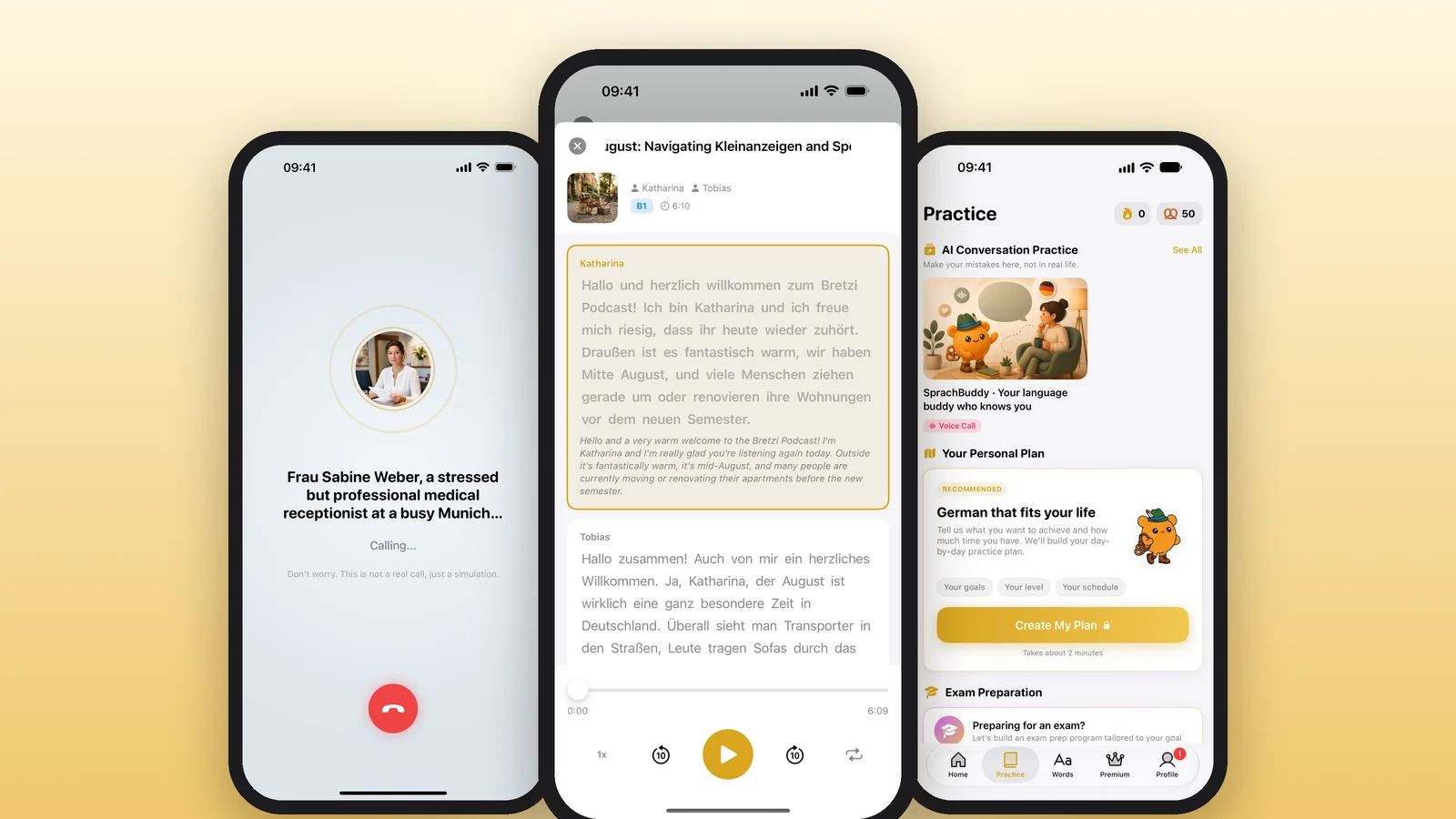
Speaking anxiety often stems from not knowing whether your accent, cadence, or word order sounds natural. Bretzi addresses spoken weaknesses through two dedicated tools:
For immigrants and foreign professionals living in Germany, language learning is often tied directly to official residency and integration milestones. Under German residence law, demonstrating adequate language ability is fundamental. For example, obtaining German citizenship generally requires passing the naturalization test alongside demonstrating at least B1-level German proficiency.
Under the official framework outlined by the Federal Office for Migration and Refugees (BAMF), integration courses culminate in the Deutsch-Test für Zuwanderer (DTZ) and the "Leben in Deutschland" test. The DTZ evaluates language proficiency at the A2 and B1 levels through approximately 100 minutes of written testing and a 15-minute oral examination. Preparing effectively requires knowing exactly which sub-skill—reading, writing, listening, or speaking—lags behind.
Bretzi provides targeted exam practice for these high-stakes milestones:
Rather than providing full mock exams, Bretzi breaks preparation down part by part. Each exam component includes a countdown timer to simulate real testing conditions. The app uses AI to grade your writing and speaking responses, archives your historical performance, and generates a clear readiness score for each individual part of the exam. This allows you to immediately see whether your listening comprehension is exam-ready while your formal letter writing still requires focused work.
Technology is most effective when paired with disciplined study habits. Here is a step-by-step strategy to systematically uncover and fix your German weaknesses using targeted digital practice:
Consistency matters far more than sporadic marathons. In Bretzi, you can set a daily practice goal between 5 and 30 minutes, supported by a daily reminder at a time that fits your schedule. Your streak counts every consecutive day of practice, supported by a streak freeze feature to protect your momentum if an unexpected interruption occurs.
Divide your practice sessions throughout the week into three distinct actions:
Every Monday, Bretzi provides a comprehensive summary of your weekly activity. Premium users receive a detailed progress report generated by AI that analyzes performance trends, highlighting where your accuracy is climbing and which topics continue to cause friction. Reviewing this data allows you to allocate your upcoming study time strategically rather than guessing what to practice next.
Mastering German does not require endless memorization of abstract charts. It requires a responsive feedback loop that exposes your unique blind spots, explains the grammar clearly at the moment of error, and reinforces your knowledge through systematic spaced repetition. Whether you are navigating your first months in Germany or preparing for your B1 integration exam, pinpointing your weaknesses early is the most dependable path to communicative confidence.
Download Bretzi on your iPhone, iPad (iOS 18+), or Android device (Android 8.0+) to begin your diagnostic lessons, practice with SprachBuddy, and build a focused daily German routine tailored to your personal learning needs.
Rules, fees and dates change. Check the current version on the official pages before you act.
Share this article:
Ask any German learner what keeps them awake at night, and chances are you will hear two words: verbs and cases. Between memorizing whether a verb...
Read moreWhen learning German, many people find that reading a textbook or recognizing words on a screen feels manageable, yet the moment someone speaks on a...
Read moreGerman grammar can feel like a maze of cases, word order, verb endings and noun genders. You may understand a sentence perfectly in a lesson, then...
Read more