Practice German Listening and Speaking: A Daily Routine
When learning German, many people find that reading a textbook or recognizing words on a screen feels manageable, yet the moment someone speaks on a...
Read more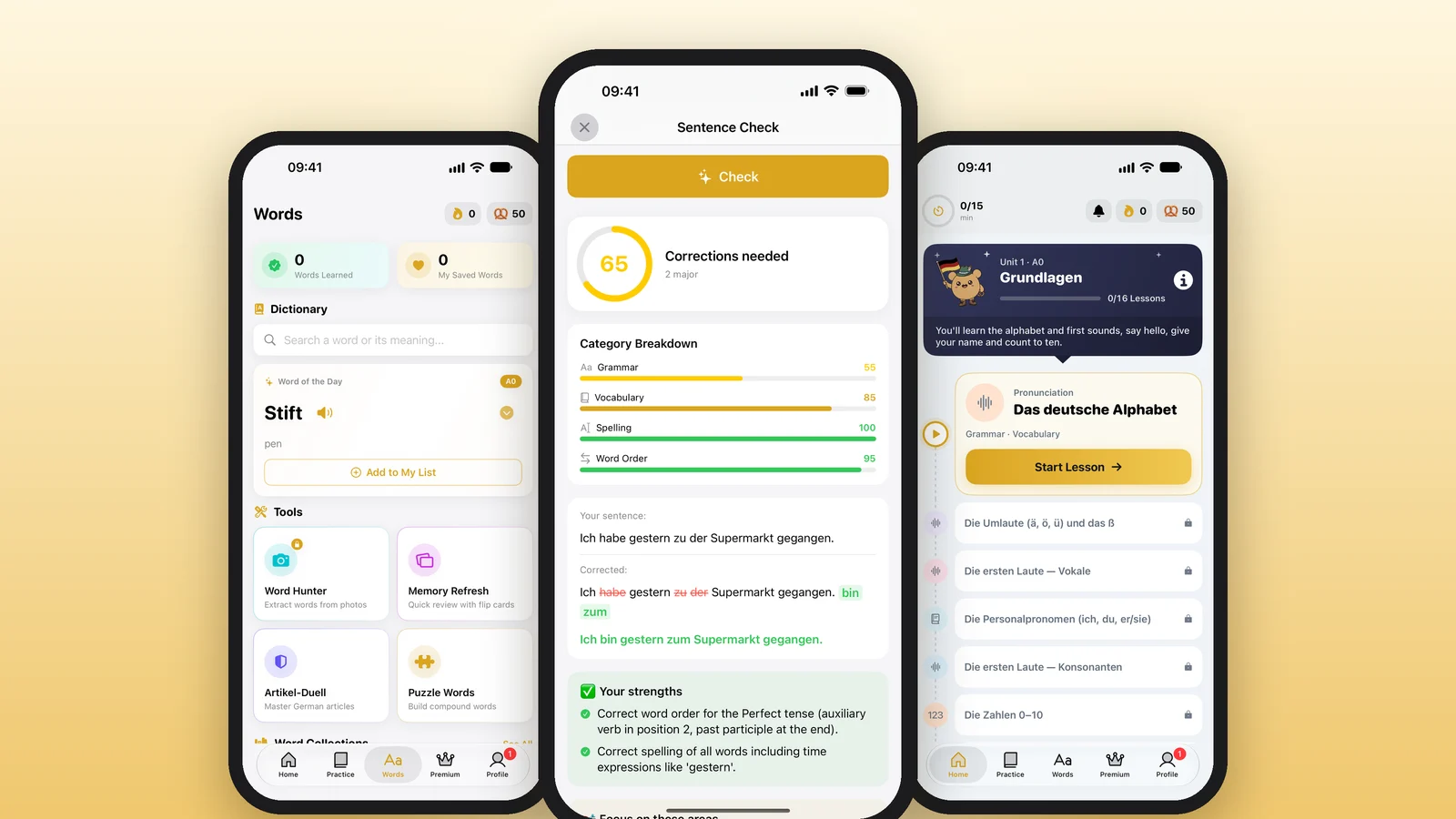
German grammar can feel like a maze of cases, word order, verb endings and noun genders. You may understand a sentence perfectly in a lesson, then hesitate when you need to say it at the Bürgeramt, write an email at work or answer a question in an integration exam. The right German grammar app can make that gap smaller by combining explanations with regular practice.
In this guide, we compare five useful types of German learning apps and explain what each is best at in 2026. The goal is not to find one universal winner. It is to help you choose an app that fits your level, your daily routine and your reason for learning German. We will also look at why Bretzi can support faster, more practical mastery by connecting grammar with listening, vocabulary, writing, speaking and real situations in Germany.
A grammar app should do more than display rules. German grammar becomes usable when you repeatedly notice a pattern, choose or produce the correct form, receive an explanation and meet the same structure in a new context. Before downloading an app, check whether it offers the following:
Also consider your learning objective. Someone moving to Germany may prioritise everyday communication. An employee may need polite requests and workplace writing. A person preparing for the DTZ may need focused practice in reading, listening, writing and speaking. For a broader comparison of learning tools, see this honest comparison of apps for learning German in Germany.
Best for: Learners who want a guided path from complete beginner to C1, with grammar connected to everyday life, work and exams.
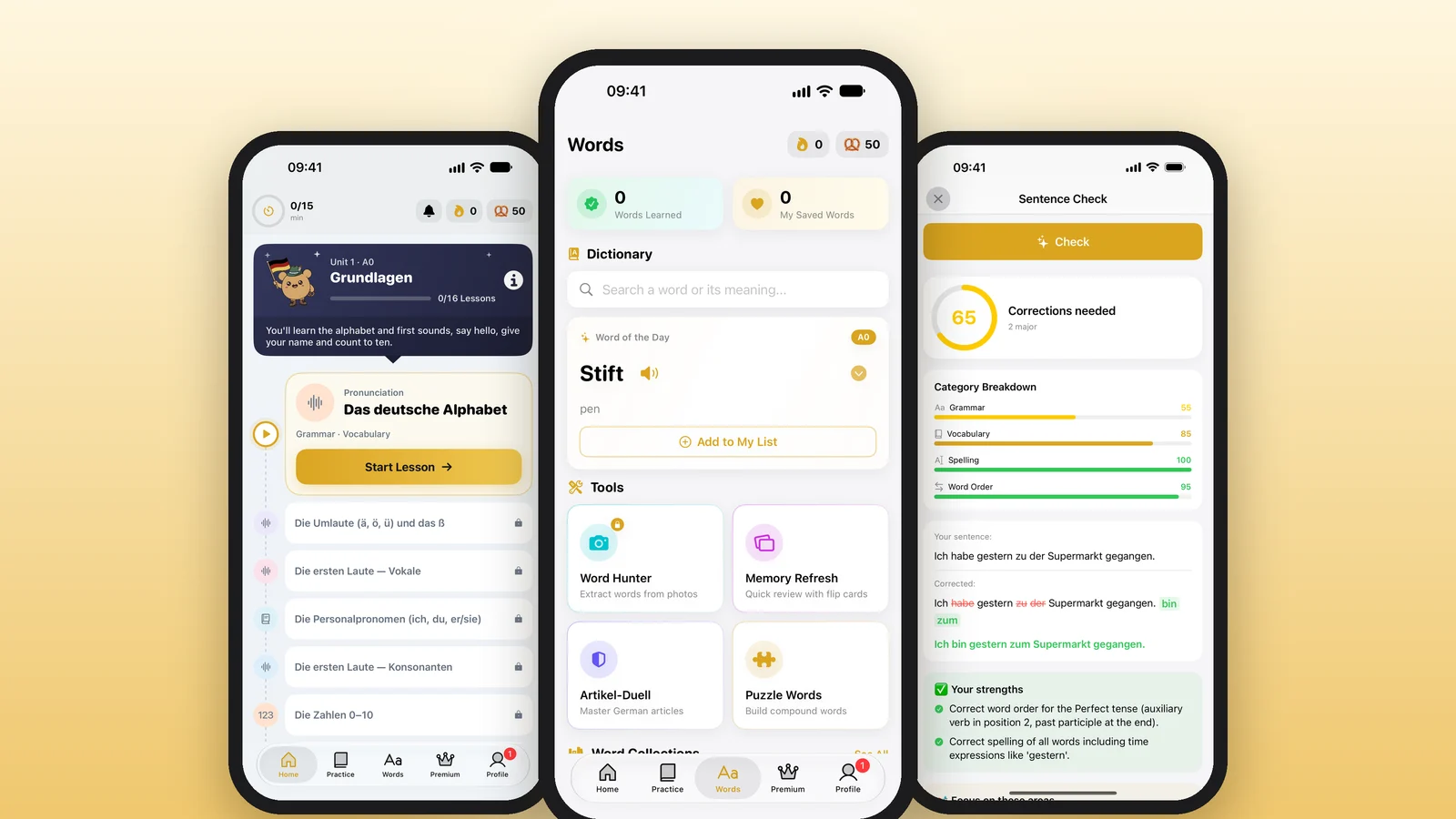
Bretzi follows a level-based lesson path from A0 to C1. Each CEFR level is organised as a sequence of short lessons, so learners can build knowledge step by step instead of jumping randomly between grammar topics. Exercises include choosing and typing answers, putting words in order, filling gaps, listening, writing down what you hear, finding mistakes and speaking. After each answer, the app shows why it is right or wrong.
This feedback matters because German grammar is often difficult for a specific reason. A learner may know that the dative is involved but still not know whether the article should be dem, der or den. An explanation immediately after the exercise connects the form to the sentence. Grammar tips, examples and conjugation tables are included within the lessons, and each unit ends with a conversation from daily life.
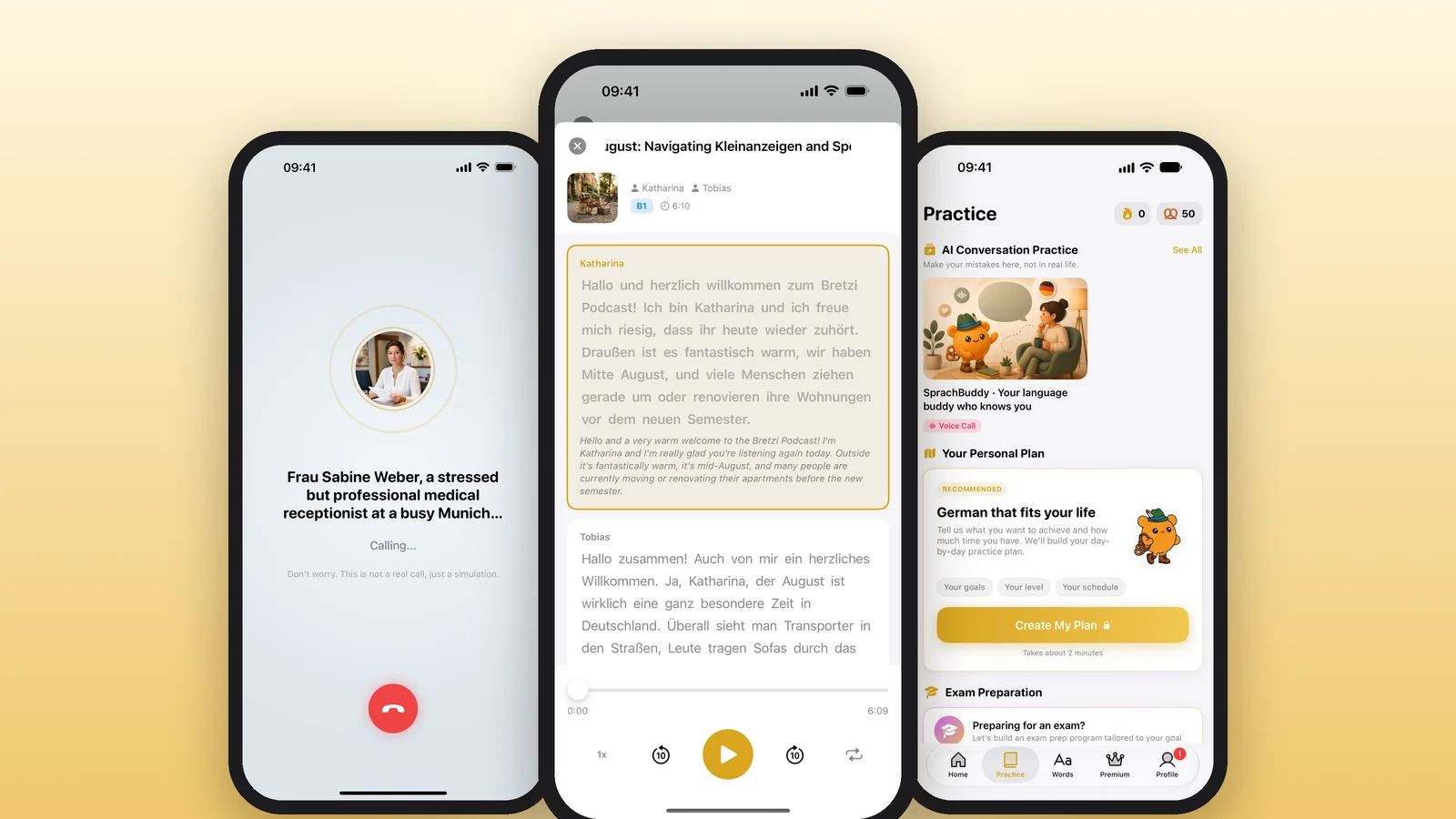
Bretzi also brings mistakes and vocabulary back in spaced reviews. This is valuable for articles, verb forms, preposition combinations and sentence patterns, which are easy to forget when they are studied only once. Premium adds Sentence Check for written sentences, AI feedback for exam writing, and speaking practice with SprachBuddy. SprachBuddy is software, not a human tutor: you speak German aloud about everyday topics or practise a situation such as a doctor’s visit or job interview.
For integration learners, the app includes practice for the Einbürgerungstest at B1 and for TestDaF at B2 and C1. The exam tools practise reading, writing, listening, speaking and questions about life in Germany separately, with a timer and an AI readiness score for each part. This is practice by exam component, not a complete mock exam.
Many learners study grammar, vocabulary and pronunciation in separate places. That can create knowledge that looks good in an exercise but disappears during a conversation. Bretzi combines these skills in a single sequence: you meet a structure, use it in an exercise, hear it, review related words and encounter it in a conversation. That integrated practice can make progress feel more direct, provided you practise consistently and still pay attention to explanations.
There are practical limitations to remember. Bretzi is a mobile app for iPhone, iPad, Android phones and tablets, plus an Apple Watch app for quick word practice. It requires an internet connection and has no web or computer version. Its certificate records your work in the app; it is not an official language certificate.
Best for: Beginners who need a simple daily routine and short exercises.
Duolingo is widely known for short, game-like lessons and a strong emphasis on building a daily habit. Its German course can help beginners practise basic vocabulary, sentence patterns and common verb forms without committing to a long study session. The bite-sized format is particularly useful if you struggle to start studying.
However, learners who want a detailed German grammar reference may need another resource alongside it. A short exercise can show that an answer is incorrect without fully explaining the relationship between case, gender and sentence function. Progress through a gamified path also does not automatically mean that you can produce the same structure in conversation.
Use this type of app actively: read every sentence aloud, write down one grammar pattern from each session and create an original example. If the app introduces a new case or tense, spend a few minutes asking yourself when a German speaker would use it in real life.
Best for: Learners who prefer course-like lessons and practical dialogues.
Babbel is designed around structured language courses and dialogues. Its German content can be helpful for learners who want to practise common exchanges, useful phrases and grammar in a lesson format rather than through an entirely game-based experience. Dialogues can make grammar easier to remember because a form appears as part of a communicative purpose.
When evaluating Babbel or a similar course app, check how much productive practice you receive. Can you type an answer, listen to a sentence more than once and review mistakes later? These details matter because recognising a phrase is easier than creating it. For learners preparing for an official exam, a general language course may also need to be supplemented with exam-specific tasks and timing practice.
A useful routine is to take one dialogue and transform it. Change the subject from ich to wir, turn a present-tense statement into a question, replace the direct object and then say the new version aloud. This turns a memorised exchange into flexible grammar practice.
Best for: Learners who like a guided course with opportunities to submit language practice for feedback.
Busuu offers structured language learning and combines lessons with practice activities. Its course approach can help learners maintain direction, especially when they are unsure which grammar topic to study next. Short tasks may cover vocabulary, comprehension and sentence formation at different levels.
The important question is whether feedback matches your goal. Feedback from a language-learning community can be useful for noticing natural phrasing, but it is not the same as a systematic grammar explanation or exam assessment. If you are preparing for the DTZ, focus on the skills and task types required by the exam rather than relying only on general course progress. The guide to the DTZ and preparation strategies explains how to organise that work.
To get more from a course app, keep a personal error log. Write the original sentence, your version, the corrected version and one short rule. Review the log twice a week, then make a new sentence that uses the same structure in a different situation.
Best for: Learners who benefit from video, pronunciation models and conversational context.
Seedlang is associated with visual, dialogue-based German practice. Video and authentic-sounding exchanges can help learners connect grammar with pronunciation, rhythm and everyday communication. This is especially helpful when you know a rule on paper but find real spoken German too fast or difficult to segment.
Its strongest role may be as a complement to systematic grammar study. Watching a dialogue can show how native speakers use a phrase, but you should pause and identify the grammar yourself. Is the speaker using a modal verb, a separable verb, a subordinate clause or a particular case? Then repeat the sentence and create one variation.
For a focused comparison of two tools for intermediate learners, read this comparison of Bretzi and Seedlang for B1 German grammar. The best choice depends on whether you need a complete lesson path, more audiovisual input or a mixture of both.
At A0 and A1, look for clear pronunciation, basic word order, articles, present-tense verbs and high-frequency phrases. At A2 and B1, prioritise cases, prepositions, past forms, subordinate clauses and modal verbs. At B2 and C1, you need nuanced connectors, passive and nominal style, reported information, formal writing and longer listening texts.
The official BAMF information explains that the naturalization test has 33 multiple-choice questions and that naturalization normally requires at least 17 correct answers. The same test is known as the Leben in Deutschland test in the integration context. Read the official BAMF information about the integration and naturalization test and use the official question catalogue when you practise.
An app is most effective when it becomes part of a repeatable system. Try this adaptable plan:
Keep sessions short enough to repeat. A daily goal of 5 to 30 minutes can make practice easier to maintain, but the exact duration should fit your schedule. More minutes are not automatically better if attention disappears. Consistent retrieval, correction and application are more important than passively reading another grammar explanation.
The best German grammar app in 2026 depends on your learning style and objective. Duolingo can support a daily habit, Babbel offers course-like dialogues, Busuu provides structured progression, and Seedlang brings visual and conversational input. Bretzi is a strong option for learners who want a connected path from A0 to C1, with grammar explanations, active exercises, spaced review, listening, speaking and exam-related practice in one mobile app.
Start by choosing one main app, one clear target and a realistic daily routine. Then track the grammar errors that repeatedly appear in your writing and speech. If you would like a guided approach centred on German used in Germany, explore Bretzi and begin with a short lesson today. The aim is not to collect apps; it is to turn grammar knowledge into sentences you can understand and use.
Rules, fees and dates change. Check the current version on the official pages before you act.
Share this article:
When learning German, many people find that reading a textbook or recognizing words on a screen feels manageable, yet the moment someone speaks on a...
Read moreFew grammatical topics in the German language cause as much hesitation for language learners as preposition combinations. Whether you are ordering...
Read moreReaching the B1 threshold is widely considered the most decisive milestone in your German learning journey. At this intermediate stage, you...
Read more