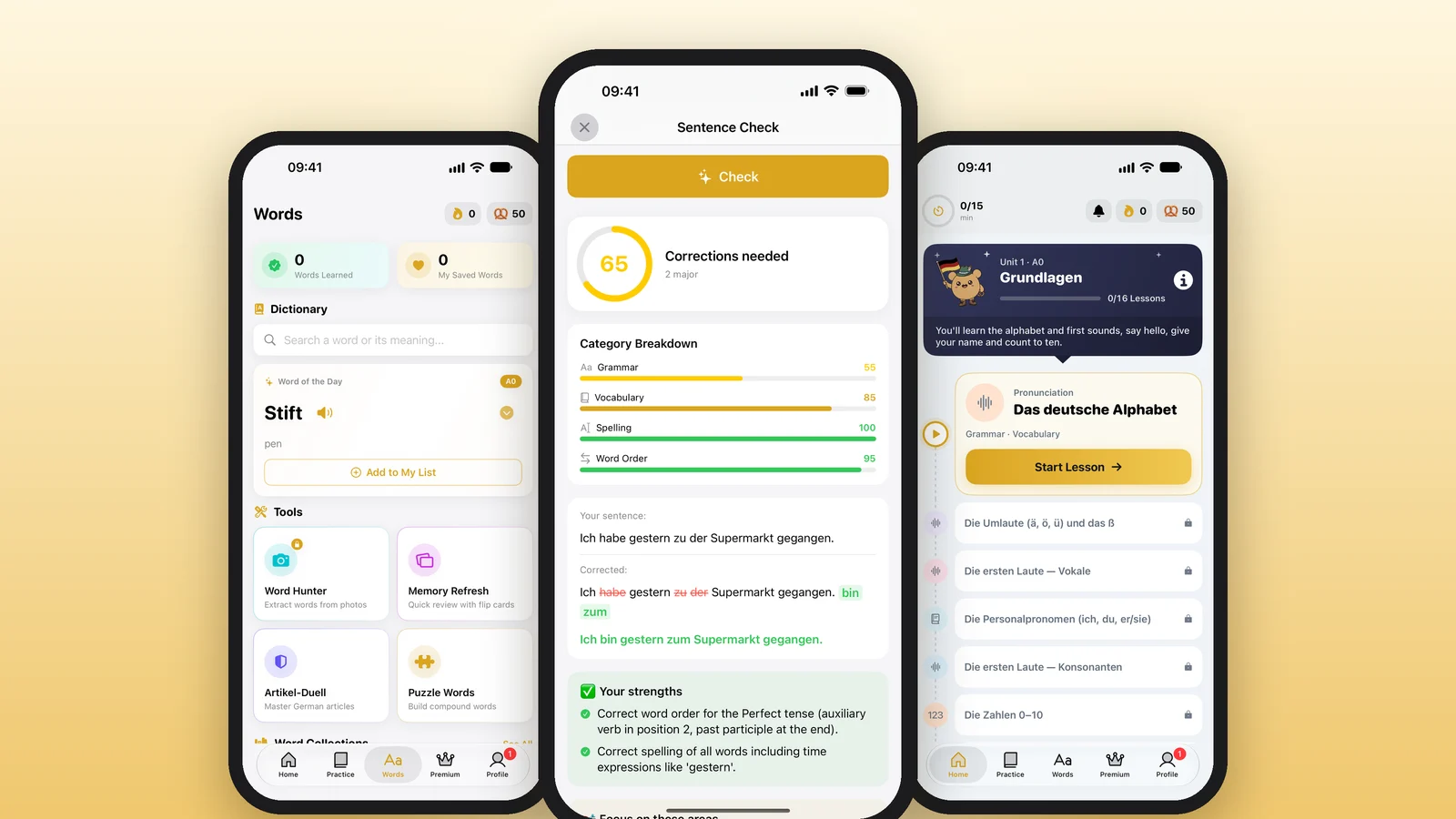
How Bretzi Uses Adaptive AI to Pinpoint German Weaknesses
Learning German often feels like navigating a maze of intricate grammatical machinery. One day you feel confident ordering a bread roll at the local...
Read more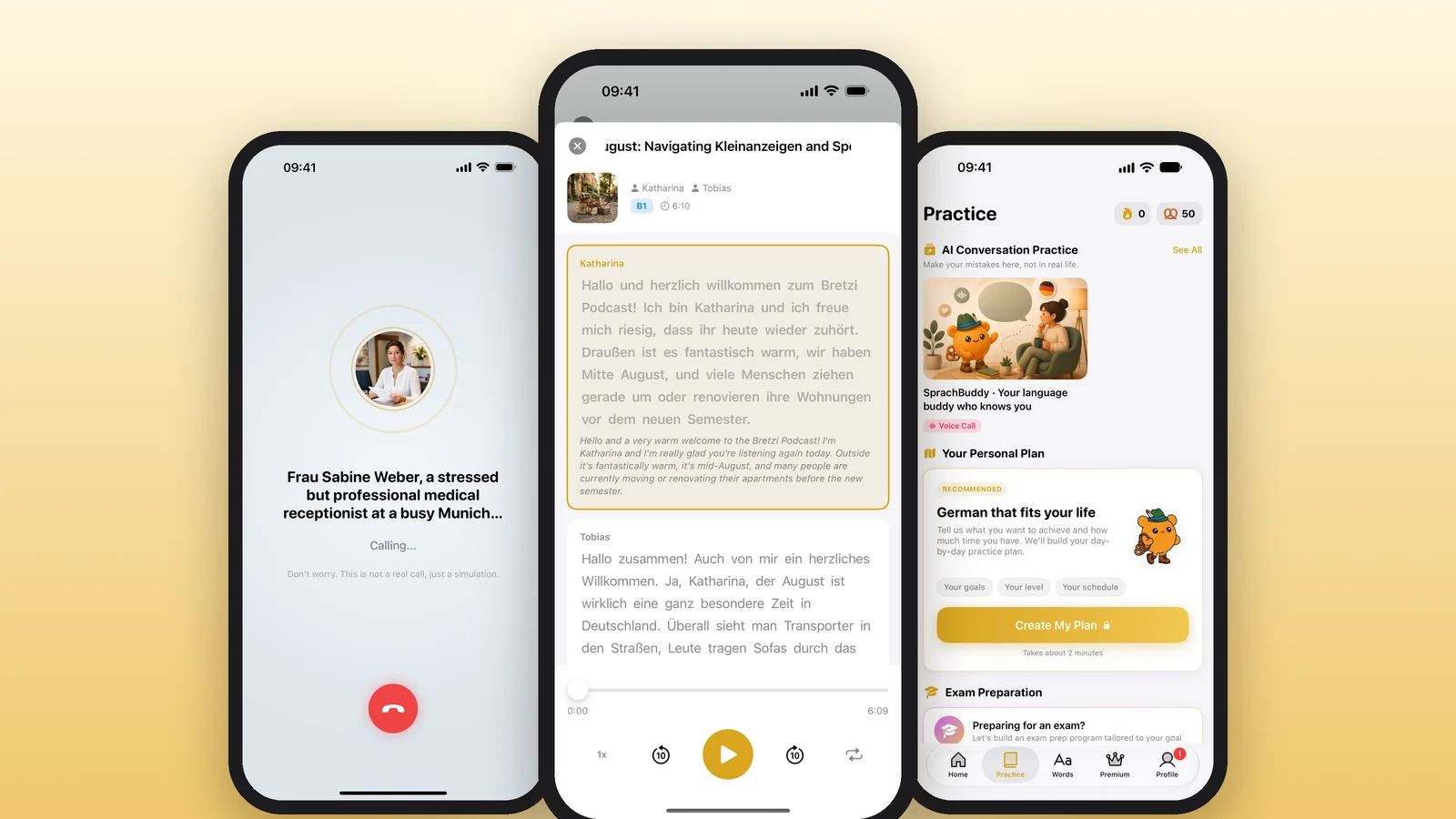
When learning German, many people find that reading a textbook or recognizing words on a screen feels manageable, yet the moment someone speaks on a Berlin street or at a Munich train station, the words seem to blur together. German spoken in daily life moves quickly, sounds merge, and sentence structures place crucial verbs at the very end. The transition from silent comprehension to active listening and confident speaking is often the steepest hurdle for learners and expats living in Germany.
Developing listening comprehension and speaking clarity does not require hours of passive podcast exposure or nerve-wracking encounters before you feel ready. By using deliberate, structured daily exercises that connect what you hear directly to how you articulate sounds, you can systematically bridge the gap between textbook German and real-life conversation.
Most language learners begin with reading and vocabulary flashcards. While this builds a foundation in grammar and vocabulary, it activates different cognitive pathways than listening and speaking. Spoken German presents three specific challenges that silent study cannot resolve:
To overcome these challenges, you must train your ear and your vocal apparatus together through targeted active exercises.
Putting on German radio while washing dishes may familiarize you with the cadence of the language, but it rarely improves comprehension on its own. Passive listening lets your brain tune out unfamiliar phrases. Instead, effective audio training relies on active engagement.
Dictation forces you to parse every syllable. When you listen to a short sentence and write down exactly what you hear, your brain must resolve ambiguities. Did the speaker say den Mann (accusative) or dem Mann (dative)? Was that sie or Sie?
Dictation exercises immediately highlight the gaps in your auditory processing, showing whether you are truly hearing the grammar endings or merely guessing based on context. Exploring how audio exercises improve conversational fluency shows that transcribing short audio snippets trains auditory working memory far more efficiently than long, passive listening sessions.
When working with authentic listening materials such as podcasts or dialogues, synchronized transcripts are invaluable. If a phrase moves too quickly, reducing the playback speed allows you to observe how native speakers connect sounds. Once you understand the mechanics of the sentence at a slower speed, returning to normal playback trains your ear to catch those same patterns at full conversational tempo.
Speaking anxiety often stems from fear of making grammatical errors or being misunderstood due to pronunciation. German articulation requires distinct muscle engagement in the lips, jaw, and tongue compared to English.
Shadowing is the technique of repeating a phrase immediately after hearing a native speaker, mimicking their pitch, stress, and pacing as closely as possible. Rather than translating words in your head, shadowing trains the physical rhythm of German phrases, such as placing emphasis on the correct root syllables or falling intonation at the end of declarative statements.
One challenge of practicing alone is that our internal ears can deceive us; we often believe we are producing a clean ü sound when we are actually substituting an English "oo". Using digital pronunciation tools that analyze your speech down to the word or sentence level provides clear, objective feedback on what needs adjustment before mispronunciations become ingrained habits.
Consistency outperforms marathon weekend study sessions. Spending 15 to 25 minutes each day actively engaging your ears and voice will yield clearer results than two hours of passive study on Sunday. Here is an actionable framework you can adopt:
Start your session with 3 to 5 short audio clips. Listen to each sentence once without reading. On the second listen, write down what you hear. Check your written sentence against the correct text. Pay close attention to case markers (-em, -en, -er) and verb endings (-t, -est).
Work with a short podcast episode or dialogue. Follow along with an interactive transcript. Whenever you encounter an unfamiliar term, pause to review its meaning and note its gender and plural form. Replay complex sentences at reduced speed to analyze how the sounds flow together, then listen again at standard speed.
Dedicate the final segment of your routine entirely to speaking out loud. Practice pronouncing individual sentences until your articulation is fluid, then transition into interactive dialogue. If you are preparing for practical tasks in Germany, rehearse specific scenarios, such as explaining symptoms to a doctor or asking for an appointment at an administrative office.
Practicing German for the doctor and the Bürgeramt ahead of time builds the vocabulary and phrase patterns you need when real administrative or medical needs arise.
For those living in Germany, listening and speaking skills are not just about daily convenience; they are also central to official certification. The Deutsch-Test für Zuwanderer (DTZ), which assesses language proficiency at the A2/B1 level at the conclusion of a BAMF integration course, features an oral section of about 15 minutes that is conducted in pairs or with examiners.
According to official regulations from the Federal Office for Migration and Refugees (BAMF), integration courses include 600 hours of language instruction leading to the DTZ exam. In the oral portion, candidates must introduce themselves, speak about a specific topic based on an image or prompt, and plan something together with a partner. Practicing structured dialogues and timed responses helps you prepare thoroughly for the format. You can learn more details in our guide on preparing for the DTZ exam.
To help you maintain this daily habit without juggling multiple disjointed resources, the language learning app Bretzi brings these specific listening and speaking exercises into a single structured path. Designed specifically for the German of Germany, Bretzi guides learners from complete beginner (A0) all the way up to C1.
Within Bretzi’s daily lessons, you regularly encounter listening comprehension tasks, gap fills, and dictation exercises where you type exactly what you hear, receiving immediate feedback that explains why an answer is correct or incorrect. For longer audio immersion, Bretzi offers podcasts with synchronized transcripts that follow the speaker in real time; you can tap any unfamiliar word to view its definition, adjust playback speeds, and save terms directly to your spaced-repetition review deck.
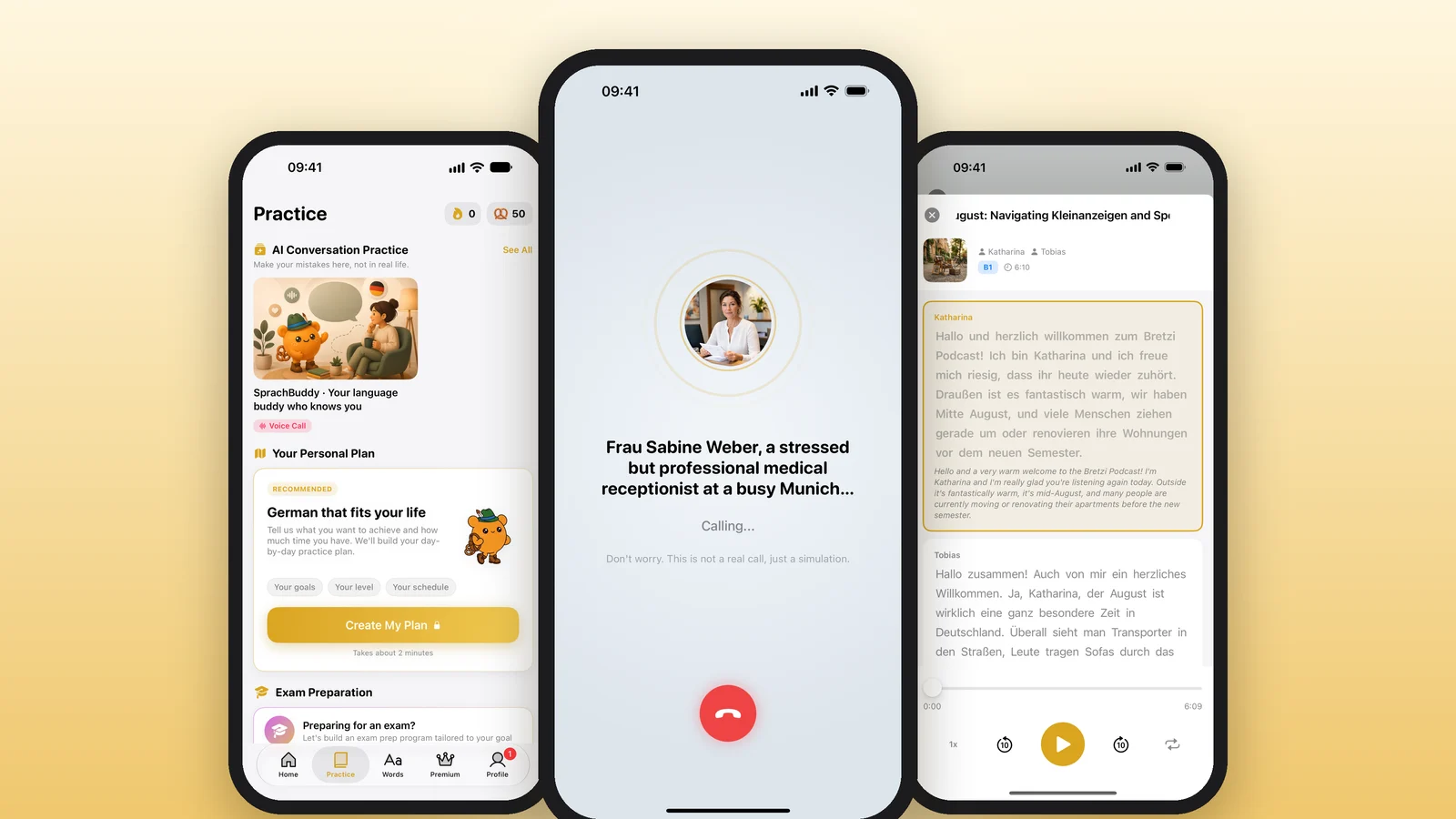
When it comes to speaking, Bretzi provides dedicated tools to practice aloud in a pressure-free environment:
Bretzi runs on iPhone and iPad (iOS 18 or later) and Android devices (Android 8.0 or later), requiring an active internet connection. Learners can get started for free, accessing the first complete unit, daily review sessions, word games, and select podcast episodes, while Premium unlocks unlimited conversation time with SprachBuddy, advanced pronunciation scoring, and modular exam practice.
Achieving confidence in German listening and speaking is not about possessing special linguistic talent; it is the natural outcome of deliberate, repeated practice. By moving away from purely passive exposure and challenging yourself to transcribe, shadow, and speak aloud every day, you train both your ear and your vocal muscles to handle real German conversations with ease.
Set aside 15 minutes today, pick a single topic or dialogue, and focus on hearing every syllable and articulating every sound out loud. With steady daily habits, the language of daily life in Germany will become clearer and more accessible with every session.
Rules, fees and dates change. Check the current version on the official pages before you act.
Share this article:
Learning German often feels like navigating a maze of intricate grammatical machinery. One day you feel confident ordering a bread roll at the local...
Read moreGerman grammar can feel like a maze of cases, word order, verb endings and noun genders. You may understand a sentence perfectly in a lesson, then...
Read moreFew grammatical topics in the German language cause as much hesitation for language learners as preposition combinations. Whether you are ordering...
Read more