Can Bretzi Replace Traditional German Language Classes?
When relocating to Germany, settling in often hinges on a single major challenge: mastering the language. Whether dealing with administrative...
Read more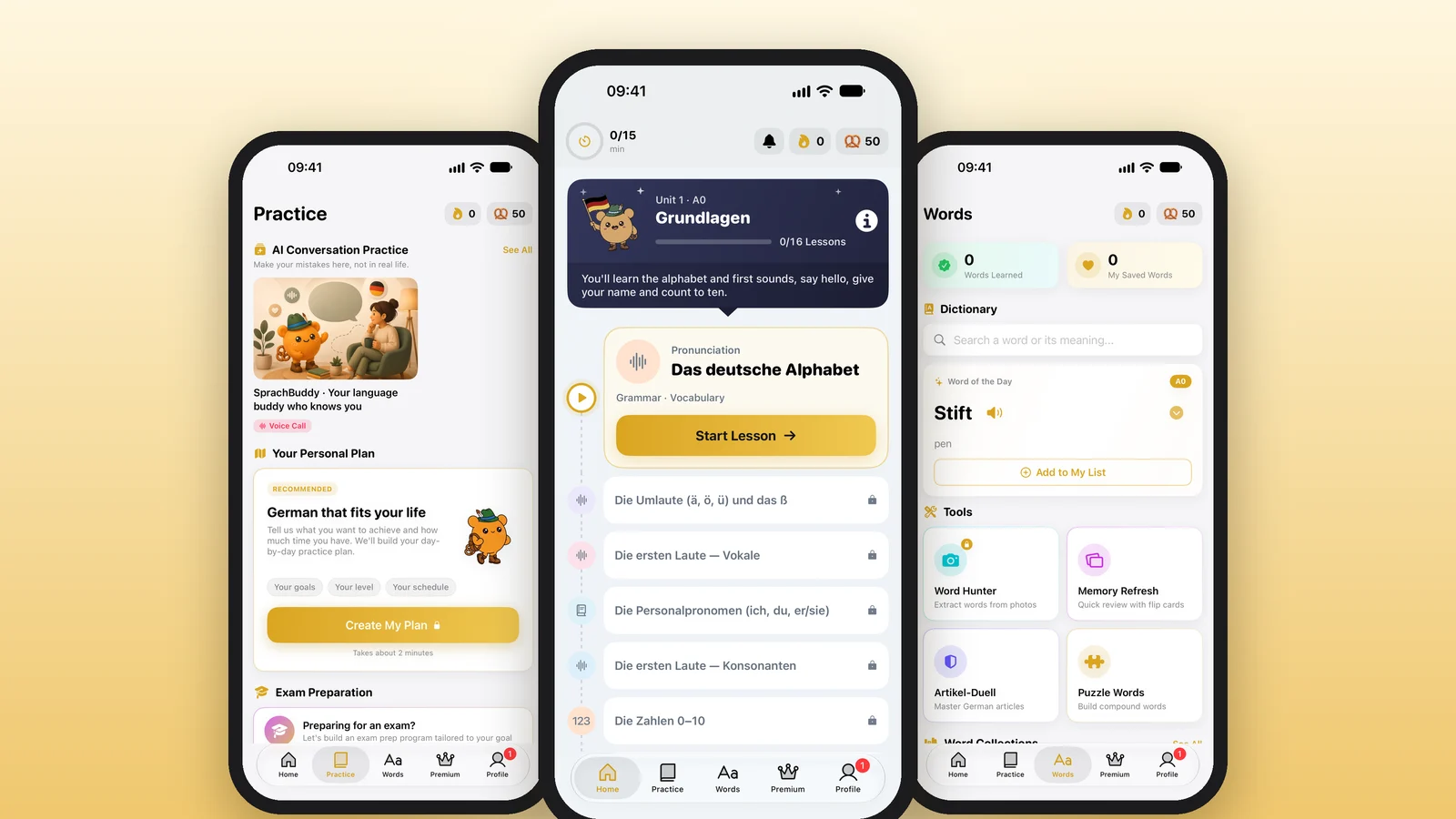
Ask any German learner what keeps them awake at night, and chances are you will hear two words: verbs and cases. Between memorizing whether a verb takes a direct accusative object or an elusive dative recipient, untangling separable prefixes, and navigating irregular past tenses, the grammatical architecture of the German language can feel like an intricate labyrinth.
By 2026, mobile language learning has evolved far beyond passive flashcards and multiple-choice guessing games. Modern learners expect interactive practice, immediate feedback, and contextual learning that translates directly to real-world communication in Germany. In this comprehensive review, we explore how modern mobile apps approach German grammar, examine the mechanics required to truly master cases and conjugations, and provide an in-depth review of how Bretzi tackles these pain points across all CEFR levels.
To understand what makes a mobile app effective, we must first dissect why verbs and cases present such a steep hurdle for learners at every stage, from absolute beginners (A0/A1) to advanced speakers (B2/C1).
In English, word order largely determines who does what to whom. In German, word order is flexible because grammatical cases reveal syntactic roles. The challenge is that German verbs dictate which case must follow them, a linguistic rule known as verb valency or Rektion:
Learners cannot simply learn a verb in isolation; they must learn the case it governs. Rote memorization often fails here because learners freeze when forming spontaneous sentences under real conversational pressure.
German verbs fall into predictable regular (weak) categories and highly irregular (strong or mixed) groups. While regular verbs like lernen follow predictable patterns (lernte, gelernt), strong verbs shift their stem vowels across tenses (sprechen, sprach, gesprochen) and frequently change vowels even in the present tense (du sprichst, er spricht).
Prefixes fundamentally alter verb meanings. Adding ver- to kaufen (to buy) gives verkaufen (to sell). Furthermore, separable prefixes (ab-, an-, auf-, mit-) break away and travel to the very end of a main clause (Ich fange morgen an), disrupting sentence flow for learners accustomed to rigid English syntax.
Rote conjugation tables in a textbook have their place as references, but passive reading rarely builds active recall. If your goal is to speak and write correctly in daily life, work environments, or official exams, an app must provide specific pedagogical tools. When evaluating the top German grammar apps, consider these essential criteria:
Language learning tools on iOS and Android approach these grammatical hurdles through different methodologies:
Specialized tools like noun gender trainers or basic verb conjugation tables are handy pocket references. They allow you to look up forms quickly before a class. However, as discussed in our analysis of der, die, das trainers and conjugation tools, learning words and endings in isolation often leaves learners struggling to construct grammatically sound sentences during spontaneous conversations or formal written exams.
Mass-market gamified apps make daily practice easy to maintain through quick multiple-choice taps. The drawback is that guessing among four options does not force your brain to generate the correct dative article or recall strong verb conjugations independently. You might pass digital levels while remaining unable to write a coherent email to your landlord.
The most balanced approach integrates grammar explanations, listening, typing, and speaking into a single, cohesive curriculum. This is where dedicated platforms like Bretzi focus their pedagogical methodology.
Bretzi is an independent, mobile-first German language learning app engineered specifically for life in Germany. Available on iPhone and iPad (iOS 18 or later) as well as Android phones and tablets (Android 8.0 or later), Bretzi covers the full CEFR spectrum from absolute beginner (A0) all the way to advanced fluency (C1). It also includes an Apple Watch app for quick word reviews and home-screen widgets on both platforms to keep your practice visible throughout the day.
Because Bretzi requires an active internet connection, its cloud-powered features seamlessly adapt to your mistakes and synchronize your progress across supported mobile devices whenever you log in via Apple, Google, or email.
Unlike apps that treat grammar as an afterthought, Bretzi weaves grammatical mechanics directly into sequential lessons. As you progress along the structured level path:
Mastering German cases requires knowing the gender of nouns, because without knowing whether a noun is der, die, or das, applying accusative or dative endings correctly is impossible.
Bretzi provides dedicated tools inside its Words tab to train these associations:
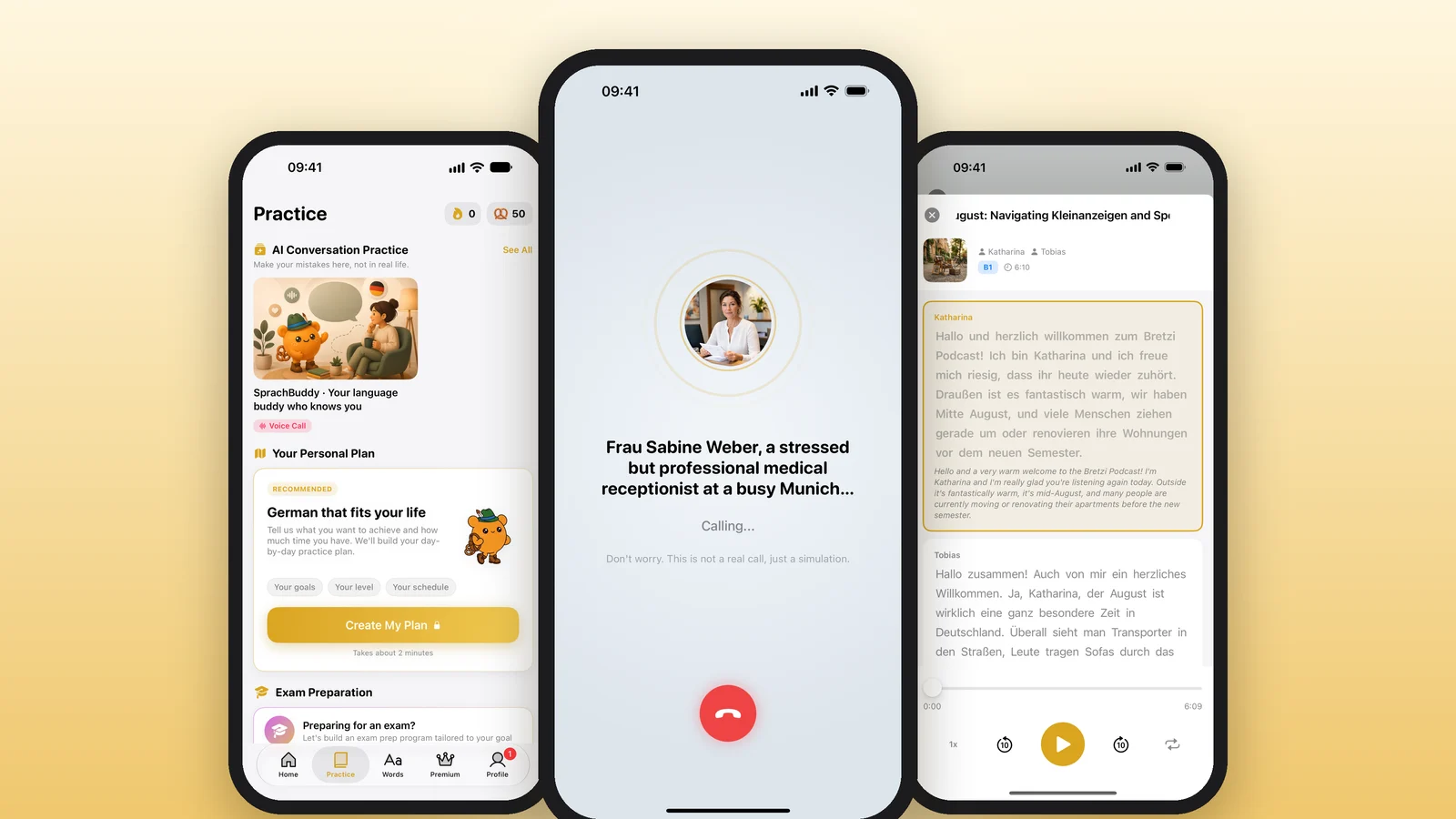
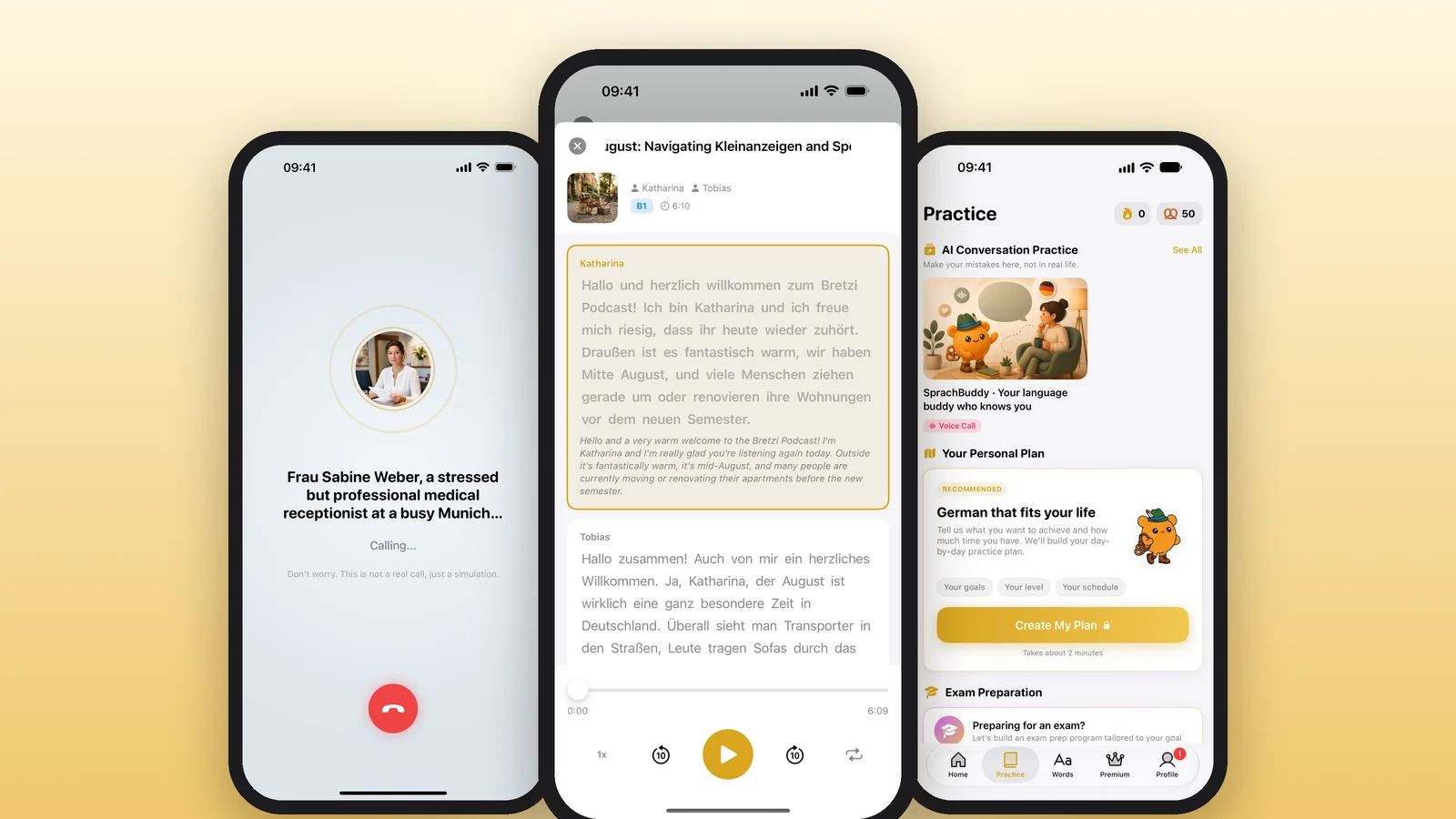
One of the biggest hurdles in mastering German cases is producing them aloud. Bretzi addresses this through SprachBuddy, an AI-powered voice conversation partner available with Bretzi Premium. SprachBuddy is clearly identified as software before you begin. You can call it on your phone and speak German out loud, roleplaying scenarios like visiting the doctor, discussing a job role, or dealing with an administrative office.
After your conversation, you can read the transcript back to analyze your phrasing. Additionally, the integrated pronunciation practice scores the words and sentences you speak aloud, highlighting specific phonetic areas to refine.
For written grammar, Bretzi Premium includes Sentence Check. When you write your own sentences, the tool corrects grammatical errors, flags incorrect case endings or misplaced verbs, and provides clear explanations of the underlying grammatical rules.
For learners living in Germany, grammatical precision is closely tied to formal residency milestones. If you are working toward the official B1 language benchmark (such as the Deutsch-Test für Zuwanderer, or DTZ), grammar accuracy in speaking and writing is heavily assessed. For in-depth preparation strategies on that front, explore our guide on preparing for the DTZ exam.
Bretzi Premium includes dedicated, timed, part-by-part exam practice for the Einbürgerungstest at B1 (including reading, writing, listening, speaking, and questions on life in Germany / Leben in Deutschland) and for TestDaF at B2 and C1 for university entrance. The app uses AI to grade your writing and speaking responses, tracks your performance, and calculates a readiness score for each individual section. Note that this provides targeted module practice rather than a full mock exam, giving you clear insight into which specific grammatical or linguistic areas require further revision.
Regardless of which digital tools you use, applying structured study habits will significantly accelerate your command of German grammar:
Never add a verb to your flashcards as an isolated infinitive. Always record its governing preposition and case:
Because case endings depend entirely on grammatical gender, linking visual cues to genders creates durable mental anchors. Use blue for masculine (der), red for feminine (die), green for neuter (das), and yellow for plural forms. When drilling dative transitions, visualize the shift: masculine (blue) transforms to dem / einem, adopting the characteristic -m ending.
Nine prepositions can govern either the accusative or the dative, depending on intent: an, auf, hinter, in, neben, über, unter, vor, zwischen.
Practice these in pairs of physical actions in your home to connect the physical sensation of movement or stillness with the appropriate case.
If you are learning German to qualify for long-term residency or citizenship, stay informed about the legal landscape. Official information regarding language expectations, integration courses, and naturalization tests can be consulted directly on authoritative government portals such as the Federal Office for Migration and Refugees (BAMF) and the federal portal Make it in Germany. As of late 2025 and 2026, German naturalization generally requires at least five years of lawful residence, certified B1 German, and a passed naturalization test, making daily grammatical consistency a high-value personal investment.
Conquering German verbs and cases requires moving past passive recognition into deliberate, active production. An effective study routine combines:
Bretzi provides an intentional, highly structured mobile environment for this workflow. With its free tier offering the entire first unit without limits, one new daily lesson thereafter, word games, daily spaced reviews, and community league motivation, you can establish an engaging daily habit. For learners seeking deeper conversational practice, writing corrections via Sentence Check, and focused exam readiness, Bretzi Premium offers the exact toolset needed to turn complex German grammar into second nature.
Rules, fees and dates change. Check the current version on the official pages before you act.
Share this article:
When relocating to Germany, settling in often hinges on a single major challenge: mastering the language. Whether dealing with administrative...
Read moreLearning German often feels like navigating a maze of intricate grammatical machinery. One day you feel confident ordering a bread roll at the local...
Read moreWhen learning German, many people find that reading a textbook or recognizing words on a screen feels manageable, yet the moment someone speaks on a...
Read more