
Ruhezeit in Germany: Sunday Quiet Hours & House Rules Guide
You have just finished completing your Anmeldung, unpacked the last moving boxes on a sunny Sunday afternoon, and decided it is the perfect time to...
Read more
This article was written by AI and published by Bretzi.
AI can get things wrong. For anything official, check the source it points to.
AI-generated image
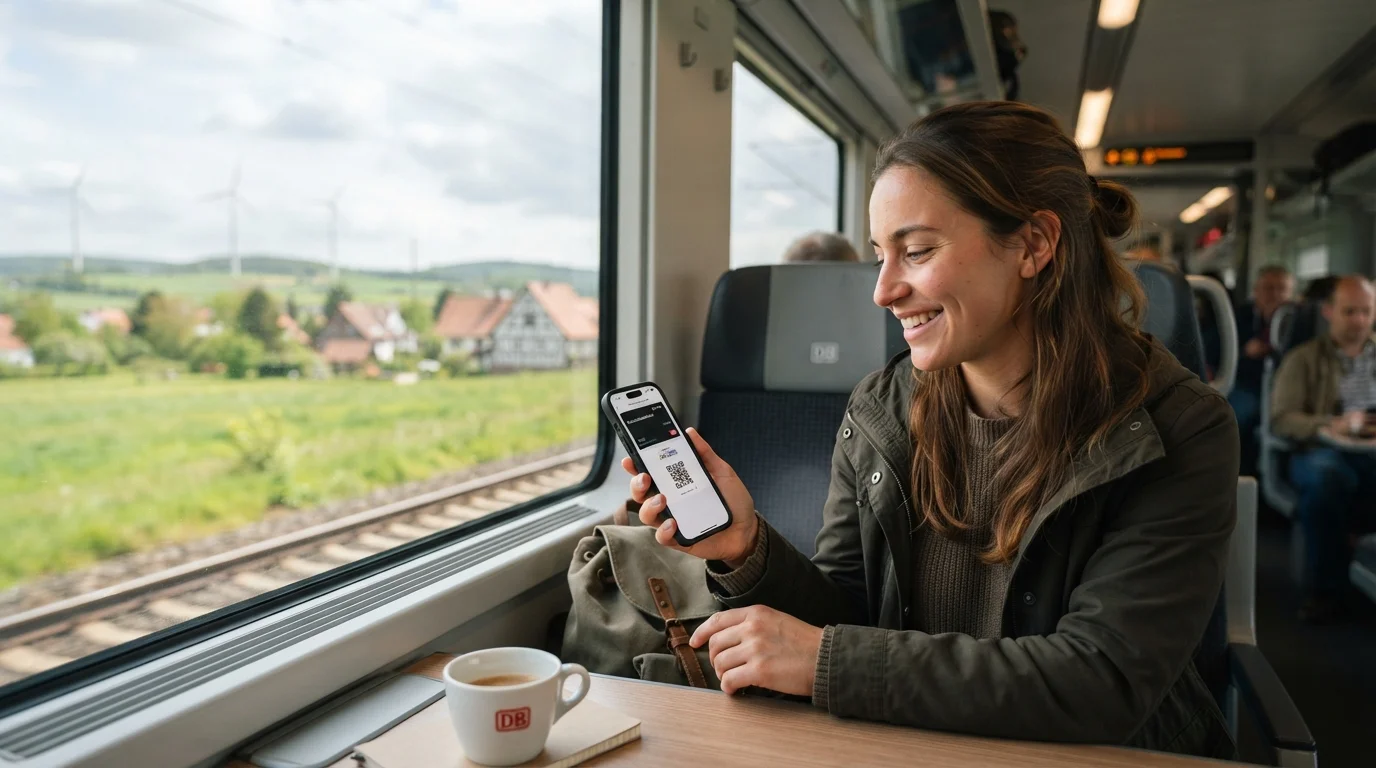
When you first arrive in Germany, figuring out public transportation can feel like deciphering ancient code. Between confusing tariff zones (Tarifzonen), local transport associations (Verkehrsverbünde), and dozens of ticket machines, taking a simple regional trip used to require serious planning. Enter the Deutschlandticket (often called the D-Ticket or 58-Euro-Ticket)—a revolutionary nationwide transit pass that simplified commuting for millions of residents and expats across the federal republic.
Whether you have just arrived in Berlin, Munich, or a charming smaller town after completing your Anmeldung in Germany, understanding how the Deutschlandticket works in 2026 is essential for keeping your travel costs predictable and your daily commute stress-free. In this ultimate guide, we will break down the current 2026 pricing, exactly where you can and cannot travel, cancellation rules, common pitfalls that lead to hefty fines, and the crucial German vocabulary you need during a ticket inspection.
The Deutschlandticket is a digital, personal monthly subscription that grants unlimited access to all local and regional public transport throughout Germany. First introduced as the famous 49-Euro-Ticket, transport ministers agreed on a nationwide price adjustment to ensure long-term funding, setting the standard price at €58 per month.
Unlike traditional monthly transit passes that tie you to a single metropolitan area (such as the MVV in Munich or BVG in Berlin), the Deutschlandticket is valid across state borders from Flensburg in the far north to Garmisch-Partenkirchen in the Bavarian Alps.
The golden rule of the Deutschlandticket is simple: Valid on local and regional transport (Nahverkehr), but NOT valid on long-distance high-speed trains (Fernverkehr).
Understanding this distinction is crucial to avoid unintended fines of €60 or more. For a comprehensive walkthrough of using train apps and buying single long-distance fares, check out our guide on how to buy train tickets in Germany with the DB Navigator.
Pro Tip: In the DB Navigator app, always toggle the filter option "Nur Nahverkehr" (Local transport only) when planning a journey using only your Deutschlandticket. This ensures your itinerary excludes all IC and ICE connections.
Surprisingly, yes! While the pass is primarily domestic, it covers several international border stations operated as part of the German regional network. Common cross-border destinations reachable with the Deutschlandticket include:
Before boarding, it is important to know that the standard Deutschlandticket covers only you and standard carry-on luggage. Additional passengers or bulky items follow specific guidelines:
Children under the age of 6 travel completely free of charge on German public transit and do not need their own ticket. Children aged 6 and older require their own valid ticket or a discounted student version (Schülerticket) provided by their local federal state.
The Deutschlandticket does not include free nationwide bicycle transport. In some regional transit authorities (e.g., in parts of Rhineland-Palatinate or Thuringia during off-peak hours), bringing a bike is free, but in most states (like Bavaria, Berlin, or Baden-Württemberg), you must purchase an extra bicycle day ticket (Fahrradtageskarte Nahverkehr).
Small dogs inside a transport box or carrier travel for free. For larger dogs, rules vary by transport association. In some regions (like NRW or Berlin-Brandenburg), ticket holders can bring a dog for free under specific local conditions, while in others, a separate child-fare ticket (Einzelfahrkarte Kind) or dog supplement is required.
The Deutschlandticket is structured as a rolling subscription (Abonnement). It renews automatically every month until you explicitly cancel it.
You can purchase the ticket through numerous channels, including:
To set up the monthly recurring payment, you will typically need a SEPA-enabled IBAN bank account. If you have just arrived in the country, make sure to read our step-by-step tutorial on setting up a German bank account with top digital and expat-friendly options.
German contract bureaucracy is famous for strict notice periods, and the Deutschlandticket is no exception. If you only need the ticket for a single month (for example, while exploring the country in July), you must cancel the subscription by the 10th day of the current month to prevent paying for the following month.
Example: If you buy a ticket for August and want to stop it for September, you must log into your provider's portal and submit the cancellation by August 10th at 23:59.
When traveling across Germany, you will inevitably encounter ticket conductors, platform announcements, and delay notices. Mastering a few essential terms will turn an intimidating interaction into a smooth experience.
If speaking German during daily interactions still makes you nervous, using an interactive tool like Bretzi can accelerate your confidence. With AI-powered conversation practice, realistic dialogue scenarios (like navigating train stations and speaking with conductors), and pronunciation training with instant feedback, Bretzi helps you practice high-frequency travel phrases anytime on your phone.
Ticket inspectors in Germany are thorough, and ignorance of local transit rules is rarely accepted as an excuse. Here are the most common pitfalls expats encounter:
Because the Deutschlandticket is digital, you are legally obligated to present a readable screen upon inspection. If your phone battery dies and you cannot show your barcode, the conductor will issue a penalty notice (Erhöhtes Beförderungsentgelt, typically €60). You can usually reduce this fee to a small administrative charge (around €7) by presenting proof of your active subscription at a customer service center within 14 days, but carrying a power bank saves you the hassle.
On certain railway corridors (for example, between Bremen and Norddeich Mole, or Stuttgart and Singen), selected IC/ICE trains accept regional tickets under special agreements. However, the Deutschlandticket is explicitly excluded from most of these exceptions. Always double-check in the DB Navigator whether the specific train accepts the D-Ticket before boarding an IC train.
Screenshots of your passport or residency card are legally insufficient. Conductors regularly ask for a physical Lichtbildausweis (passport, EU identity card, or Aufenthaltstitel) to match the name on the digital ticket.
Even with updated pricing at €58 per month, the Deutschlandticket remains one of the best value-for-money transit passes in Europe. If your regular daily round-trip metro or bus commute costs more than €2 to €3 per day, the ticket pays for itself in less than three weeks—not to mention the freedom of hopping on any regional train for spontaneous weekend getaways to medieval towns, national parks, and neighboring cities.
Take full advantage of Germany's interconnected transit grid, keep your ID handy, remember the 10th-of-the-month cancellation rule, and use your travel time to brush up on your German language skills!
Share this article:
You have just finished completing your Anmeldung, unpacked the last moving boxes on a sunny Sunday afternoon, and decided it is the perfect time to...
Read moreSigning a contract in Germany is notoriously easy—whether you are picking up a shiny new smartphone plan or joining a local fitness club. But when...
Read moreIf you have recently moved to Germany, your first trip to a local grocery store might feel less like a routine errand and more like an Olympic sport....
Read more