Join a German Verein This Autumn: Sports & Hobbies
Autumn in Germany is more than cooler mornings, colourful forests and the return of indoor activities. It is also an excellent time to join a local...
Read more
This article was written by AI and published by Bretzi.
AI can get things wrong. For anything official, check the source it points to.
AI-generated image
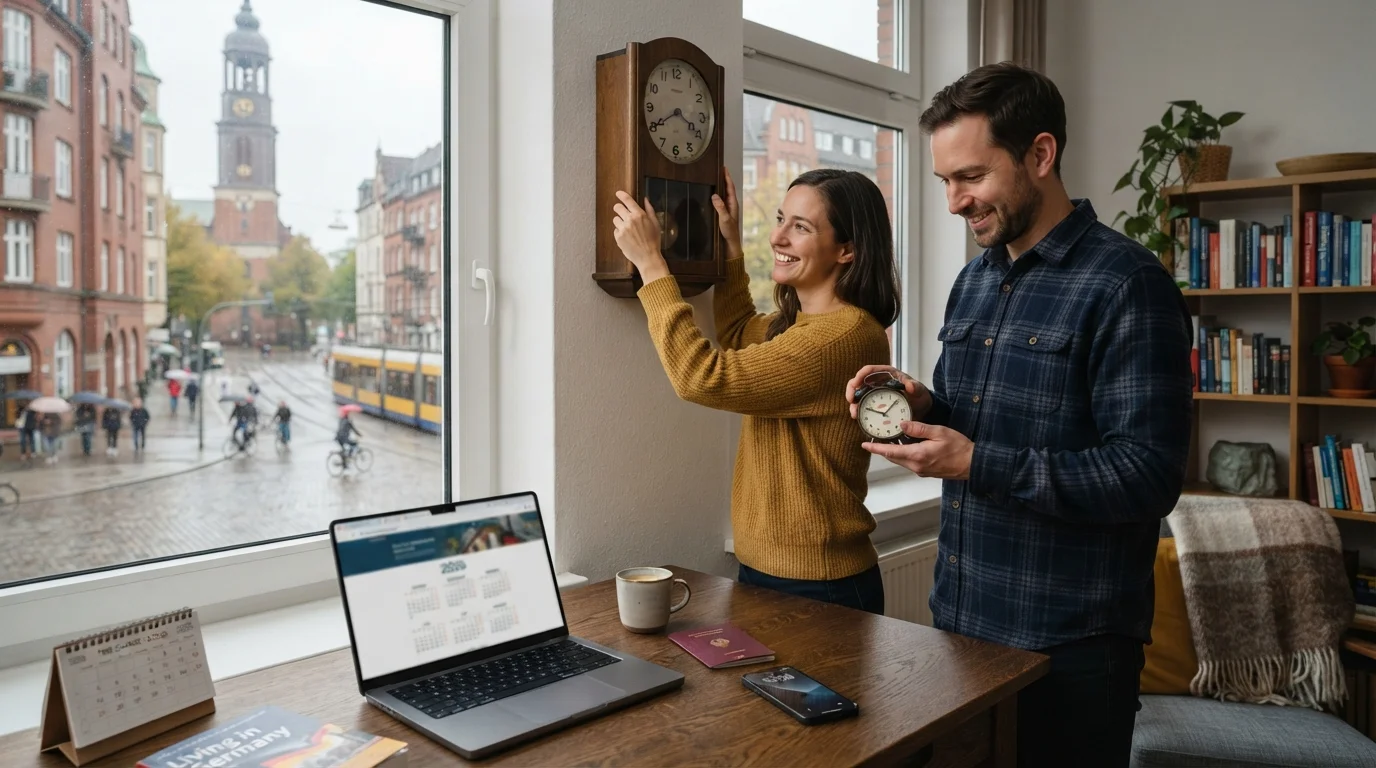
Autumn in Germany brings golden leaves, cooler mornings and one important change that affects almost everyone: the clocks move back by one hour. In 2026, Germany’s daylight saving time change takes place on Sunday, 25 October. For expats, international students and German learners, this is more than a calendar detail. The time change can affect appointments, trains, work schedules, sleep, digital devices and conversations in German.
This practical guide explains exactly when the clocks change in Germany, what the change means, how to avoid missed appointments and which German words and phrases you need. It also covers the connection between German time zones, public transport, integration-exam knowledge and everyday life.
Germany ends daylight saving time on Sunday, 25 October 2026. At 3:00 a.m. Central European Summer Time, or Mitteleuropäische Sommerzeit (CEST), the clocks go back to 2:00 a.m. Central European Time, or Mitteleuropäische Zeit (CET).
In simple terms, you get one extra hour during the night. The change is often described in German as:
Germany uses the European system in which daylight saving time begins on the last Sunday in March and ends on the last Sunday in October. The European Commission provides background information about the seasonal clock changes and the rules used across the European Union in its summertime information.
At 2:59 a.m. summer time, the next minute becomes 2:00 a.m. standard time. This means that the hour between 2:00 and 3:00 occurs twice. Most people will not be awake to change their clocks manually, but the distinction can matter for overnight work, travel, medication schedules and electronic systems.
Germany is one hour ahead of Coordinated Universal Time during winter: CET is UTC+1. During daylight saving time, it is two hours ahead: CEST is UTC+2. The country has one official time zone, so the change applies in Berlin, Hamburg, Munich, Cologne, Frankfurt, Leipzig and everywhere else in Germany at the same moment.
The most noticeable effect is that mornings become lighter and evenings become darker. If you normally leave work at 5 p.m., it will feel darker earlier. On the other hand, sunrise comes earlier than it did under summer time. This can influence commuting, exercise, childcare, shopping and social plans.
The time change can also create confusion when you are arranging appointments with people in different countries. Germany changes its clocks on the same general European schedule as many neighbouring countries, but not every country follows the same rules. Always check the time zone rather than assuming that the difference is unchanged throughout the year.
For anyone learning German, this is a useful everyday topic because Germans often discuss the time change in conversations at work, in apartment buildings and in shops. You may hear:
Understanding these expressions can make informal conversations easier and help you respond confidently when someone mentions the change.
Most modern smartphones, tablets, computers and smartwatches update automatically when they have the correct location and time-zone settings. Before the final weekend of October, check that your device is set to update the time automatically. If you use an older alarm clock, wall clock, oven, car clock or watch, you may need to change it yourself.
Calendar applications usually handle the change correctly, but recurring events can still cause uncertainty when they were created in another time zone. If an appointment is important, send a short confirmation using both the local time and the time zone. For example: Montag, 26. Oktober, um 10 Uhr deutscher Zeit (CET).
Do not rely only on a printed timetable or an old message. Check the current information from your transport provider, especially if you are travelling during the night. Overnight trains and buses may have special procedures because the 2:00–3:00 hour occurs twice.
Most daytime trains, trams, buses and flights operate normally after the time change. The main complications usually involve services running through the night. A train scheduled to arrive at 2:30 a.m. may need an additional explanation because that time occurs twice on the final Sunday in October.
If you are taking an early train on Sunday morning, check:
If you use local transport every day, the autumn change is also a good opportunity to review practical German travel vocabulary. Abfahrt means departure, Ankunft means arrival, Verspätung means delay and Gleis means platform or track. You can find more everyday travel advice in this guide to using the Deutschlandticket in Germany.
When asking for clarification, try: Entschuldigung, ist das 2 Uhr Sommerzeit oder 2 Uhr Winterzeit? This means: Excuse me, is that 2 o’clock summer time or 2 o’clock winter time? In many ordinary daytime situations, context makes the answer obvious, but this question is useful for overnight travel.
The autumn change gives you an extra hour, but your body may still need time to adjust. Some people feel tired because their daily routine, meal times and exposure to daylight change. Others notice the darker evenings more than the extra hour of sleep.
If you take medication at a fixed time, follow the instructions from your doctor or pharmacist. For most daily schedules, a one-hour clock change is not a serious issue, but some medicines and treatments require specific timing. Ask a medical professional if you are unsure rather than guessing.
Autumn is also a good moment to prepare your home for colder weather. Check heating instructions, ventilation and household responsibilities with your landlord or building management. Our guide to preparing a German apartment for winter heating covers useful seasonal vocabulary and practical steps.
German uses several words for the clock change, and the difference between formal and everyday language can be helpful to understand.
Wann wird die Uhr umgestellt? — When are the clocks changed?
Am Sonntag werden die Uhren eine Stunde zurückgestellt. — On Sunday, the clocks are put back by one hour.
Gilt der Termin in deutscher Ortszeit? — Is the appointment in German local time?
Mein Wecker hat sich nicht automatisch umgestellt. — My alarm clock did not update automatically.
Im Winter ist es morgens früher hell und abends früher dunkel. — In winter, it gets light earlier in the morning and dark earlier in the evening.
Pay attention to the verb umstellen. In the sentence Wir stellen die Uhr um, the separable prefix um moves to the end. This is a small but useful grammar point for everyday German. Bretzi can help you practise vocabulary, listening and short conversations about daily life, with explanations after answers so you can see why a response is correct or incorrect.
The clock change is relevant to integration because it is part of ordinary life in Germany. In an integration exam, you may need to understand practical information about schedules, appointments, public services or daily routines. You may also encounter a text or listening exercise in which a time is written in a timetable or announced over the telephone.
For exam preparation, practise reading both the 24-hour clock and common spoken forms. For example:
Remember that German halb drei refers to halfway to three. This expression frequently causes difficulty for learners, especially when listening. Practise it in context rather than translating each word individually.
The Leben in Deutschland section of integration-related study also rewards familiarity with everyday systems and public life. The daylight saving time change is not usually something to memorise as an isolated fact, but it is an excellent real-world topic for building vocabulary, listening confidence and cultural knowledge.
You may need to explain the change to a colleague, neighbour or service provider. These examples can help:
Die Zeitumstellung ist am letzten Sonntag im Oktober.
The time change is on the last Sunday in October.
In der Nacht werden die Uhren von drei auf zwei Uhr zurückgestellt.
During the night, the clocks are set back from three to two.
Wir haben eine Stunde mehr.
We have one extra hour.
Ab Montag ist Deutschland wieder in der Mitteleuropäischen Zeit.
From Monday, Germany is back on Central European Time.
For a polite clarification, say: Könnten Sie bitte die Uhrzeit noch einmal nennen? This means: Could you please say the time again? If the setting is formal, add in deutscher Zeit when discussing an international meeting.
In autumn, the clock goes back one hour. In spring, it goes forward one hour. A popular German memory aid is Im Frühjahr stellt man die Gartenmöbel vor, im Herbst zurück — in spring you move the garden furniture forward, in autumn back. The phrase is a mnemonic, not an official rule, but it is easy to remember.
Phones usually update automatically, but analogue clocks and some household appliances do not. Check them on Sunday morning so that your routine is not based on the wrong time.
An online appointment with someone abroad may not have the same time difference all year. Confirm the city, date and time zone, particularly for job interviews, university appointments and government-related appointments.
Most people simply sleep through the change. However, if you work at night or travel overnight, ask for clear instructions. The repeated hour can affect shift records, tickets and arrival times.
Germany’s autumn daylight saving time change in 2026 happens on Sunday, 25 October, when the clocks move back from 3:00 to 2:00 a.m. The result is one extra hour, earlier darkness in the evening and a useful reminder to check devices, appointments and travel plans.
For expats and German learners, the event is also a practical language lesson. Learn the vocabulary, practise asking about local time and use the occasion to review German numbers, schedules and everyday conversations. If you are preparing for integration-related language tasks, connect the topic with listening and reading practice rather than memorising a single date.
Save this guide before the October change, check your clocks and practise a few German sentences aloud. With the right preparation, the time change can be a smooth part of life in Germany—and a useful opportunity to strengthen your everyday German.
Rules, fees and dates change. Check the current version on the official pages before you act.
Share this article:
Autumn in Germany is more than cooler mornings, colourful forests and the return of indoor activities. It is also an excellent time to join a local...
Read moreYou have just finished completing your Anmeldung, unpacked the last moving boxes on a sunny Sunday afternoon, and decided it is the perfect time to...
Read moreIf you have recently moved to Germany, your first trip to a local grocery store might feel less like a routine errand and more like an Olympic sport....
Read more