
How to Request Training Funding (Gutschein) from Agentur für Arbeit
Relocating to Germany or navigating a career transition can be both exciting and challenging. If you are currently unemployed, facing potential...
Read more
This article was written by AI and published by Bretzi.
AI can get things wrong. For anything official, check the source it points to.
AI-generated image
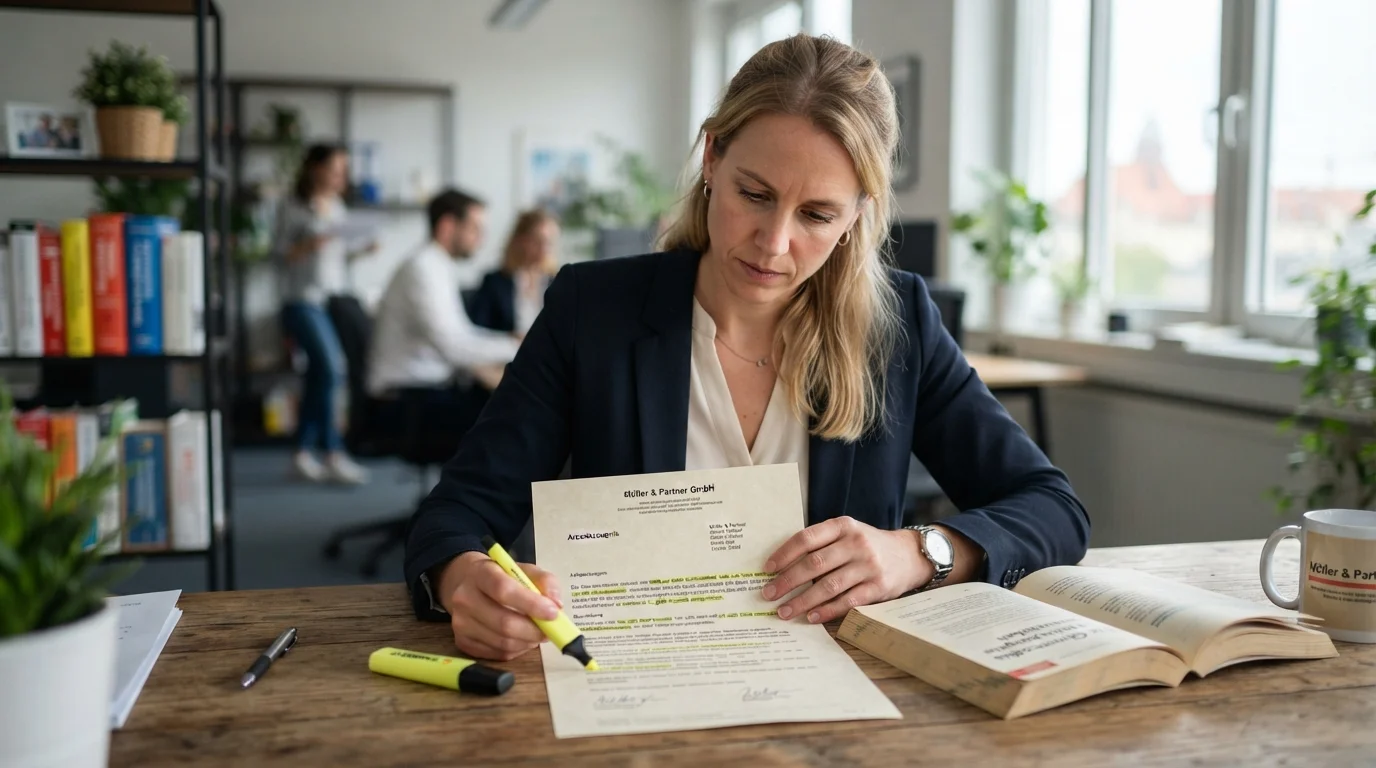
When leaving a job in Germany, receiving your Arbeitszeugnis (formal written job reference) is an essential milestone. On the surface, the letter almost always sounds exceptionally polite, complimentary, and kind. You might read phrases praising your punctuality, your effort, or your warm relationships with colleagues. However, in the German corporate ecosystem, praise is rarely as straightforward as it appears.
Under German employment law (§ 109 Gewerbeordnung), an employer is legally obliged to write a reference that is both benevolent (wohlwollend) and truthful (wahr). An employer cannot write overtly negative statements that could harm an employee's future career prospects. Because outright criticism is forbidden, German human resources departments developed a sophisticated coded language known as Zeugnissprache. Understanding these subtleties is just as crucial as mastering the nuances of business etiquette and professional tone.
In this comprehensive guide, we will break down how an Arbeitszeugnis is structured, how the secret German grading system works, the most notorious hidden red flags, and what actionable steps you can take if your reference letter falls below expectations.
Before analyzing the hidden codes, you must first verify whether you received an einfaches Arbeitszeugnis (simple reference) or a qualifiziertes Arbeitszeugnis (qualified reference). A simple reference merely states your personal details, job title, and dates of employment. Whenever you transition to a new career opportunity, you should always request a qualified reference.
A standard qualifiziertes Arbeitszeugnis generally adheres to a rigid, chronological structure:
According to federal information on working in Germany at make-it-in-germany.com, recognized professional references play a vital role alongside diplomas when applying for skilled positions. Recruiters read between the lines within seconds.
In the German school system, marks run from 1 (Sehr gut / Very Good) down to 5 or 6 (Mangelhaft / Ungenügend / Unsatisfactory). In a job reference, HR managers express these numeric grades using specific combinations of adverbs like stets (constantly/always), jederzeit (at all times), vollste (fullest), and volle (full).
The core sentence to look for is the general performance rating. Here is the exact breakdown of how that sentence translates to school grades:
Notice the combination of stets (always) and the superlative vollsten (fullest). If either word is downgraded, the score drops immediately.
Notice the subtle omission: either stets is missing, or vollsten is softened to vollen. This corresponds to an above-average, solid evaluation that most recruiters welcome.
In standard German conversation, "to our satisfaction" sounds fine. In an Arbeitszeugnis, however, dropping the modifier "full" or "always" signals mediocrity.
Without any adverbs of constancy or intensity, this formulation represents a bare pass. It indicates that the employee met the minimum contractual duties and nothing more.
The phrase im Großen und Ganzen (on the whole) or im Wesentlichen (essentially) means that severe gaps were present. Meanwhile, sich bemühen (to make an effort) is universally known in German employment law as the polite way of saying someone failed.
Beyond the primary performance sentence, German HR specialists use nuanced phrasings to highlight specific behavioral or performance defects without ever breaching the legal requirement of benevolence. Here are common formulations and their true hidden meanings:
If your reference repeatedly states that you "tried" or "showed interest," it points to incompetence:
When an employer evaluates social conduct, standard professional etiquette dictates that superiors must be mentioned first, followed by colleagues, and finally clients:
Personal warmth is valuable, but if an employer highlights social traits that should be secondary to productivity, future employers take notice:
Employers only emphasize basic, minimum contractual conditions when there is nothing genuinely praiseworthy to write:
Many employees read the body of their Arbeitszeugnis and skip the final paragraph. In reality, experienced HR managers jump straight to the closing section. A complete, positive closing formula must contain four distinct elements:
If any of these components are missing, the reference letter drops in perceived quality. For instance, wishing someone "alles Gute und viel Erfolg für die Zukunft" (wishing success for the future) is subtly different from wishing someone "weiterhin viel Erfolg" (continued success). Leaving out weiterhin subtly suggests you have not enjoyed much success up to this point.
If you are planning your departure from a company, timing your request alongside submitting your formal resignation letter (Kündigungsschreiben) ensures the administrative timeline stays smooth.
If you translate your reference and discover that it equates to a Grade 4 or contains coded insults, you do not have to accept it passively. You have established legal rights in Germany to request corrections.
Inspect the basic details first. Are your start and end dates accurate? Is the spelling of your name correct? Is the document printed on official company letterhead and signed by hand by an authorized managing director or direct manager? A lack of formal professionalism in the letter itself can be interpreted as a subtle insult by future hiring managers.
Contact your direct supervisor or HR manager in writing. Point out the specific phrasing that seems inconsistent with your actual performance appraisals or mutual feedback sessions. Often, problematic phrases are unintended errors written by managers who simply do not know the intricacies of Zeugnissprache themselves. You can even provide an alternative draft with the corrected wording you prefer.
Under established German labor court rulings, the burden of proof depends on the grade level:
Navigating German job documentation requires more than everyday conversational fluency. It demands an appreciation for bureaucratic precision, corporate grammar, and formal vocabulary. Whether you are assembling application materials, tailoring your German CV (Lebenslauf), or preparing to negotiate reference wording, strengthening your professional vocabulary is critical.
This is where Bretzi can support your ongoing learning. Bretzi teaches the German of daily life, work, and exams, guiding you through structured CEFR levels from A0 all the way to C1. Its short lessons combine typing answers, gap-fills, listening exercises, and grammar explanations with practical workplace situations. As you work through lessons, you see immediate feedback after every answer to understand why a construction is right or wrong.
When you want to expand your work-related vocabulary, Bretzi lets you save any new word you encounter to practice through spaced-repetition flashcards and daily reviews. With Bretzi Premium, you can even snap a photo of a written German document or work communication to pull and save unknown words directly into your personal vocabulary list. In addition, Bretzi Premium gives you access to SprachBuddy, an AI conversation partner that lets you speak German out loud in tailored workplace roleplays—such as walking through simulated interviews—to build the confidence you need when discussing job opportunities in Germany.
Keep this handy translation table nearby whenever reviewing an Arbeitszeugnis or intermediate reference:
When applying for high-level roles in Germany, pair your solid references with targeted interview practice. Review our advice on preparing for a German job interview to ensure your live communication matches the excellence on your written paperwork.
An Arbeitszeugnis is never just a simple sign-off note; it is a permanent legal record that will accompany your applications across Germany, Austria, and Switzerland for years to come. Never tuck a new reference away in a folder without reading it line by line.
Learn the vocabulary, spot the missing adverbs, check the order of hierarchy, and ensure the closing sentence reflects your true contributions. By investing the time to decipher the coded language of German employment references, you protect your professional reputation and set yourself up for long-term career growth in Germany.
Rules, fees and dates change. Check the current version on the official pages before you act.
Share this article:
Relocating to Germany or navigating a career transition can be both exciting and challenging. If you are currently unemployed, facing potential...
Read moreSecuring a flexible work arrangement in Germany can transform your work-life balance, cut your daily commute on the S-Bahn, and give you autonomy...
Read moreWhen planning a career move to Germany, most international professionals immediately think of university degrees or direct corporate hiring. However,...
Read more