
English-Speaking Tech Jobs in Germany: Top Platforms & Guide
Germany is currently experiencing one of the most substantial tech talent shortages in Europe. From booming AI startups in Berlin to cloud...
Read more
This article was written by AI and published by Bretzi.
AI can get things wrong. For anything official, check the source it points to.
AI-generated image
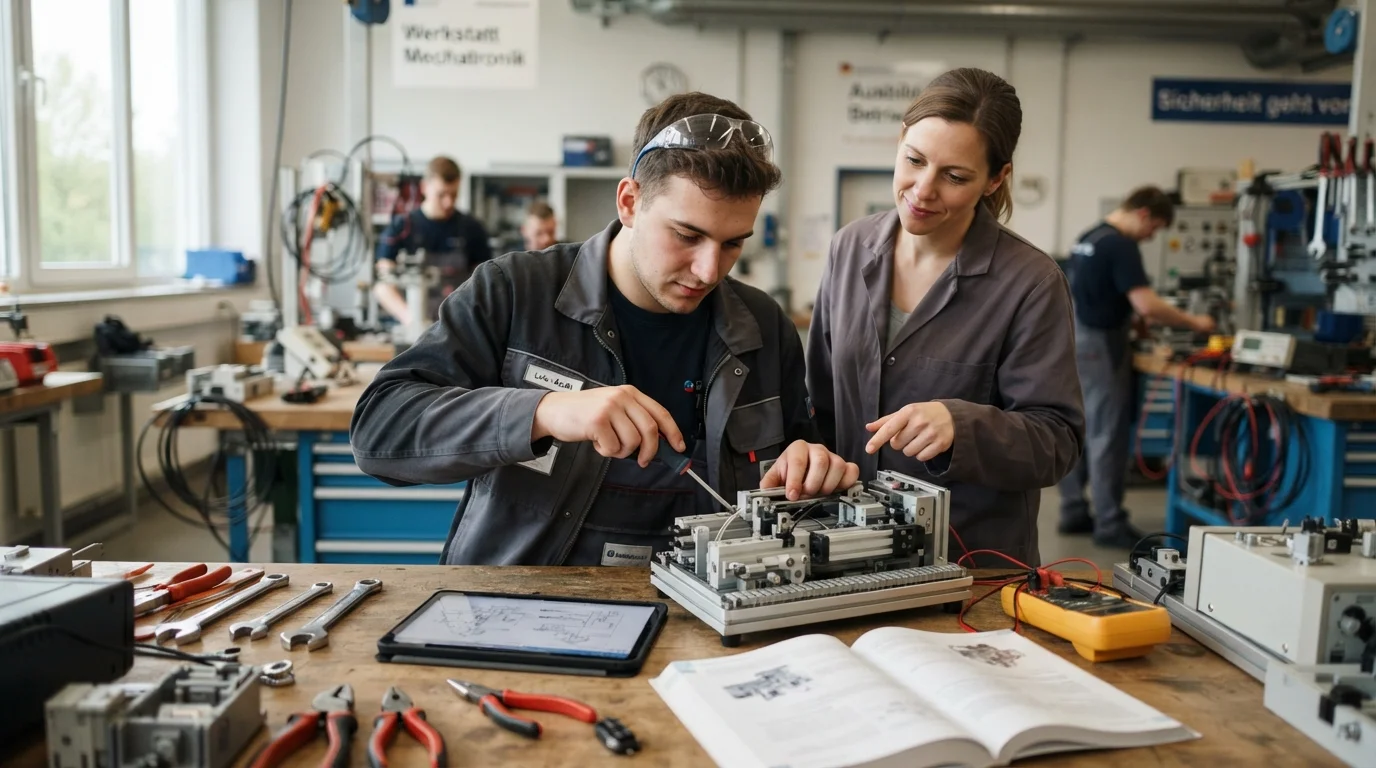
When planning a career move to Germany, most international professionals immediately think of university degrees or direct corporate hiring. However, Germany possesses one of the world's most successful, respected, and accessible educational-employment pathways: the dual vocational training system, known in German as the Ausbildung.
Unlike traditional academic degrees where students rack up debt or vocational programs that only offer theoretical workshops, a German Duale Ausbildung integrates on-the-job training with state-funded vocational school education. Best of all: you get paid a monthly salary from day one, and graduation frequently guarantees a secure, well-compensated job contract.
Whether you are already living in Germany or planning to relocate from abroad, this comprehensive guide covers everything you need to know about the German Ausbildung system, including visa requirements, salary expectations, top industries, and application strategies.
The German dual vocational training model is a bedrock of the country's economic strength. Governed by the Federal Institute for Vocational Education and Training (BIBB), the system combines practical work experience inside a certified company with structured academic lessons at a specialized vocational school (Berufsschule).
During an Ausbildung, your time is split between two learning environments:
Most dual training programs last between 2.5 to 3.5 years, depending on the profession and your prior qualifications. At the end of the program, apprentices take standardized state examinations administered by regional chambers of commerce such as the IHK (Industrie- und Handelskammer) or the HWK (Handwerkskammer).
While the dual system is the most common, Germany also offers Schulische Ausbildung (purely school-based vocational training). This format is typical for healthcare professions, physiotherapy, social work, and design. In school-based programs, you spend the majority of your time at a vocational college (Berufsfachschule) paired with extended clinical or commercial internships. In recent years, many school-based healthcare apprenticeships (such as nursing) have transitioned to paid dual models to attract international talent.
Germany is experiencing a demographic shift leading to severe labor shortages (Fachkräftemangel). Consequently, German employers are actively recruiting motivated international applicants across various sectors:
Germany's modernized immigration laws make applying for an Ausbildung more straightforward than ever for non-EU citizens. To qualify for a training position and a vocational training visa (Visum zur Berufsausbildung), you must satisfy three primary criteria:
You need a recognized school-leaving certificate equivalent to at least a German Hauptschulabschluss or Realschulabschluss (typically 9–10 years of formal secondary education). Your foreign certificates must be officially translated and recognized by the relevant state certification authority (Zeugnisanerkennungsstelle).
Language skills are non-negotiable. While some academic university programs in Germany are taught in English, an Ausbildung is almost entirely conducted in German. Vocational school exams, classroom lectures, safety regulations, and daily workplace operations require solid communication skills.
Before applying for your visa at a German embassy, you must have a signed contract with your host employer, registered with the respective chamber (IHK or HWK). If your monthly apprenticeship stipend does not fully cover Germany's statutory subsistence requirement, you may need to prove additional funds through a blocked account (Sperrkonto) or a formal declaration of commitment (Verpflichtungserklärung).
Note: If you are looking to enter Germany to search for training positions on-site, explore your options under the new points-based system by reading our detailed guide on how to apply for a German Chancenkarte (Opportunity Card).
Unlike standard university study, apprentices receive a legally regulated monthly allowance called the Ausbildungsvergütung. This stipend increases with every completed year of your training.
| Sector | 1st Year (Gross/Month) | 3rd Year (Gross/Month) |
|---|---|---|
| Nursing / Healthcare | €1,150 – €1,350 | €1,350 – €1,550 |
| IT & Systems | €1,000 – €1,150 | €1,200 – €1,400 |
| Industrial Mechatronics | €1,050 – €1,200 | €1,250 – €1,450 |
| Gastronomy / Hotel | €850 – €1,000 | €1,050 – €1,250 |
*Figures are estimates based on standard collective bargaining agreements (Tarifverträge). Exact amounts vary by federal state and company size.
From your gross allowance, deductions are made for public health insurance, nursing care insurance, pension contributions, and unemployment insurance. Because your annual income is relatively modest, apprentices pay very little to no income tax.
Securing an apprenticeship position requires structured preparation, usually starting 6 to 12 months before the training year begins in August or September.
Browse official German databases to find accredited apprenticeship vacancies:
German hiring managers expect an application package (Bewerbungsunterlagen) formatted to local business standards. Your portfolio must include:
If shortlisted, you will participate in an interview (either via video call or in person) and potentially complete an online aptitude assessment (Einstellungstest). Demonstrating cultural etiquette and conversational confidence is paramount. Review our guide on how to prepare for a German job interview to practice handling behavioral questions and formal German business protocols.
Once you begin your training, navigating daily German workplace communication is essential for your success. In German companies, professional interactions often maintain clear boundaries between formal and informal speech.
As an apprentice, always address senior instructors, team leads, and clients using the formal "Sie" until you are explicitly invited to use the informal "Du". To avoid social missteps on the shop floor or in office meetings, familiarize yourself with our overview of Du vs. Sie in the workplace.
Beyond grammatical rules, daily workplace fluency requires conversational agility. Practicing realistic workplace scenarios with Bretzi's AI conversation feature gives you the confidence to ask questions when instructions are unclear, interact smoothly with colleagues, and master specialized industry jargon.
Completing a German Ausbildung opens up attractive long-term career prospects inside Germany and across the European Union:
The German dual vocational training system is one of the most effective paths for international talent to build a stable, prosperous career in Europe. By providing guaranteed workplace experience, a monthly income, and a recognized professional title, an Ausbildung sets you up for long-term career success.
The single most important key to unlocking this opportunity is your German language competence. Download Bretzi today to build personalized study streaks, refine your pronunciation with instant feedback, and gain the language skills you need to land your dream apprenticeship in Germany.
Share this article:
Germany is currently experiencing one of the most substantial tech talent shortages in Europe. From booming AI startups in Berlin to cloud...
Read moreThe Expat Dilemma: Navigating the German Workplace Picture this: It is your first week at a German company. You walk into the kitchen to grab coffee,...
Read moreMastering the German Lebenslauf: Your Gateway to Working in Germany Securing a job in Germany is an exciting milestone, whether you are relocating...
Read more