German Hiking Etiquette for Autumn Forest Walks (Herbstwanderungen)
When the crisp air settles across Germany and broadleaf canopies in the Black Forest, Harz, and Bavarian Alps turn vibrant shades of amber and gold,...
Read more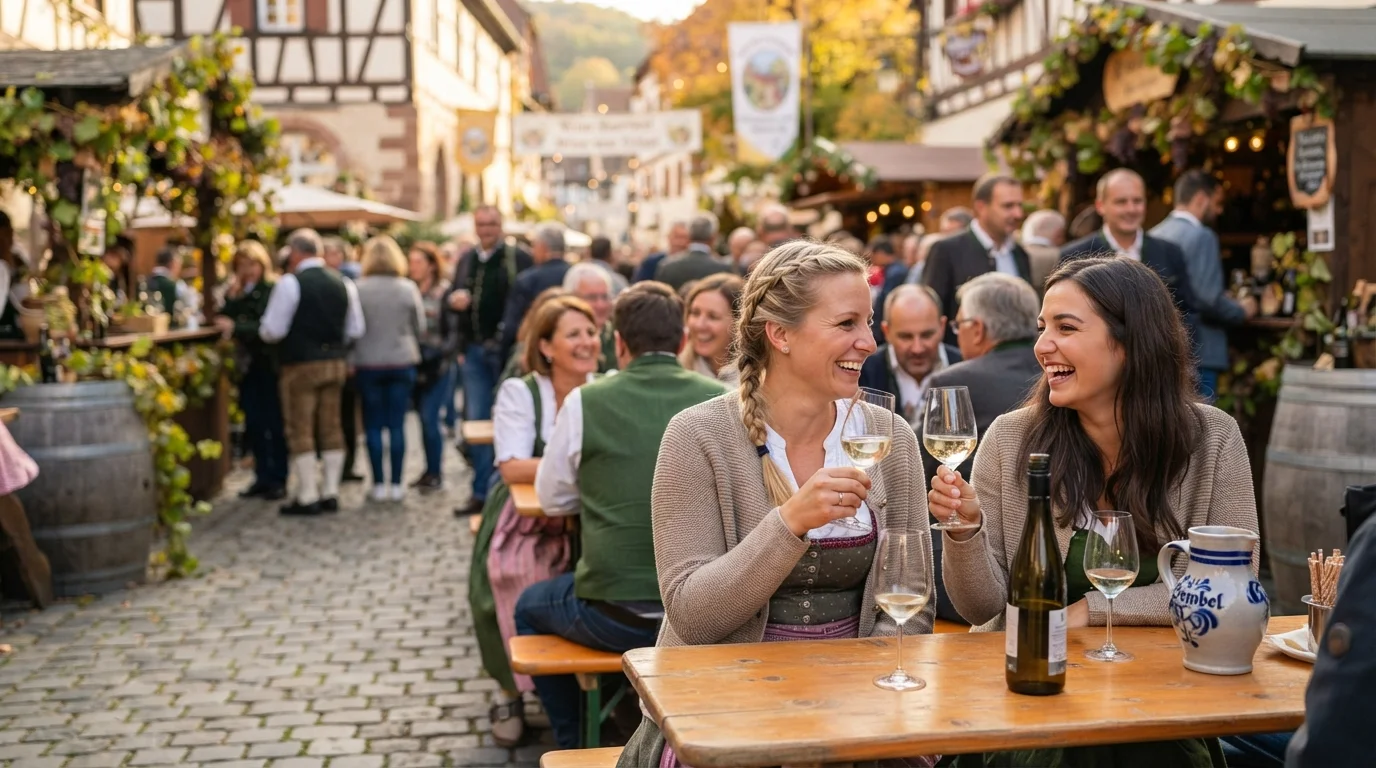
As golden leaves blanket rolling hills and vineyard terraces along the Rhine, Mosel, and Neckar, Germany enters one of its most festive seasons. While summer attracts beer garden crowds and September sets the stage for early tastings, October is the true heart of the German wine harvest (die Weinlese). Across the country's celebrated wine-growing valleys, historic towns celebrate the culmination of months of arduous vineyard work with vibrant, welcoming harvest festivals known as Weinfeste or Winzerfeste.
For expats, international professionals, and language learners living in Germany, attending an autumn wine harvest festival is far more than an evening out. It is an immersive entry point into German regional culture, community traditions, and everyday conversational language. Whether you want to sip cloudy, sparkling Federweißer alongside warm Zwiebelkuchen, listen to local brass bands, or chat with vintners who have tended these hillsides for generations, our comprehensive guide walks you through the top regions, cultural customs, and essential German phrases for October 2026.
Wine cultivation in Germany dates back more than two millennia to Roman times. Today, Germany boasts 13 official wine-growing regions (Anbaugebiete), recognized internationally for world-class Riesling, elegant Pinot Noir (Spätburgunder), and distinctive regional varietals. You can read more about the history and geography of these areas via German wine regions on Wikipedia.
By late September and throughout October, picking teams work their way through the steep hillsides. The grape harvest (die Traubenlese) requires precise timing, as vintners assess sugar levels, acidity, and weather conditions. Once the picking is well underway, communities gather to celebrate the fresh juice, fermenting must, and previous vintages.
If you explored our earlier guide on September wine festivals and tasting phrases, you will notice that October brings a distinct atmosphere. Summer warmth gives way to crisp autumn afternoons, colorful foliage along river bends, and seasonal culinary specialties crafted specifically to accompany fresh, fermenting wine.
You cannot attend an October wine festival without encountering the ultimate autumn duo: Federweißer and Zwiebelkuchen. Understanding this culinary pairing is fundamental to appreciating German harvest customs.
Federweißer (literally "feather-white") is freshly pressed grape must that has just begun to ferment. Containing active yeast, it appears cloudy and naturally effervescent. In its earliest stages, it tastes sweet like fresh grape juice; as the yeast consumes the sugars over several days, it becomes less sweet, more alcoholic, and pleasantly tart. Depending on the region, you might also hear it called Neuer Wein (new wine), Bremser (in Franconia), or Süßer.
Because fermentation produces carbon dioxide, bottles of Federweißer are never sealed airtight—they have loose, permeable caps to prevent exploding. Always transport them upright!
To balance the sweetness and lively acidity of Federweißer, festivals serve fresh-baked Zwiebelkuchen (savory onion tart). Baked in large trays with yeast dough, caramelized onions, smoked bacon cubes (Speck), cream, and caraway seeds, this warm delicacy cuts through the sweetness of the new wine. It fits neatly alongside other beloved German autumn comfort foods enjoyed throughout the cooler months.
While nearly every wine village hosts an event, several prominent regions offer unforgettable October harvest celebrations.
The Pfalz is Germany's second-largest wine region, renowned for its mild, almost Mediterranean microclimate along the German Wine Route (Deutsche Weinstraße). In early October, Neustadt an der Weinstraße hosts the Deutsches Weinlesefest, one of the country's most significant wine events.
Flanked by the Rhine River and the Taunus mountains, the Rheingau is celebrated for aristocratic wine estates and historic monasteries like Kloster Eberbach. Throughout October, towns such as Eltville, Rüdesheim, and Hochheim celebrate the harvest with tastings in medieval courtyards. The south-facing river slopes turn a brilliant gold, making it ideal for combining vineyard hikes with leisurely stops at local taverns.
The Mosel river valley boasts some of the steepest vineyards on earth. During October, villages like Bernkastel-Kues, Cochem, and Traben-Trarbach buzz with harvest activity. Many small family vintners open their barns, cellars, and courtyards directly to the public as pop-up wine taverns (Straußwirtschaften), indicated by a wreath or broom hung above the entrance.
In Bavaria's Franconian wine country surrounding Würzburg, harvest festivals take on distinct regional character. Wine is bottled in traditional flat, round-bellied flasks called Bocksbeutel, with Silvaner taking center stage. Towns along the Main River host cozy autumn festivals where Bremser flows freely alongside hearty sausages and Franconian onion cakes.
Attending a festival provides an ideal real-world setting to build your confidence speaking German. Here are the core terms you will encounter at harvest stalls:
When you approach a wine booth (der Weinstand), use these natural conversational phrases:
Learning practical vocabulary like this turns social events into rewarding milestones on your language journey. If you are building your everyday German, the Bretzi app organizes vocabulary and everyday scenarios from A0 to C1 into short, structured lessons. You can practice dictation, sentence building, and listening, while the Words tab lets you review terms using spaced repetition so they stick when you need them at the counter.
To feel completely comfortable at your first autumn Weinfest, keep these local cultural norms in mind:
Festivals feature long wooden benches and tables (Biertischgarnituren). Seating fills up quickly, and it is entirely normal to sit down with people you do not know. Simply smile, gesture toward an open spot, and ask: "Ist hier noch frei?" (Is this free?) or "Darf ich mich dazu setzen?" (May I sit here?). Within minutes, friendly chatter often follows naturally.
When raising a glass with table neighbors, look each person directly in the eye and say "Zum Wohl!" (To your health/well-being) or "Prost!" Failing to make eye contact during a toast is jokingly considered bad luck in German social culture.
When you purchase your first glass of wine, you will pay a deposit (das Glaspfand), usually between 2 and 5 euros. You will receive a plastic chip (die Pfandmarke) along with your glass. When ordering your next round at the same stand, hand over your empty glass to have it refilled or swapped without paying another deposit. When finished, return both the glass and the chip to get your cash back.
While modern card readers are becoming more common in metropolitan areas, many rural festival stands, family-run wine booths, and traditional pastry stalls still operate on cash only. Keep 20 to 50 euros in small notes and coins in your pocket to avoid searching for an ATM in a tiny vineyard village.
Immersing yourself in local harvest traditions is a powerful way to understand German regional diversity. From civic pride in community festivals to the historical regulations governing wine production, these customs reflect how German society values craftsmanship, seasonality, and communal gathering.
Familiarity with regional customs, public institutions, and social life also forms a central pillar for those preparing for the Leben in Deutschland test or planning long-term integration. Navigating casual small talk at a local festival gives you real-world conversational competence that classroom textbooks rarely capture on their own.
If you want to practice conversational exchanges before stepping into a lively crowd, Bretzi's AI conversation partner, SprachBuddy, lets you call and speak German out loud about daily situations. You can rehearse ordering food, asking for regional wine recommendations, or making casual conversation, scoring your pronunciation and reviewing the dialogue transcript right in the app.
October harvest festivals showcase Germany at its warmest, friendliest, and most colorful. Whether you board a regional train into the Rheingau, hike between terraced slopes in the Mosel valley, or join the bustling crowds in Neustadt, celebrating the harvest will give you lasting memories and authentic conversational practice.
Check the regional tourism boards of Rhineland-Palatinate, Hesse, or Baden-Württemberg for specific festival dates, pack comfortable walking shoes, and make sure to order a warm slice of Zwiebelkuchen with your Federweißer. Zum Wohl!
Rules, fees and dates change. Check the current version on the official pages before you act.
Share this article:
When the crisp air settles across Germany and broadleaf canopies in the Black Forest, Harz, and Bavarian Alps turn vibrant shades of amber and gold,...
Read moreWhen golden leaves drift across cobblestone streets and farm stands brim with squash, apples, and newly pressed cider, Germany shifts into its cozy...
Read moreWhen the crisp October winds begin to sweep across Germany and the golden days of Altweibersommer transition into darker, chillier evenings, the...
Read more