
Federweißer and Zwiebelkuchen: Germany’s September Taste
September in Germany has a flavor: slightly sweet, gently sparkling Federweißer served with a warm slice of savory Zwiebelkuchen. This seasonal...
Read more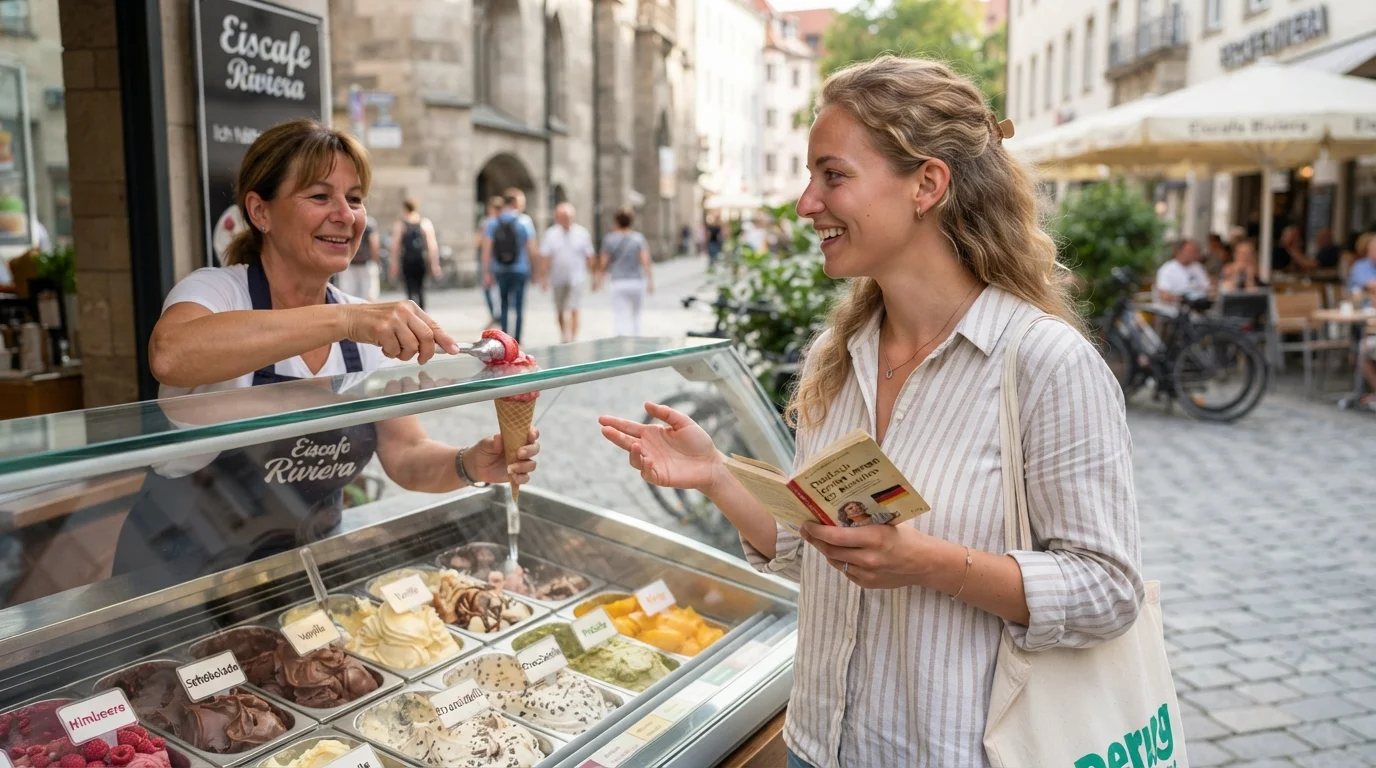
Picture this: It is a warm, sunny July afternoon in Berlin, Munich, or a picturesque town along the Rhine. The sun is beating down, and locals and expats alike are flocking to the nearest Eisdiele (ice cream parlor). The queue stretches down the sidewalk, filled with happy chatter, the scent of freshly baked waffle cones, and the vibrant display of colorful gelato-style scoops. When it is finally your turn to step up to the counter, will you stumble over your words, or will you order your favorite treat with total confidence?
Ordering ice cream in German is one of the most rewarding, low-stakes real-world speaking experiences you can have as a language learner. Whether you are living in Germany, traveling for summer vacation, or preparing for your oral integration exam, mastering the vocabulary of the German Eiscafé will instantly make you feel like a local. In this comprehensive guide, we will cover essential phrases, flavor lists, practical ordering dialogues, cultural etiquette, and grammar tips so you can satisfy your sweet tooth without language anxiety.
Ice cream shops in Germany—commonly referred to as an Eisdiele or Eiscafé—hold a special place in German summer life. Many of the most famous parlors were established by Italian immigrant families in the mid-20th century, bringing artisanal gelato traditions to German cities. Today, visiting an ice cream shop is an essential warm-weather ritual, right alongside enjoying the tradition of German Freibad culture or taking a sunny afternoon stroll through a city park.
Before you join the line, it helps to understand how ordering works. In Germany, ice cream parlors generally operate in one of two ways:
Let us start with the quick counter order. When stepping up to the glass display, a friendly employee will usually greet you with a quick "Der Nächste, bitte!" (Next, please!) or "Bitte schön?" (What can I get for you?). Here is the exact vocabulary and phrase structure you need to respond smoothly.
While you could simply point and state a flavor name, using full polite phrases will make your German sound natural and respectful:
Before choosing flavors, you need to specify how many scoops you want and how you want them served. In Germany, ice cream scoops are called Kugeln (singular: die Kugel).
Putting it together: "Ich hätte gerne zwei Kugeln in der Waffel, bitte." (I would like two scoops in a cone, please.)
When picking your flavors, Germans often use the word einmal (one portion of) or zweimal (two portions of) before each flavor name. This helps the ice cream scooper track your order clearly.
To order effectively, you need to know your flavor vocabulary. German menus feature traditional classics alongside unique local creations. Here is your ultimate flavor breakdown with essential articles and translations:
If you want to practice repeating these flavor names until your accent is flawless, the Bretzi app offers interactive pronunciation training with instant AI feedback. You can rehearse saying "Stracciatella" and "Waldmeister" and get a score with tips on what to improve!
You cannot talk about summer in Germany without highlighting one of the country's most beloved culinary inventions: Spaghettieis. Created in Mannheim in the late 1960s by Italian ice cream maker Dario Fontanella, this nostalgic dish looks like a plate of Italian pasta but is 100% dessert.
Vanilla ice cream is pressed through a modified potato ricer to create long strands that resemble spaghetti noodles. The dish is topped with a rich strawberry sauce (to mimic tomato sauce) and white chocolate shavings or grated coconut (to mimic Parmesan cheese). Underneath the ice cream noodles lies a secret layer of whipped cream, which freezes slightly upon contact with the ice cream, creating a delightful crunchy texture.
If you sit down at an Eiscafé table, ordering a Spaghettieis is a quintessential cultural right of passage. Much like adjusting to afternoon German Kaffee und Kuchen etiquette, lingering over a glass bowl of Spaghettieis is the ultimate way to slow down on warm afternoons.
Once your base order is set, the server might ask: "Mit Sahne?" (With whipped cream?). Here is how to handle extras and toppings like a pro:
To help build your confidence, let us review two complete, real-world dialogues. Read them out loud to get used to the natural flow of conversation.
Verkäufer (Seller): Der Nächste, bitte! Hallo!
Du (You): Hallo! Ich hätte gerne zwei Kugeln in der Waffel, bitte.
Verkäufer: Welche Sorten möchten Sie?
Du: Einmal Joghurt und einmal Mango, bitte.
Verkäufer: Kommt noch Sahne dazu?
Du: Nein, danke, ohne Sahne.
Verkäufer: Das macht drei Euro sechzig, bitte.
Du: Hier bitte, stimmt so! (Here you go, keep the change!)
Verkäufer: Vielen Dank, schönen Tag noch!
Du: Danke, ebenso!
Kellner (Waiter): Guten Tag! Haben Sie schon gewählt?
Du: Ja, ich nehme ein Spaghettieis und einen Eiskaffee, bitte.
Kellner: Sehr gerne. Mit Sahne auf dem Eiskaffee?
Du: Ja, bitte mit Sahne.
Kellner: Kommt sofort!
Want to turn these scripts into real speaking habits? With Bretzi, you can engage in realistic German conversation practice with AI. Bretzi acts as your patient virtual conversation partner, allowing you to practice ordering ice cream, booking tables, or asking for the bill without any real-world pressure.
To complete your transaction smoothly, keep these practical cultural tips in mind:
While major German cities have embraced card payments rapidly in recent years, small traditional Eisdielen often remain cash-only operations—especially for small purchases under €10. Look out for signs that say "Nur Barzahlung" (Cash only) near the register. Always carry a few Euro coins or small banknotes when heading out for ice cream.
If you buy a cone at the walk-up window, tipping is not strictly expected, though rounding up to the nearest 50 cents or Euro by saying "Stimmt so" is always appreciated. If you sit down at an Eiscafé with table service, leaving a tip of around 5–10% is customary, just as you would when enjoying German BBQ culture with friends or dining at a traditional restaurant.
Ordering ice cream is a fantastic opportunity to test your grammar skills in action. Notice how articles change depending on how you construct your sentence:
The Noun Genders:
When you say "Ich hätte gerne einen Becher", Becher is in the accusative case because it is the direct object of what you want. However, when you state where the ice cream should be placed (location preposition in), you use the dative case: in der Waffel or im Becher. Master this distinction, and your German grammar will impress any local vendor!
Ordering ice cream in German does not have to be intimidating. By remembering simple structure patterns like "Ich hätte gerne...", knowing your favorite flavors by heart, and keeping a handful of Euro coins ready, you can turn every sunny afternoon into a successful language practice session.
Ready to take your practical German skills to the next level? Download the Bretzi app today. With personalized learning plans, interactive dialogue games, and bite-sized grammar lessons covering levels A0 through C1, Bretzi gives you the tools and confidence to speak German effortlessly in real-life everyday situations. Try a practice dialogue today and get ready to enjoy your summer scoops like a native!
Share this article:
September in Germany has a flavor: slightly sweet, gently sparkling Federweißer served with a warm slice of savory Zwiebelkuchen. This seasonal...
Read moreHave you ever experienced a warm, golden autumn day in Germany when summer seems to return for one last visit? Germans have a beautiful word for this...
Read moreAs summer winds down and the morning air turns crisp, Germany undergoes a golden transformation. While millions of tourists flock to Bavaria for...
Read more