
Federweißer and Zwiebelkuchen: Germany’s September Taste
September in Germany has a flavor: slightly sweet, gently sparkling Federweißer served with a warm slice of savory Zwiebelkuchen. This seasonal...
Read more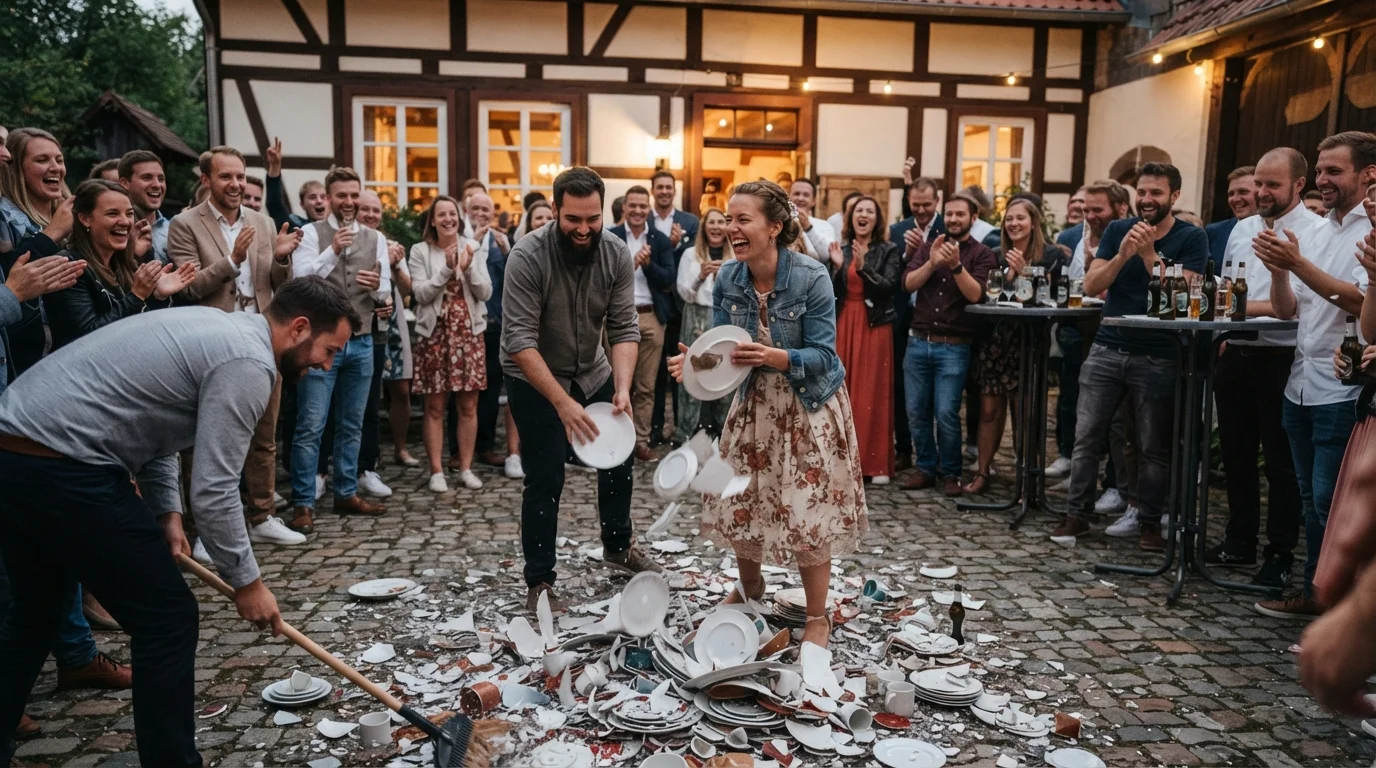
If you ever find yourself walking through a quiet German residential neighborhood on a Friday evening and suddenly hear the deafening sound of shattering ceramics, do not panic. You haven't stumbled into a riot or a bizarre domestic dispute. You are likely witnessing one of Germany's oldest, loudest, and most beloved pre-wedding customs: the Polterabend.
For expats, language learners, and anyone preparing for the Leben in Deutschland integration exam, understanding German customs goes far beyond memorizing grammar rules. Culture and language are deeply intertwined. Grasping traditions like the Polterabend gives you a fascinating look into German social life, history, and communal values. In this comprehensive guide, we will unpack everything you need to know about this unique tradition, from the rules of ceramic smashing to essential German wedding vocabulary.
The word Polterabend comes from the German verb poltern (to make a loud noise or rumble) and Abend (evening). Literally translated, it means 'rumbling evening' or 'crash evening.' Traditionally held on the night before the wedding ceremony (though nowadays often held a weekend or two earlier), a Polterabend is an informal party where friends, family, neighbors, and colleagues gather to celebrate the bride and groom-to-be.
The highlight of the event? Guests bring old porcelain, stoneware, or ceramic items and smash them forcefully onto the ground right outside the couple's home or party location.
A Polterabend is a traditional German pre-wedding celebration where community members gather to smash porcelain and ceramic goods in front of the bride and groom to bring them good fortune. Unlike formal wedding receptions, a Polterabend is entirely informal, participatory, and open to anyone who knows the couple—including neighbors, sports teammates, and work colleagues.
The event typically takes place outdoors in a courtyard, driveway, or community hall entrance. Guests arrive with boxes and crates filled with discarded dishware, wait for a festive moment, and forcefully shatter them against a designated paved area. The party continues late into the night with casual catering, local beer, and community games. Much like the communal revelry found at September wine festivals in Germany, the atmosphere is loud, lively, and deeply focused on bringing people together without rigid formalities.
The literal Polterabend meaning translates to 'rumble evening' or 'crash evening,' derived from the Old High German verb poltrōn (to make noise, crash, or knock noisily) and âband (evening). Historically, the Polterabend meaning extends beyond the linguistic translation to encompass a pagan protective rite: creating intense clatter and noise was believed to drive away mischievous spirits and demons (*böse Geister*) before two people entered a holy matrimonial union.
In modern German culture, the symbolism of the Polterabend has evolved into three distinct psychological and social meanings:
Similar to outdoor gatherings held during late summer festivals in Germany, this custom proves how enduring German folk rituals remain across generations.
Why would anyone celebrate a impending marriage by destroying kitchenware? The practice is rooted in ancient Germanic folklore. It was believed that loud noises would ward off evil spirits and demon forces that might wish ill upon the couple's upcoming union.
Over centuries, this superstition evolved into a famed German proverb: "Scherben bringen Glück" (Shards bring good fortune). The breaking of the porcelain represents leaving the old behind and wishing the couple prosperity, luck, and happiness in their new life together. To explore how this fits into the broader context of marriage celebrations in the country, take a look at our ultimate German wedding guest etiquette guide.
While a Polterabend might sound like a chaotic free-for-all, Germans approach even their most boisterous traditions with a clear set of rules. If you are invited to a Polterabend, you cannot simply throw any household item onto the driveway!
The general rule is simple: bring anything made of clay, porcelain, or stoneware. Common items include:
Bringing the wrong material to a Polterabend is considered a major cultural faux pas. Pay extra attention to these restrictions:
Once the pile of broken porcelain reaches impressive proportions, the most symbolic part of the evening begins: the clean-up. The bride and groom are handed a broom (*Besen*) and a dustpan (*Kehrblech*). Together, they must sweep up every single piece of broken ceramic.
This cleanup ritual is not just about keeping the street tidy. It symbolizes the couple's commitment to working together as a team to tackle life's messes and obstacles. No matter how large or difficult the task, they solve it side by side.
Of course, guests love to make this task as challenging as possible! It is a common prank for friends to kick over the dustpan just as the couple finishes sweeping, or to dump an extra box of broken plates right onto their freshly swept spot. It is all done in good fun, showcasing the cheerful, informal nature of the night.
As German society evolves, wedding customs adapt. Today, you might encounter a few different variations of this tradition depending on the region and the couple's personal preferences:
Held a few days prior to the official civil or church wedding. It is usually an open-door event where almost anyone can attend without a formal invitation—including neighbors, local club members, and casual acquaintances who might not be on the formal wedding guest list.
Many modern couples choose to save money and stress by combining the Polterabend and the actual wedding reception into one giant event called a Polterhochzeit. Guests dress up a bit more than at a regular Polterabend, but the porcelain-smashing tradition remains intact early in the evening.
Influenced by Western culture, many younger Germans now also celebrate a Junggesellenabschied (bachelor party) or Junggesellinnenabschied (bachelorette party). However, the Polterabend remains unique because it is a joint celebration for both partners rather than gender-segregated nights out.
Much like attending a casual German grillparty as a guest, the atmosphere at a Polterabend is relaxed, cheerful, and unpretentious, making it very different from the formal wedding day itself.
If you want to impress the locals or prepare for practical German conversations, mastering topic-specific vocabulary is essential. Here are the key words and phrases associated with a Polterabend:
Want to practice speaking these words out loud with accurate pronunciation? With the Bretzi AI language learning app, you can practice real-life German conversation scenarios and get instant pronunciation feedback, helping you feel confident speaking German at any social gathering or traditional event.
If you have been invited to your first Polterabend in Germany, here is a practical survival guide so you know exactly what to bring, wear, and do:
Unlike the actual wedding ceremony, a Polterabend is an informal, outdoorsy event. You will likely be standing on gravel, concrete, or cobblestones near flying pieces of ceramic. Wear comfortable casual clothes and sturdy, closed-toe shoes (avoid high heels or open sandals for safety reasons!).
Do not expect a three-course plated dinner. Polterabende are famous for buffet-style comfort food: hearty soups (like *Mitternachtssuppe* or *Gulaschsuppe*), sausages (*Bratwurst*), potato salad, pretzels, and plenty of draft beer, wine, or soft drinks. If you want to dive deeper into traditional German dining social habits, read our guide on German Kaffee und Kuchen etiquette.
Small gifts or monetary contributions are welcome, but expensive presents are generally reserved for the wedding day itself. Bringing a nice box of old porcelain plates for smashing, along with a card or a bottle of wine, is usually more than sufficient.
Language is more than just vocabulary lists and grammar rules; it is the living reflection of a culture's history and social values. When you understand traditions like Polterabend, local idioms like "Scherben bringen Glück" immediately make sense, making your German sound far more natural and native-like.
This is where immersive learning tools make all the difference. Instead of relying solely on rigid textbook exercises, using an intelligent tool like the Bretzi app allows you to explore bite-sized cultural lessons alongside structured grammar from A0 to C1. Bretzi's AI-powered personalized learning plans adjust to your specific goals—whether you are preparing for your German integration exam, moving to Munich, or attending your first German wedding.
The German Polterabend is a wonderful example of how ancient traditions survive in modern European life. It combines noisy fun, symbolic teamwork, community connection, and rustic hospitality into an unforgettable evening. The next time you hear plates smashing outside, grab a ceramic pot, join in the fun, and shout "Scherben bringen Glück!"
Ready to boost your German language skills and understand local customs like a native? Download Bretzi today to practice real-life German conversations, master tricky grammar, and build your vocabulary with spaced repetition games designed for real-world success!
Share this article:
September in Germany has a flavor: slightly sweet, gently sparkling Federweißer served with a warm slice of savory Zwiebelkuchen. This seasonal...
Read moreHave you ever experienced a warm, golden autumn day in Germany when summer seems to return for one last visit? Germans have a beautiful word for this...
Read moreAs summer winds down and the morning air turns crisp, Germany undergoes a golden transformation. While millions of tourists flock to Bavaria for...
Read more