Applying for an Executive Position in Germany: Expat Resume Tips
Stepping into an executive role—whether as a Director, Vice President, Bereichsleiter, or Geschäftsführer—in Europe’s largest economy is a...
Read more
This article was written by AI and published by Bretzi.
AI can get things wrong. For anything official, check the source it points to.
AI-generated image
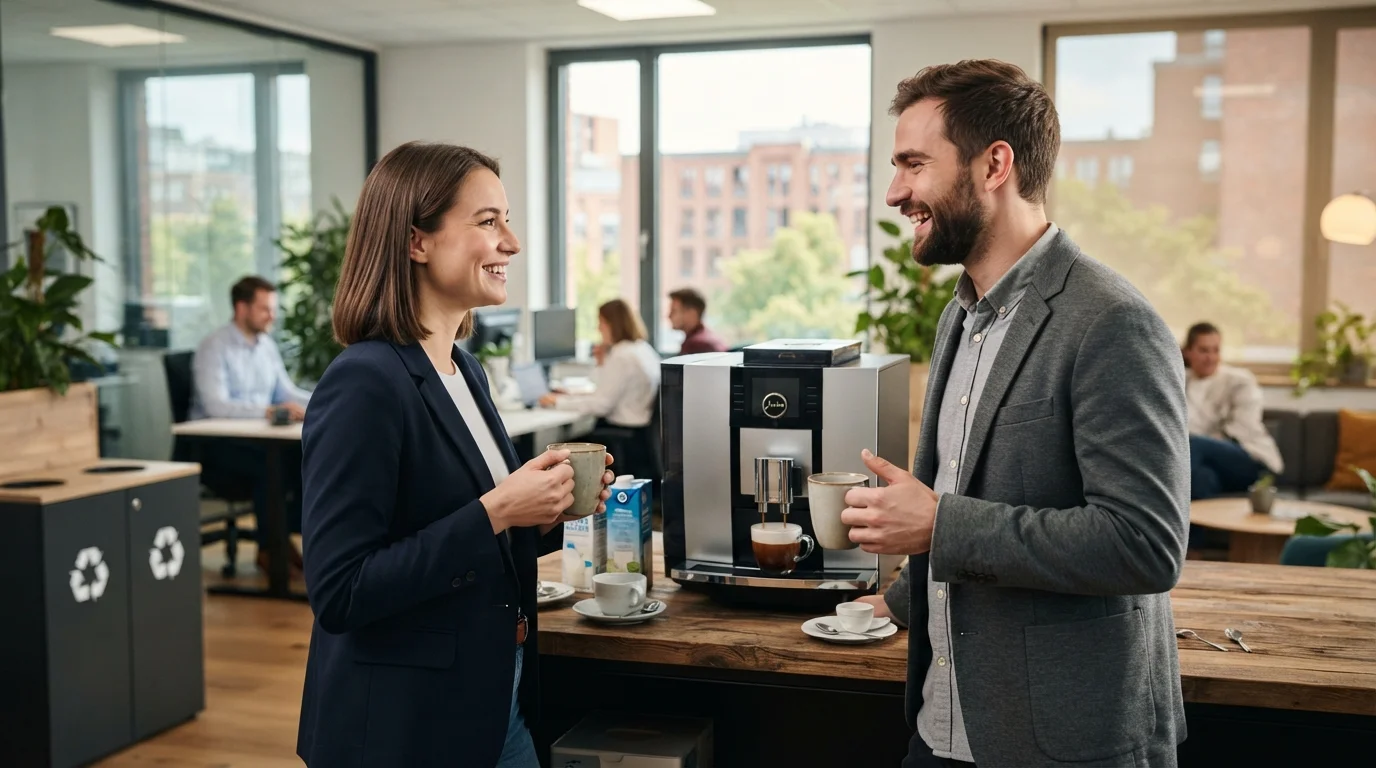
For international professionals working in Germany, few places provoke as much subtle anxiety as the office kitchen (die Kaffeeküche). You walk in simply wanting a fresh cup of filter coffee or an espresso, only to find a colleague standing by the machine. Suddenly, you face a dilemma: do you offer a polite nod and stare intently at the coffee dripping into your cup, or do you dive into a spontaneous German conversation?
While German work culture is celebrated worldwide for its focus on efficiency, structure, and Sachlichkeit (matter-of-factness), casual corridor conversations play a vital role in building social cohesion. Small talk in a German office is not the relentless, hyper-enthusiastic networking you might encounter in the United States, nor is it completely avoided. Instead, it follows its own understated rhythm, pragmatic topics, and subtle etiquette rules.
Whether you are starting your first position at a German company or preparing for career mobility via official portals like Make it in Germany, learning how to handle spontaneous chats by the coffee machine will help you feel at home in your team.
To succeed at German small talk, you first have to understand what your colleagues expect. International professionals often assume Germans despise small talk entirely. While it is true that Germans value substance over superficial pleasantries, the Kaffeepause (coffee break) is a recognized safe zone where professional guardrails relax slightly.
In many English-speaking environments, asking "How are you?" functions simply as a greeting; the only accepted answer is "Great, how are you?" In Germany, asking "Wie geht's?" might result in a genuine, honest update about someone's bad back, poor sleep, or frustration with their morning commute. Germans prefer a touch of grounded realism to forced optimism. Do not feel pressured to sound endlessly thrilled; genuine, modest answers resonate far better.
Before launching into casual chatter, observe the office culture regarding forms of address. Modern startups, tech companies, and creative agencies almost exclusively use the informal Du. However, traditional corporate institutions, banks, law firms, and public sector offices may still rely on the formal Sie until an explicit offer (das Duz-Angebot) is extended. Understanding Du vs. Sie in the workplace prevents awkward missteps when chatting over an Americano.
When you have 90 seconds while the beans grind and the kettle boils, stick to predictable, relatable themes. Here are the most reliable topics in German corporate life, complete with natural phrases you can deploy immediately.
It sounds cliché, but the weather is an absolute staple of German everyday conversation. Germany experiences distinct seasonal shifts, and commenting on rain, sudden cold snaps, or unexpected sunshine creates an instant bond.
The weekend is sacred in Germany. From Monday morning until Tuesday noon, the default icebreaker is asking how someone spent their days off. By Thursday afternoon, attention shifts to plans for the upcoming weekend.
Whether someone drives through morning traffic jams (der Stau) or relies on regional trains (die Regionalbahn) and city transits (die S-Bahn / U-Bahn), the daily commute is an endless wellspring of solidarity.
Direct observations about the immediate environment require zero cognitive load. Discussing the machine itself, asking about cafeteria specials, or noting the approach of the end of the workday (Feierabend) works reliably.
Small talk is not just about what you say; it is about signaling that you are engaged while processing spoken German in real time. In German, short reaction words (interjections) show active listening without interrupting the speaker's flow:
If you don't catch a specific word, you do not need to freeze. Simply say: "Sorry, das Wort kenne ich noch nicht – was bedeutet das?" (Sorry, I don't know that word yet – what does it mean?). German colleagues generally respect the honesty and are happy to clarify.
While the coffee machine is informal, professional boundaries in Germany differ from those in other countries. To keep relations harmonious, steer clear of these potential pitfalls:
The old German idiom "Über Geld spricht man nicht" (One does not speak about money) still carries weight. Inquiring about what a colleague earns, how much their apartment rent costs, or the price of their new car can cause instant discomfort.
While discussing broad economic trends or headline news is acceptable, probing a coworker's voting record or diving into contentious partisan debates during a casual three-minute break is considered unprofessional.
Questions like "Why don't you have children yet?" or detailed inquiries into someone's romantic life are seen as boundary-crossing. Let colleagues offer personal details voluntarily before you probe further.
Once the coffee mug is full, you need a smooth exit line. Germans appreciate punctuality and focus, so breaking away is completely painless. You never need an elaborate excuse:
Casual rapport built at the coffee machine often makes formal settings much easier. When you transition from informal banter to structured workplace discussions, you can build on that warmth by reviewing essential business German phrases for leading professional meetings.
Understanding phrases on a screen is one thing; pulling them out spontaneously when someone unexpected walks into the break room is another. Here is how you can train your reflexes:
Do not overwhelm yourself with dozens of idiomatic expressions. Pick two low-risk phrases on Monday—for instance, "Ganz schön frisch heute" and "Hast du am Wochenende was Schönes vor?"—and resolve to use them at least once before Friday.
Speaking anxiety usually stems from the fear of freezing or making basic grammatical slips. Practicing spoken interactions regularly helps build linguistic muscle memory. If you are exploring learning tools, our overview of the best app to learn German in Germany breaks down modern options designed for real-life immersion.
For targeted speaking practice, you can turn to the Bretzi app. Its AI conversation partner, SprachBuddy, lets you call and speak German out loud about everyday workplace and daily life topics. Because it is dedicated conversational software, you can practice low-stakes small talk out loud and review the dialogue transcript afterward. Bretzi also features pronunciation scoring that evaluates your spoken sentences and provides tips on where to improve, helping you refine your accent before stepping into the kitchen.
Casual office chatter often migrates into digital messaging apps like Teams or Slack. If you want to check your written phrasing before messaging a colleague, Bretzi's Premium Sentence Check feature corrects sentences you type and explains the underlying grammar rules, reinforcing correct structures over time.
Mastering German small talk is not about having an expansive literary vocabulary; it is about building shared moments of connection. The next time you find yourself waiting for the espresso machine to hiss, resist the urge to pull out your phone. Offer a warm "Guten Morgen!", mention the weather or the approaching weekend, and enjoy taking part in the authentic rhythm of German working life.
Share this article:
Stepping into an executive role—whether as a Director, Vice President, Bereichsleiter, or Geschäftsführer—in Europe’s largest economy is a...
Read moreRelocating to Germany or navigating a career transition can be both exciting and challenging. If you are currently unemployed, facing potential...
Read moreWhen leaving a job in Germany, receiving your Arbeitszeugnis (formal written job reference) is an essential milestone. On the surface, the letter...
Read more