Federweißer and Zwiebelkuchen: Germany’s September Taste
September in Germany has a flavor: slightly sweet, gently sparkling Federweißer served with a warm slice of savory Zwiebelkuchen. This seasonal...
Read more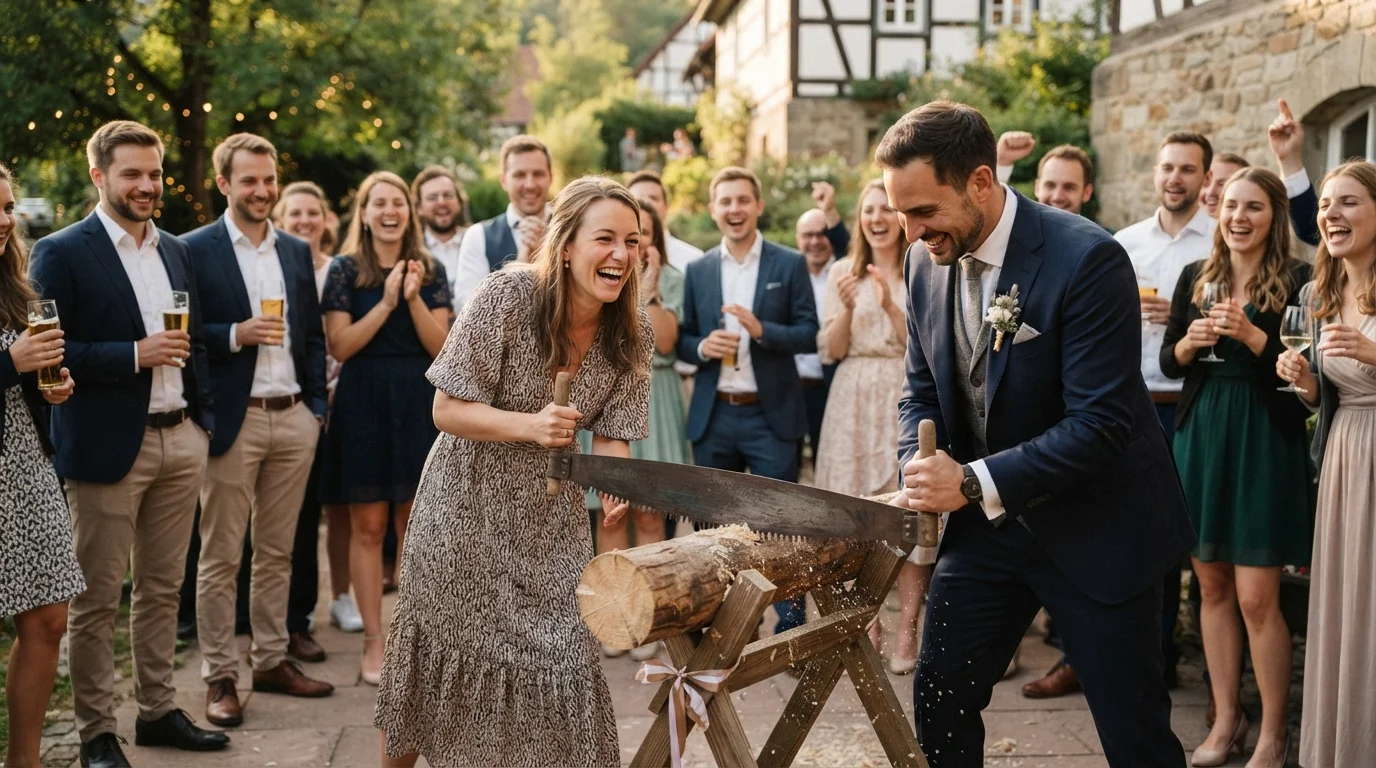
Imagine checking your mailbox to find a beautifully designed, minimalist card. You open it, and there it is: "Wir heiraten!" (We are getting married!). If you are an expat living in Germany, a language learner, or someone preparing for their integration exam, receiving an invitation to a German wedding (eine Hochzeit) is an exciting milestone. It means you have successfully built meaningful connections in your new home.
However, once the initial excitement fades, a wave of cultural anxiety might set in. What do you wear? Do you really have to smash porcelain plates on the street? How much money should you give as a gift? And what on earth is a "bride kidnapping"? German weddings are a fascinating blend of deep-rooted regional traditions, modern romance, and legendary German organization. To help you navigate this social rite of passage with confidence, we have put together the ultimate guide to surviving and enjoying your first German wedding.
In many English-speaking countries, a single wedding ceremony combines both the legal signing of the marriage certificate and the romantic, celebratory vows. In Germany, things are done a bit differently. By law, all couples must be married at the Standesamt (registry office) for their marriage to be legally recognized. A church wedding (kirchliche Trauung) or a secular, symbolic ceremony (freie Trauung) is entirely optional and carries no legal weight.
Because of this two-step process, you might find yourself invited to one or both events:
Make sure to read your invitation carefully to see which parts of the celebration you are invited to. If you are only invited to the evening reception (Abendfeier), it is perfectly normal and not considered an insult; it is simply a practical way couples manage guest counts and budgets.
Before the wedding day even arrives, there are two major events you should know about. The first is the Junggesellenabschied (often abbreviated as JGA), which is the German equivalent of a bachelor or bachelorette party. If you are close friends with the bride or groom, you might be invited to join. Expect a day of fun activities, often involving the bride or groom wearing a funny costume and selling small items (like shots or candy) from a tray (Bauchladen) to strangers on the street to fund their drinks.
The second, and uniquely traditional, pre-wedding event is the Polterabend. Historically held the night before the wedding, the Polterabend is a casual, open-house style party where friends, neighbors, and colleagues gather. The defining feature of this event is the smashing of porcelain.
Guests bring old plates, ceramic bowls, tiles, and porcelain cups and smash them onto the ground in front of the couple. According to the German proverb, "Scherben bringen Glück" (shards bring luck). Crucially, the bride and groom must sweep up the shards together. This symbolizes their ability to work as a team and overcome life's obstacles together.
A vital rule of etiquette: Never bring glass or mirrors to a Polterabend! Smashing glass is believed to bring bad luck, and mirrors represent seven years of misfortune. Keep your contributions strictly to ceramic and porcelain.
German weddings feature several interactive traditions that might surprise a first-time international guest. Knowing what they are beforehand will help you participate enthusiastically.
Immediately after the ceremony—often right outside the church or registry office—the newlyweds are confronted with a large log resting on a sawhorse and a two-person crosscut saw. The couple must work together, pulling the saw back and forth, to cut the log in half. This is their first official task as a married couple, demonstrating how they will share labor and synchronize their efforts throughout their marriage. Guests cheer them on, and it is customary to clap loudly when the log finally falls apart.
In southern Germany and parts of Austria, the Brautentführung is a highly popular and chaotic tradition. During the reception, close friends of the couple will "kidnap" the bride and take her to a nearby pub or bar. The groom is left behind to search for her.
The catch? The groom must pay the bar tab at every location he visits while searching for his bride. Once he finds her, he often has to perform a task or make a humorous promise to win her back. While this is happening, guests back at the main venue enjoy drinks and wait for the couple's return. If you are invited to join the kidnapping group, be prepared for a fast-paced, alcohol-fueled detour!
Germans love structured fun, and weddings are no exception. Throughout the evening, the Trauzeugen (best men and maids of honor) will organize various games. A classic is the Ehetauglichkeitstest (marriage compatibility test). The couple sits back-to-back, each holding one of their own shoes and one of their partner's shoes. The host asks questions like, "Who is the worse driver?" or "Who made the first move?", and the couple holds up the corresponding shoe to answer. It is a lighthearted way to see how well they agree.
If you are wondering what to buy the happy couple, the answer in Germany is almost always money. While wedding registries (Hochzeitstisch) used to be common, modern German couples overwhelmingly prefer monetary gifts (Geldgeschenke) to help fund their honeymoon or offset the cost of the wedding.
However, simply handing over a plain white envelope with a bank note inside is considered incredibly boring. Germans pride themselves on crafting creative, artistic ways to present money. You might fold the bills into origami flowers, tape them to a miniature beach scene representing their honeymoon destination, or freeze them inside a block of ice (complete with a hammer for the couple to use).
How much should you give? As a general rule of thumb, your gift should at least cover the estimated cost of your food and drinks at the venue. For a standard guest, this translates to roughly €50 to €100. If you are a close friend or family member, €100 to €150 (or more) is standard. If you are bringing a plus-one, you should adjust the amount accordingly.
What should you wear to a German wedding? The golden rule is to follow the invitation's dress code, which is usually Festliche Abendkleidung (festive evening wear) or Elegant.
For men, a well-tailored suit in navy, grey, or black is always a safe choice. For women, an elegant cocktail dress or a sophisticated jumpsuit works perfectly. Unless explicitly stated otherwise, avoid wearing white, cream, or ivory (reserved exclusively for the bride), and avoid overly casual clothing like denim or sneakers.
In terms of social flow, German weddings are meticulously planned. You will likely receive a Tagesablauf (itinerary) outlining exactly when the cake cutting, dinner, speeches, and dancing will occur. Respecting this timeline is highly appreciated. Arriving late is a major social faux pas, so plan your travel with plenty of buffer time to account for German train delays!
To truly feel like part of the celebration, mastering a few key German phrases and terms is essential. This will help you offer your congratulations, make small talk with other guests, and understand the speeches.
If you want to feel completely confident speaking with native speakers at the reception table, you can master German pronunciation at home using advanced AI feedback. Practicing these phrases beforehand will make your interactions much more natural and enjoyable.
During the reception, you may also find yourself trying a variety of local beverages. If the wedding takes place during the warm summer months, the couple might serve lighter, refreshing drinks alongside traditional beer and wine. To understand the local drinking culture and what to order at the bar, take a look at our guide on why Germans love 'Schorle' in summer.
Attending a major social event like a wedding in a foreign language can be intimidating. You might worry about making grammatical mistakes, using the wrong gender for nouns, or struggling to keep up with fast-paced group conversations.
This is where Bretzi stands out. Unlike traditional language apps, Bretzi offers personalized learning plans designed for real-life scenarios. You can practice realistic conversations with our AI tutor, simulating small talk at a wedding reception or practicing how to congratulate the bride and groom. Additionally, if you struggle with the complex rules of German nouns, you can learn how to master German genders with spaced repetition through Bretzi's interactive games. This targeted practice builds the muscle memory you need to speak naturally without second-guessing yourself.
While the rules, timelines, and traditions of a German wedding might seem rigid at first glance, the atmosphere is ultimately one of warmth, joy, and deep connection. Once the formal ceremonies and dinner are complete, Germans love to let loose on the dance floor, often continuing the party until the early hours of the morning.
By understanding the basic etiquette, preparing a creative Geldgeschenk, and learning a few key German phrases, you will not only survive your first German wedding—you will thoroughly enjoy it. For more insights into German traditions and to explore historical context, you can read more about German wedding traditions on Wikipedia.
Ready to boost your German language skills and cultural confidence before your next big invitation? Download the Bretzi app today and start your personalized learning journey!
Share this article:
September in Germany has a flavor: slightly sweet, gently sparkling Federweißer served with a warm slice of savory Zwiebelkuchen. This seasonal...
Read moreHave you ever experienced a warm, golden autumn day in Germany when summer seems to return for one last visit? Germans have a beautiful word for this...
Read moreAs summer winds down and the morning air turns crisp, Germany undergoes a golden transformation. While millions of tourists flock to Bavaria for...
Read more