How to Ace the Oral Picture Description in the DTZ B1 German Exam
Standing outside the exam room, heart thumping, waiting for the oral portion of the Deutsch-Test für Zuwanderer (DTZ) is an experience thousands of...
Read more
This article was written by AI and published by Bretzi.
AI can get things wrong. For anything official, check the source it points to.
AI-generated image
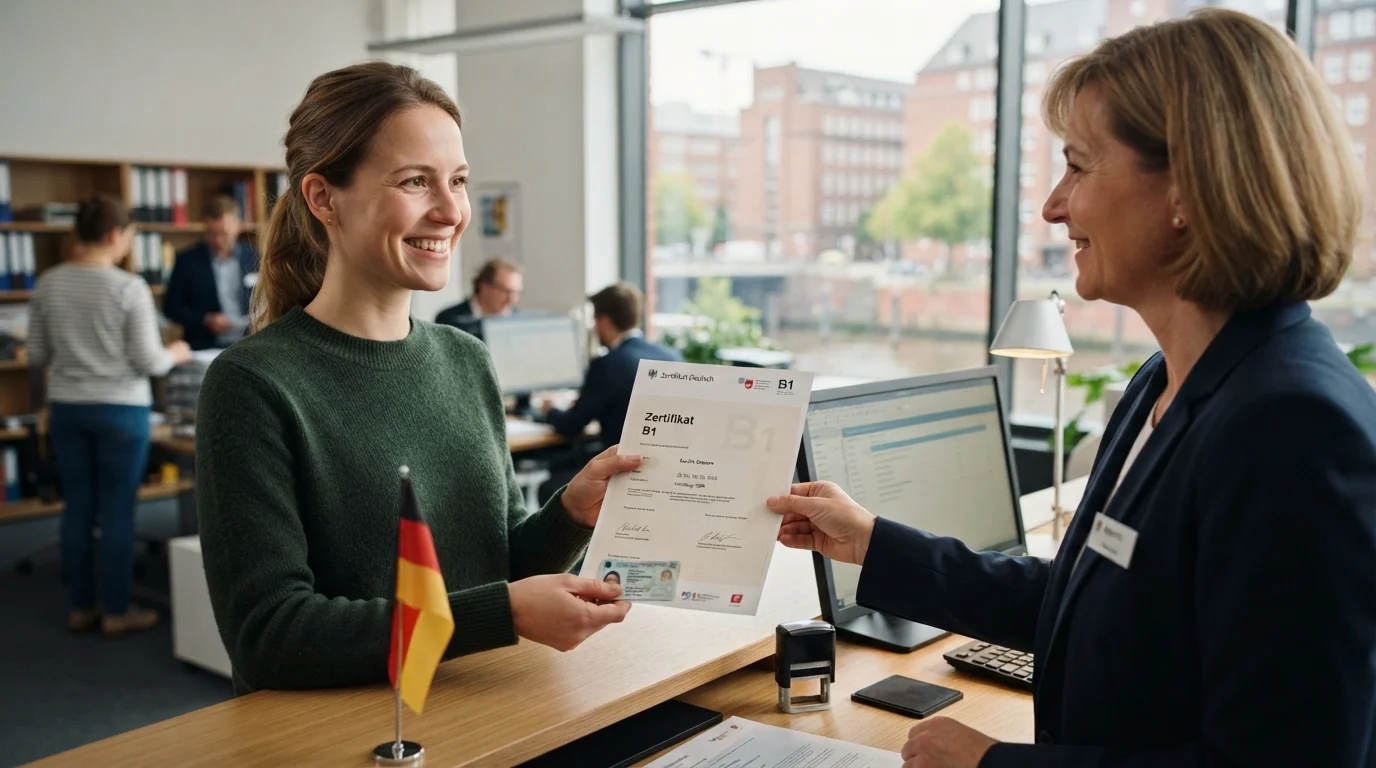
Securing a permanent settlement permit (Niederlassungserlaubnis) is one of the most significant milestones for expats and foreign professionals living in Germany. Unlike a temporary residence permit, a settlement permit gives you the right to live, work, and study in Germany indefinitely without needing regular renewals at the immigration office (Ausländerbehörde or Landesamt für Einwanderung).
However, achieving this coveted status requires meeting specific criteria under German immigration law. While requirements vary slightly depending on your entry pathway—such as whether you hold an EU Blue Card, are a skilled worker, or are married to a German citizen—one requirement remains almost universally vital: proving intermediate German language proficiency at the B1 level.
In this comprehensive guide, we will break down exactly how to prove B1 German for your settlement permit application in 2026, which language certificates are officially accepted, alternative exemptions, and actionable strategies to pass your B1 exam on your very first try.
Under Section 9 of the German Residence Act (Aufenthaltsgesetz), applicants for a standard permanent settlement permit must demonstrate a sufficient knowledge of the German language, defined legally as level B1 of the Common European Framework of Reference for Languages (CEFR).
Reaching B1 level means you are no longer a beginner who merely relies on memorized phrases. At B1, you are considered an independent user of the language. You can express opinions, understand the main points of clear standard input on familiar matters, write coherent text on familiar topics, and handle most everyday situations encountered in Germany without needing an interpreter.
Depending on your current residency status, the time required before you can apply for a settlement permit often directly hinges on your German proficiency:
Not all language certificates are treated equally by German authorities. To avoid wasted time and money, you must ensure that your test provider is official and accredited. The foreign national authority will only accept certificates from recognized test providers that follow standardized ALTE (Association of Language Testers in Europe) quality criteria.
The four primary B1 certificates accepted nationwide across all 16 German federal states include:
For official information regarding legal integration requirements, you can check the guidance provided by the Federal Office for Migration and Refugees (BAMF).
Important Warning: Casual online course completion certificates, language app certificates, or certificates from unaccredited private language schools will not be accepted by your immigration caseworker.
Whether you choose telc, Goethe, or the DTZ, all B1 examinations evaluate four distinct modules. Understanding how each section works is crucial to effective preparation.
You will be asked to read short newspaper articles, official letters, online forum entries, and advertisements. You must answer multiple-choice questions or true/false prompts proving that you understand both overall meaning and specific details.
This module tests your ability to comprehend spoken German in public announcements, phone messages, radio broadcasts, and casual conversations. Improving your auditory comprehension requires consistent exposure to native speech. Candidates often benefit from targeted practice like reviewing DTZ listening exam prep strategies to build speed and accuracy.
In this section, you will write a short formal or semi-formal letter or email (usually around 80–100 words). Typical prompts involve responding to an invitation, writing an inquiry to a landlord, or making an official request. Correct use of formal greetings (Sehr geehrte Damen und Herren), connective words (weil, obwohl, deshalb), and appropriate tenses is evaluated.
The speaking exam is usually conducted in pairs alongside another candidate in front of two examiners. You will introduce yourself, discuss a given topic or article, and complete a joint planning task (such as organizing a trip or party together). Mastering collaborative prompts like planning something together in the B1 speaking exam is essential to earning high marks in this module.
Reaching B1 German requires consistency, active production, and systematic grammar and vocabulary development. Here are actionable steps to streamline your learning curve:
Consistency beats cramming. Spending 20–30 minutes every day engaging actively with German produces far better retention than a single weekly marathon session. Using intelligent modern tools like the Bretzi app can significantly accelerate this process. Bretzi offers AI-powered personalized learning plans and interactive dialogue games for practical scenarios, enabling you to practice realistic German conversations whenever it fits your busy work schedule.
To pass B1, you must demonstrate comfort with core grammatical structures, including:
German sentence structure relies heavily on word order rules, such as placing conjugated verbs at the end of subordinate clauses. Furthermore, managing noun genders (der, die, das) is critical to getting correct cases. Engaging in focused daily exercises or article mastery games helps solidify these rules until they become second nature.
In certain specific scenarios, you may satisfy the legal language requirement without sitting for an official Goethe or telc exam. The immigration office usually accepts the following documents as alternative proof:
To learn more about general eligibility rules for working and living in Germany, consult the official portal Make it in Germany.
Once you have received your official B1 certificate and gathered your supporting documents (employment contract, pay slips, pension insurance record, rental agreement), you will schedule your appointment at your local immigration office.
It is important to note that immigration caseworkers frequently assess your spoken German during the appointment itself. While they are not formal language examiners, speaking confident, polite German during your interaction helps confirm that your certificate reflects genuine practical capability.
Before stepping into the office, make sure you review key vocabulary and essential German phrases for your appointment to handle administrative questions smoothly.
Proving B1 German is one of the most rewarding steps on your journey to securing permanent residency in Germany. Beyond fulfilling a statutory legal requirement for the Niederlassungserlaubnis, attaining B1 proficiency unlocks true independence in your everyday life—from negotiating rental contracts to thriving in German-speaking work environments.
If you are preparing for your B1 exam or working toward permanent residency in 2026, start building your language foundation today. With targeted study habits, structured vocabulary building, and continuous practice through modern AI tools like Bretzi, you can master B1 German with confidence and secure your future in Germany.
Share this article:
Standing outside the exam room, heart thumping, waiting for the oral portion of the Deutsch-Test für Zuwanderer (DTZ) is an experience thousands of...
Read moreGermany's modernized citizenship law has transformed how long-term foreign residents build their futures in the country. Following landmark updates...
Read moreSecuring a German B1 language certificate is one of the most critical milestones for anyone building a life in Germany. Whether you are aiming for a...
Read more